Search
 The Employer Handbook Blog
Who is a supervisor?


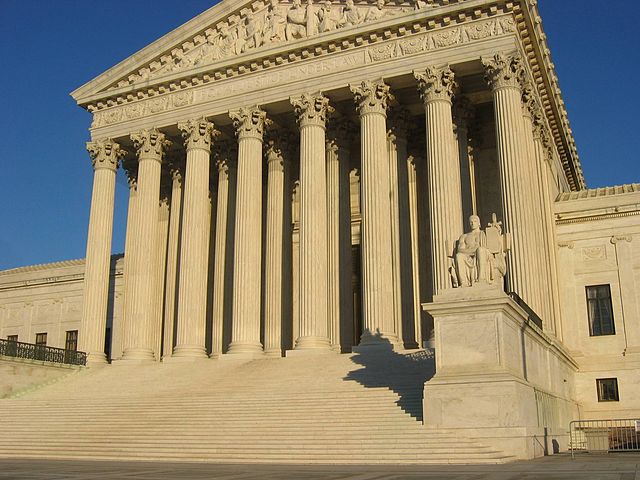
Nah, brotha. This isn’t Jeopardy. That’s the question that the Supreme Court has decided to answer.
Meyer, what are you talking about? Who cares?
Well, you should…

Nah, brotha. This isn’t Jeopardy. That’s the question that the Supreme Court has decided to answer.
Meyer, what are you talking about? Who cares?
Well, you should…

I’m a firm believer that discussing religion (or politics) at work is a recipe for disaster. On this blog; however, if it’s employment-related, then that’s how we roll…
And, after the jump, we roll into Oklahoma and discuss whether it’s ok for a lighting company to require that it’s employees be born-again Christians. (Hint: It’s not ok).
(If you’d rather read about the Oklahoma City Thunder and the NBA Finals, I understand).
 That according to a a new survey from The National Partnership for Women & Families.
The survey compared how state-based rights and protections compare to the 12 weeks of leave for new and expecting parents provided by the federal Family and Medical Leave Act (FMLA), the protections provided by the Pregnancy Discrimination Act (PDA), and the right to express breast milk at work provided to some nursing mothers under the Fair Labor Standards Act (FLSA).
The report card covers all 50 states, plus the District of Columbia. No state earned an A. Only 1/3 scored a C- or higher, while more than 1/3 flat-out failed. The highest grades went to California and Connecticut, each earning an A-. Locally, New Jersey ranked near the top with a B+, while Pennsylvania scraped by with a D.
 That’s right folks. It’s time for another edition of “Fact or Fiction” a/k/a “Quick Answers to Quick Questions” a/k/a QATQQ f/k/a “I don’t feel like writing a long blog post.”
So, let’s get right to it. In Pearce-Mato v. Shinseki, decided earlier this week, a Pennsylvania federal court reminded us that episodic impairments may, indeed, be disabilities under the Americans with Disabilities Act Amendments Act:
The fact that the periods during which an episodic impairment is active and substantially limits a major life activity may be brief or occur infrequently is no longer relevant to determining whether the impairment substantially limits a major life activity … An impairment that is episodic or in remission is a disability if it would substantially limit a major life activity when active.
One of my favorite reads on NJ employment law is Ogletree Deakins’s New Jersey eAuthority. The June 2012 issue highlights several pieces of legislation now pending in NJ of which employers should take note. I’ve summarized four of them after the jump…
 If an employee complains that her supervisor is sexting her, making unwelcome physical contact, and telling her that she can get a better work schedule in exchange for “small favors,” you better damn well investigate that!
Ignore it and you risk losing a valuable defense to sexual harassment claim. This is because, generally, to avoid liability for sexual harassment, an employer must demonstrate that it undertook reasonable care to prevent and promptly correct harassment.
But the failure to investigate could cost an employer even more. Like a dead-to-rights retaliation claim too.
Really? Retaliation too? Yes. I’ll explain after the jump…
 Billed as a way to provide more effective remedies to victims of discrimination in the payment of wages on the basis of sex, the Paycheck Fairness Act, did not make it out of the Senate yesterday. The Paycheck Fairness Act earned 52 votes in favor of proceeding to final consideration, eight votes shy of the 60 votes necessary for cloture. The vote came down strictly along party lines, with the two independent senators voting with the Democrats and Sen. Mark Kirk (R-Ill.) not voting. Senate Majority Leader Harry Reid (D-Nev.) changed his vote so that he could bring the bill up again.
In other news…
- The Eleventh Circuit Court of appeals ruled on Monday that Title VII of the Civil Rights Act of 1964 permits claims for retaliatory hostile work environment. The decision brings the Eleventh Circuit in line with everyone else.
According to a federal appellate court from California, a state that has embraced marijuana as an effective treatment for individuals who face debilitating pain, an employer may discriminate against an employee because of the employee’s use of marijuana. This holds true whether the marijuana use is recreational or medicinal, because the Americans with Disabilities Act does not protect illegal drug use.
However, there are instances in which the ADA does protect medical-marijuana users. For example, an employee who uses medical marijuana to treat glaucoma may be discriminated against because of the employee’s marijuana use, but not the glaucoma. Assuming that: (a) the glaucoma is a disability; (b) the employee can perform essential job functions with or without a reasonable accommodation; and (c) and the employer takes an adverse employment action against the employee because of the glaucoma, the employer has violated the ADA.
For more on the CA case, check out Robin Shea’s post at the Employment and Labor Insider. For more on the interplay between medical-marijuana use and state disability-discrimination laws, check out this post I did last year.
To improve the reinstatement rights of returning war veterans, and to add more enforcement teeth to the Uniform Services Employment and Reemployment Rights Act (USERRA), Pennsylvania Senator Robert Casey reintroduced the Servicemembers Access to Justice Act (SAJA) last week.
Details on SAJA and what it could mean for employers follow after the jump…
What started out well for the employer…
On April 29, 2009, Catherine Coffman, an employee of Robert J. Young Company, Inc. (“RJY”), got into a motorcycle accident. RJY provided Ms. Coffman with leave under the Family and Medical Leave Act. Just before Ms. Coffman’s FMLA expired, RJY offered to return her to work in a sedentary job that provided the same pay and benefits as her old position. Ms. Coffman rejected the offer because she did not feel that she was able to return to work yet.

…Quickly turned bad. Very bad.