Search
 The Employer Handbook Blog
The one about the porta-potty harassment


 Hey, they can’t all be about Brazilian waxes and irresistible attraction. After the jump, we get down and dirty.
* * *

Hey, they can’t all be about Brazilian waxes and irresistible attraction. After the jump, we get down and dirty.
* * *
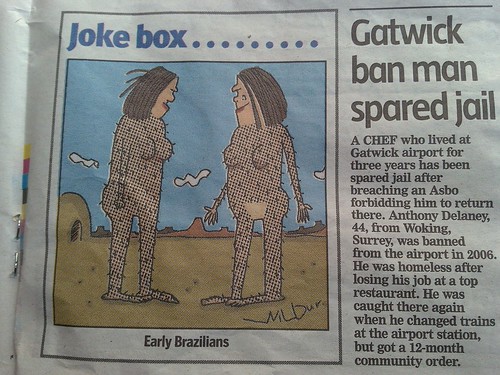
You know, maybe I should have gone with the porta-potty-harassment post that I originally had planned for today. Nah. My analytics tell me that my best-received posts have a common theme: crotch and Brazil. Besides, everyone knows that nothing says Friday like a porta-potty post. Just wait ’til Friday.
So today, after the jump, let’s wax poetic, shall we?
(Ouch, again).
 Want an explanation of yesterday Supreme Court decision regarding challenges to California’s ban on same-sex marriage and the federal Defense of Marriage Act, check out Amy Howe’s analysis “In Plain English” at SCOTUSblog.com.
And for more on yesterday’s decision and the impact it may have on your business, check out:

[Whichever one of you had the voodoo doll positioned in such a way that wouldn’t allow me to pun this lede, I’m gonna git you sucka!]
In Hayes v. Erickson Air-Crane, Co. (opinion here), a male plaintiff was constantly barraged with small penis nicknames from his male co-workers ranging from “little jimi” to “tiny tim” to “dodgeball” (based on Ben Stiller’s White Goodman character). He didn’t like it, and sued.
The Court found that, based on this behavior, a jury could find that the plaintiff could potentially prevail on his sexual harassment claims because a jury may find that he was subjected to unwelcome sexual comments that were pervasive enough to create a hostile work environment.
 This week, I am on vacation. The Supreme Court didn’t get my memo. Fine. But, I’m not putting down my beer to write this post. So, you get a one-handed rundown of the two employment-law decisions the court issued yesterday.
Pardon my typos after the jump…
* * *
Every so often, I get a call from an employee. The call goes something like this:
“I need an employment lawyer. Are you an employment lawyer?”
“Yes.”
 DISCLAIMER: Since I’m getting the fodder for my post from RadarOnline (via the National Enquirer), consider the sources, and remember that what you are about to read are allegations. Plus, Ms. Deen’s team subsequently told Entertainment Tonight that Ms. Deen does not condone or find the use of racial epithets acceptable. So make of this what you will and don’t shoot them messenger…
Remember back when I reported here that a former employee of one of celeb chef Paula Deen’s restaurants had accused both Deen and her brother of race discrimination and sexual harassment? You’d expect that Ms. Deen would cast aside these “allegations” — especially the ones about her using the N-word and having black waiters perform as slaves at a wedding party — as slanderous accusations.
You’d expect that wouldn’t you?
 The Americans with Disabilities Act (ADA) limits when an employer can require an employee to take a medical examination. Specifically, the ADA forbids employers from requiring medical exams (and cannot otherwise inquire into the nature or severity of a disability) unless the exam or inquiry is shown to be “job-related and consistent with business necessity.”
The U.S. Equal Employment Opportunity Commission (EEOC) advises (here) that an exam is permissible where the employer “has a reasonable belief based on objective evidence, that: (1) an employee’s ability to perform essential job functions will be impaired by a medical condition; or (2) an employee will pose a direct threat due to a medical condition.”
So, let’s assume that you have an employee about whom you receive multiple reports of emotionally-erratic workplace behavior. At what pointy can you require that employee to seek counseling?
Biting the staff doesn’t help either; even if it doesn’t leave a mark.
You see, I couldn’t make this stuff up if I tried.
Barbara Joy McElmurry worked for the Arizona Department of Agriculture. In a Complaint she filed in federal court, she alleged that her supervisor forced her into a field work position in which she would not be able to drive vehicles because she was too short (4’10”). So, McElmurry asserted a claim for discrimination on the basis of disability, namely, her short stature.
So, could height (or lack thereof) be a disability?
Well, under the Americans with Disabilities Act, a person is disabled if she suffers from “a physical or mental impairment that substantially limits one or more of the major life activities of such individual.” An employer could also regard an employee as disabled, even if she isn’t; that too would bring the employee within the scope of the ADA.