Search
Can employees use your confidential documents to prove discrimination?
If you are reading this and you are a New Jersey employer, then the answer is yes. But only under certain circumstances. I’ll lay out the test for you after the jump.
Next week is our firm holiday party. And I am a big fan.
At the party, I like to drink Four Loko boilermakers all night until I get blackout drunk socialize with colleagues for a few hours before cabbing home for the evening. Generally, I go crazy have a good time. But I rarely always keep it in check. There are others like me at OTHER holiday parties who succumb to the sweet nectar of the gods get a bit tipsy after consuming too many drinks. And where there’s Tipsy, both Handsy and Sailormouth generally come out to play too.
This will could happen at your business. So what steps are you taking to prepare for this inevitability possibility (besides having my number on speed-dial)? Not sure what to do? I’ll help you with some tips after the jump.
If you know me, you know that I am a BIG advocate of social media policies for employers. I’ve written about it here. And I’ve spoken both to clients and at global conferences on the subject.
If you have not adopted a social media policy yet, check out this story by The Consumerist. It’s a sobering read about how important it is to educate employees about appropriate online behavior.
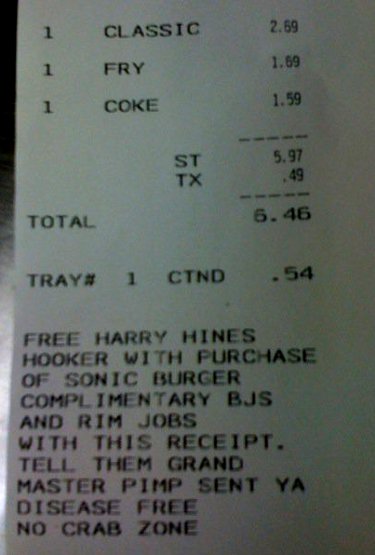
No, the title to this post isn’t gratuitous. Morran’s story involves an employee advertising hookers. The receipt to the right just may have given that away.
Recently, I had an article published in Bloomberg Law Reports about how employers can reduce their potential exposure to employee litigation by implementing a strong anti-harassment policy and then coupling that with training for supervisors and employees. If I do say so myself — and I do — this is a good read for any employer.
You can read my article here.
Do I have your attention now?
Early next year, the Construction Workplace Misclassification Act goes into effect. Signed in October, 2010, this legislation provides criteria for classifying a person as an independent contractor (versus an employee) in the construction industry. If you operate a business in the construction industry, you need to get prepared. Otherwise, you may be looking at fines and jail time.
Learn more after the jump.
What could possibly beat a New Jersey jug handle? Anything really. But will you settle for three short items involving social media and the courtroom? If so, hit the jump. If not, here’s a Wikipedia post about the history of jug handles.
Even without theNational Labor Relations Board may decide cases in a way that enhances the union’s ability to organize a workforce. The the Board may also place additional limits on employer speech rights and attempt to give union organizers access to an employer’s workplace.
But even without direct, on-site access to employees, unions have smartly taken advantage of social media and, as a result, have many new effective organizing tactics, as demonstrated in this YouTube video (after the jump)…
Continue reading
Title II of the Genetic Information Nondiscrimination Act of 2008 (GINA), which prohibits genetic information discrimination in employment, took effect on November 21, 2009. Nearly a year later, the EEOC published the final GINA regulations.
How does this law affect employers? I’ll break it down for you after the jump.
FMLA Insights has a very timely post about how to calculate FMLA leave around the holidays.
I’ll summarize it for you after the jump.
Continue reading
The New Jersey Supreme Court in