Search
 The Employer Handbook Blog
And the first state to ban asking for employee Facebook passwords is…



A severance agreement helps to allow businesses to ensure that former employees don’t sue. The concept is fairly simple: in exchange for $X, the former employee agrees to release the company from every claim under the sun from the beginning of time through the date the former employee signs the agreement (or seven days after the agreement is signed in cases where the employee releases claims under the Age Discrimination in Employment Act).
Where am I going with this? Let’s take a hypothetical. Assume that ABC Company decides to lay off two employees: Bob and Mary. Both worked the same position, have the same seniority, and reported to the same supervisor. However, ABC offers Bob six weeks of severance and Mary only three weeks of severance. Does Mary have a potential gender discrimination claim against ABC?
The answer follows after the jump…
* * *
On Employment Legislation:
Just when you thought you had the employment law landscape figured out, along comes pending legislation that could change everything. From age discrimination claims to workplace flexibility to unionization and labor organizing, new bills in the House and Senate may change the way you run your business. Here I am discussing all that jazz with Stephanie Thomas at the Proactive Employer.
On Social Media:
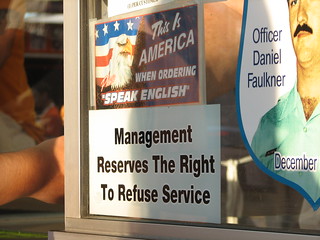
Unfair treatment because of one’s language may be related to race or national origin discrimination. Indeed, language may be used as a covert basis for discrimination.
But that’s not always so. A recent case and some helpful nuggets on English-only rules after the jump…
 Now in autotune.
(Betcha didn’t expect that).
Yesterday, we were rapping (without the benefit of autotune) about immigration status and unlawful discrimination and concluded that Title VII of the Civil Rights Act of 1964 does not prohibit workplace discrimination on the basis of immigration status (although national-original discrimination is unlawful). And we know from a super-hot “Fact or Fiction” post last year that Title VII covers Americans who are employed abroad. It was so hot.
 I had this song in my head for about two hours on Sunday.
Then I listened to the Trent Reznor version, ick….
 It was just last month that I blogged about arbitration agreement tips for PA employers from the 3rd Circuit. I hate to leave NJ employers out of the loop, so today’s post is for you.
Last week, the NJ Superior Court, Appellate Division, in Cole v. Jersey City Medical Center denied a company’s attempt to enforce an arbitration provision in its employee contract because it waited too long to do so after being sued:
 Yesterday, the U.S. Equal Employment Opportunity Commission (EEOC) issued its “Final Regulation on Disparate Impact and Reasonable Factors Other than Age” (RFOA) under the Age Discrimination in Employment Act of 1967 (ADEA).
Wait, wha, wha, what the heck is an RFOA? (The Cliff Notes versions because, like, you could click on the link above, dudes.)
Can you tell it’s been a long day as I punch out this post? Anyhoo, make with the jump, dawg…
 That’s right folks. It’s time for another edition of “Fact or Fiction” a/k/a “Quick Answers to Quick Questions” a/k/a QATQQ f/k/a “I don’t feel like writing a long blog post” d/b/a (just for today) “Eric’s 36th-Birthday Post”.
*** Sigh ***
Ahh…let’s get to today’s question:
Yesterday, I presented “Reducing the Risk of Wage and Hour Litigation” with my partner, Jennifer Platzkere Snyder, at ALM’s In-House Counsel Labor and Employment Law Forum. We talked best practices, common mistakes, and Supreme Court.
We also dipped into some hot issues, the hottest of which, by far, based on audience engagement, was unpaid internships. Oh boy, is it easy for companies to potentially screw up unpaid internships. Just ask Charlie Rose and Harper’s Bazaar.
Want to get ’em right without running afoul of the Fair Labor Standards Act. Six steps to success follow after the jump…