Search
 The Employer Handbook Blog
 1. Yoga
Psst…there’s a hella-good new blog for HR and employment law


Janette Levey Frisch, In-House Counsel at Joule, Inc., has guest-blogged here before (here and here). As you know from her posts here, she is a fantastic employment lawyer. Now you can reap more of the benefits by checking out her brand new employment-law blog: The Emplawyerologist (http://theemplawyerologist.wordpress.com/).
Welcome Janette!
Utilityman can’t climb utility poles, but has ADA claim against utility company
From the blog that brought you “Can a bridge worker with a fear of heights have a viable ADA claim?,” comes news of a recent federal-court decision which — well — you read the title to this blog post.
In RRRRRRRRRRRRRRico v. Xcel Energy, Inc. [cue music] the plaintiff, an apprentice lineman working for a utility company, was ordered by his doctor not to climb utility poles due to a back injury suffered on the job. The plaintiff alleges that he sought a transfer and, instead of getting that transfer, was terminated and told to apply for long-term-disability benefits. Plaintiff alleges that the defendant then offered him a job at a lower rate of pay as a “substation electrician,” which the plaintiff accepted. The defendant allegedly also eliminated Plaintiff’s three years of seniority as an apprentice lineman.
The plaintiff subsequently sued for disability discrimination. The defendant argued that the plaintiff’s back injury was not a disability, as defined under the Americans with Disabilities Act Amendments Act. The court, however, disagreed and kept the case alive so that the plaintiff could develop a factual record which may indicate that his back injury “substantially limits [his] to perform a major life activity as compared to most people in the general population.”
Does the Computer Fraud and Abuse Act cover lost LinkedIn business opportunities?
In the beginning of the year, I wrote here about a federal-court decision, which recognized that LinkedIn connections are not company trade secrets. Earlier this month, that same court, in the same case, was asked to decide whether hijacking an employee’s LinkedIn account may violate the Computer Fraud and Abuse Act (CFAA).
In Eagle v. Morgan, the plaintiff, Dr. Eagle, claimed that her former employer had locked her out of her LinkedIn account for 22 weeks. Thus she was “unable to receive ‘invitations to connect, business opportunities and ongoing communications with clients, potential clients and other business and personal contacts.'”
Go jump in the lake! (and then sue for race discrimination)
 Back in 2010, Douglas Clayton had a rough Summer.
In August, Mr. Clayton was employed as a deckhand on a boat in Louisiana — that is, until one of his white co-workers allegedly raised a wrench to Clayton and told him to get his “stupid mother f**king n**ger ass” off the boat. Mr. Clayton promptly complained to Human Resources and was transferred to another of the defendant’s boats.
In September, Mr. Clayton again reported to Human Resources that his new co-workers continued to say “n**ger,” among other comments, around him. Allegedly, HR responded by telling Mr. Clayton to “lighten up.” Allegedly, later that day, after telling one of his co-workers to stop using the word “n**ger” on the boat, that co-worker attacked Mr. Clayton from behind.
Five pending Supreme Court cases for HR, In-House & the C-Suite to follow
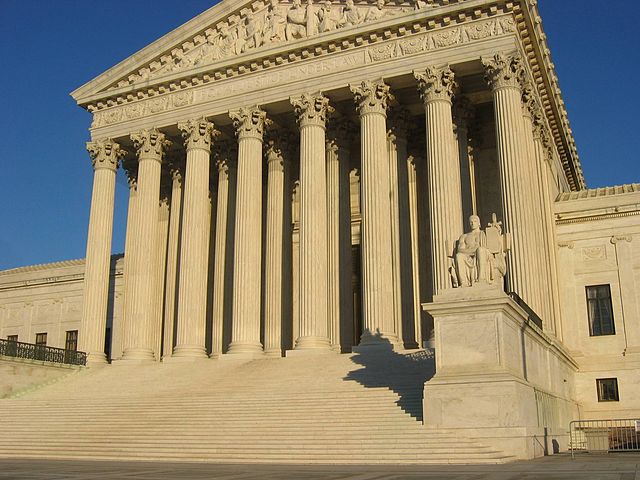
Earlier this month, the Supreme Court reconvened for its 2012-2013 term.
Although not chock full of pending employment-law cases, this term will see several important issues decided which could affect your workplace. Below, I have a collected a series of links to stories on these cases:
- “New Supreme Court Term Promises a Range of Labor and Employment Cases” by Lindsey Marcus and Jeff Nowak at Franczek Radelet P.C.
GUEST POST: 3 Reasons to Consider Job Applicants with Online Degrees
Today we have a guest blogger at The Employer Handbook. It’s Caroline Ross. Caroline is a former educator who writes for accreditedonlineuniversities.com and specializes in distance education platforms and online program accreditation. She is an avid reader and advocate for global education and equality. Please submit any comments or feedback in the section below! Feel free to email her some comments!
(Want to guest blog at The Employer Handbook? Email me.)
* * *
$$$ reasons to have a second-language anti-harassment policy
 When an employer is faced with a sexual-harassment lawsuit, one of its best defenses is that the company took reasonable care (e.g., policy, training) to prevent sexual harassment (and then addressed complaints in a manner that is reasonably designed to end the sexual harassment)
In EEOC v. Spud Seller (opinion here), the employer had an anti-harassment policy that detailed what constitutes sexual harassment and how to report it. Further, it specifically advised employees that, “You can feel state that your complaint will receive immediate attention and if the facts support your complaint, the offender will be disciplined.”
Sounds good to me.
New bill would require accommodations for pregnant employees
 Does an employer have to provide a reasonable accommodation to a pregnant employee to allow her to perform the essential functions her job?
Let’s see.
Americans with Disabilities Act? No. Pregnancy is not a disability. Title VII of the Civil Rights Act? Well that depends. The Pregnancy Discrimination Act is part of Title VII. But the current state of law is such that employers need only treat pregnant employees as they would other employees with temporary disabilities. However, most employers do afford accommodations (e.g., light duty) to employees with temporary disabilities. So, they would have to do the same for pregnant employees too.
But do I smell some duplicative federal legislation after the jump? I sure do. Click through for details…
* * *
In its first Facebook-firing decison, the NLRB backs an employer
 Look out for that flying pig!!!
No, it’s true. I’ve got proof after the jump…
* * *