Wednesday night was crazazy, yo!

I had this dream that was I slaloming down a snowy mountain towards a giant fortress under a hail of gunfire. But the next thing I know, I wake up and I’m falling down this elevator shaft. And, just as I’m about to bite it, I find myself in a car submerged underwater, having just taken a 100-foot fall from the bridge above.

And then I’m in my bed.

It’s 3 am and I am dripping sweat. I tap the Joe Beimel bobblehead on my nightstand — I know I shouldn’t have told you about my totem but, damnit, I love my readers.

Just as I’m starting to get my bearings, what hit me next was ten times as powerful as any three-tiered Inception dream and it kept me up for the rest of the night:

Could the United States Supreme Court’s decision in
Staub v. Proctor Hospital, in which the Court affirmed the
theory of subordinate bias — or “cat’s paw” —  in an
action under USERRA, equally apply to claims brought
under the Age Discrimination in Employment Act (ADEA)?
 

But, oh hells-to-the-yeah, the Tenth Circuit, sensing my angst, issued an opinion on Thursday answering all of my questions. So, while I grab my meds, you hit the jump and find out if the cat’s paw doctrine applies to ADEA claims.

* * *
Continue reading

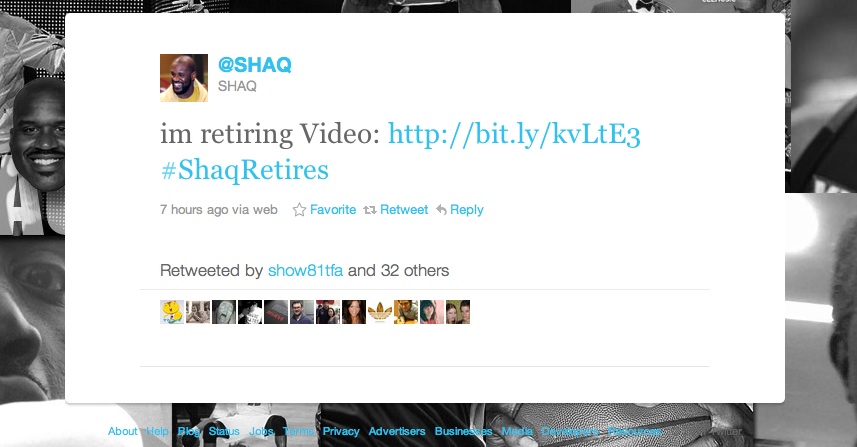
Yesterday afternoon, Shaquille O’Neal (@Shaq) put an end to an illustrious 18-year NBA career in a single tweet:

shaq.jpg

As I type this post — during the second intermission of the Stanley Cup Finals — the hashtag #ShaqRetires is still trending on Twitter.

So, the question is, would you ever use social media to announce your retirement? 

I was reading a blog post from Jennifer L. Gokenbach at the Colorado Employer’s Law Blog, discussing how, as of yesterday, Colorado deems continuation of at-will employment to be sufficient consideration to support a non-competition agreement. In non-lawyer speak, that means that if an employee signs an agreement not-to-compete in Colorado after the employee starts working, on the condition that if the employee does not sign the agreement then the employee will be fired, the employer may later enforce that agreement.


That’s now the law in Colorado. Is that also the law in PA, NJ, and DE?

Delaware: Yes. Research & Trading Corp. v. Powell, 468 A.2d 1301, 1305 (Del.Ch.1983).

New Jersey: Yes. Hogan v. Bergen Brunswiq Corporation, 153 N.J.Super. 37, 378 A.2d 1164 (App.Div. 1977).

Pennsylvania: No. An agreement not to compete with a former employer must be supported by new consideration; i.e., a change in the conditions of employment (e.g., a raise, promotion, or other financial benefit). Maintenance Specialties, Inc. v. Gottus, 455 Pa. 327, 314 A.2d 279, 280 (Pa. 1974).

Continue reading

Many of you have seen the rat on the right. Well, maybe not that particular rat, but a large inflatable rat, nonetheless. Usually, a union will position the large rodent in front of a business or job site as part of a protest effort.

But, just because a union uses it as a protest symbol doesn’t make it legal. Does it?

Is the rat even legal?

Find out after the jump.

* * *

Continue reading

A 51-year-old auto-parts specialist with lupus, fibromyalgia, diabetes and arthritis, claimed that his 29-year-old co-worker called him an “old cripple” and an “old man,” labeled him “too old to be trained,” and threatened to beat him with a baseball bat.

The 51-year-old responded by telling his manager that he would kick the 29-year-old’s ass and then came to work with a handgun in his car.

Wha Wha Whaaaaaat?!?!

Did the older employee overreact? Maybe. But was he the victim of a hostile work environment?

Find out after the jump.

* * *

Continue reading

Last week, I reported that a Pennsylvania state court had ruled that a plaintiff did not have to provide access to her Facebook page during discovery by accepting a “friend” request from defense counsel. That same week, another Pennsylvania state court was asked to resolve whether a plaintiff’s “privacy rights” would trump a defendant’s request to access the plaintiff’s Facebook and MySpace accounts to discover facts relating to the plaintiff’s claim for damages.

Pennsylvania has become a hotbed of social-media-discovery litigation. Who knew?

I break down the latest decision, which I predict will be a “go-to” for defendants and courts alike, after the jump.

* * *

Continue reading

As I previously reported, on May 9, 2011, the National Labor Relations Board issued a Complaint, in which it alleges that a NY non-profit company fired five employees for complaining on Facebook about working conditions. Now, Law 360 reports that the NLRB has issued a second complaint against a Chicago-area luxury car dealership alleging the company ran afoul of federal labor laws by firing a sales employee over a message he posted on Facebook.

Molly DiBianca at The Delaware Employment Law Blog brought this second complaint to my attention and you can read her write-up on it here.

Last week, Governor Christie signed the “New Jersey First Act,” a bill that will require all NJ public employees hired after September 1, 2011 to live in New Jersey. Current public workers will not be affected. New hires will have up to a year to move.

***I would have reported this last week. But, then there was that masturbating Brazilian accountant thing. C’est la vie.***

Can a company create and enforce a policy that requires employees on paid sick leave to remain close to their homes, unless they obtain the company’s permission?

Would that policy infringe on an employee’s FMLA rights?

Good questions.

The answers are after the jump.

* * *

Continue reading

“Doing What’s Right – Not Just What’s Legal”
Contact Information