Is this Retaliation 2.0?

Two weeks ago, Adria Richards attended an industry conference at which she overheard sexual jokes from two attendees sitting behind her during a session. So, she complained…on Twitter:

And then she blogged about it here. The social-media complaints resulted in one of the joke tellers getting fired. And, last Wednesday, Ms. Richards tweeted that her employer supported her.

That same day, SendGrid, Ms. Richards’s employer, fired her.

(Jon Brodkin at arstechnica.com has the full story here).

We can argue about the propriety of using social media to publicize a harassment complaint, especially when a private complaint could have sufficed. Still, the SendGrid response certainly seems harsh and unfair.

But did SendGrid go so far as to retaliate (as a matter of law) against Ms. Richards?

Find out, after the jump…

* * *

Continue reading


School teacher, Lawrence Smizer, is a regular Facebook wordsmith:

To all my family that fought my sister tooth and nail over some BULLSHIT (And you know who you are) FUCK YOU BITCHES!!!! HE IS GOING HOME WHERE HE BELONGS!!!!! HAHAHAHAHAHAH AHAHAHAHAH AHAHAHA AHAH HAHAH HAAH

Smizer was Facebook friends with two co-workers. They dimed him out to the school and Smizer was fired. So, he sued for reverse-race discrimination.

Reverse-race discrimination, mmm-kay. How do you think it worked out for him?

Find out after the jump…

* * *

Continue reading

Your social media policy may be good when it comes to addressing legal risks. But getting that message across to your employees…

Not so much, according to a recent survey from Protiviti (here).

The Protiviti survey shows that more businesses are addressing employee use of social media — 57% of respondents have social media policies. And, generally, those social media policies do a good job of addressing legal risks. For example, 90% of surveyed companies with social media policies have provisions in those policies what address disclosure of company information.

Why just last week, I was hanging out with the ghost of John Houseman, who was blabbering on and on about making money the old-fashioned way. And while all this reminiscing of the old Smith Barney days was giving me the vapors, he just wouldn’t let me get a word in edge-wise.

That was until, someone pulled along side of us and asked for our Grey Poupon, which seemed strange at the time because we were driving around in the ’93 Ford Probe I drove in high school.

*** hears familiar sound of restraining orders being taken out ***

Sorry for the late post gang. Rough night last night.

Today, I’m punting the ball over to my blogging buddy Phil Miles at Lawffice Space who has the scoop on a new age-discrimination matter that the Supreme Court has agreed to address. You can read Phil’s post here.

Posted in:
Updated:

Of all employment claims presented to the Equal Employment Opportunity Commission, retaliation numero uno. It’s been that way since 2010.

There are three essential elements of a retaliation claim: (1) protected activity — opposition to discrimination or participation in the statutory complaint process; (2) adverse action; and (3) causal connection between the protected activity and the adverse action.

This post focuses on “opposition to discrimination.” Specifically, is withdrawing from what one perceives to be a sexual advance by one’s employer opposition to discrimination and, thus, a protected activity?

The answer after the jump…

* * *

Continue reading

Thumbnail image for thatswhathesaid.png

On March 12, a federal court in PA resolved the first HUGE LinkedIn account dispute case involving an employee and former employer. I’ve written about out it a few times previously. (Here, here,and here).

The latest decision is involved. And rather than pontificate — too many syllables — I’ll defer to Venkat Balasubramani, who has the full scoop here.

My laziness knows no ends. Unless those ends involve a medium-rare burger, wrapped in bacon.

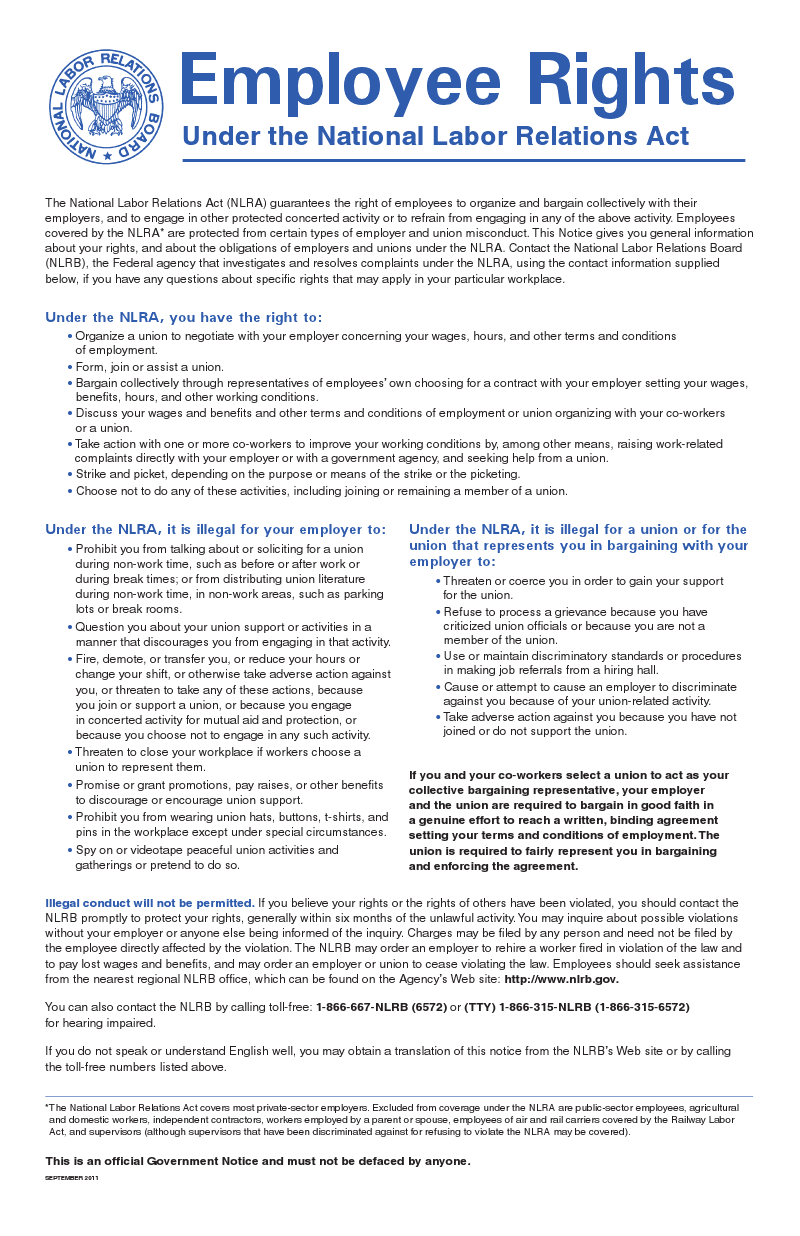
nlrb.jpgBack in late January, a federal appellate court ruled that President Obama lacked the power to make three recess appointments last year to the National Labor Relations Board. More on that here.

In this press release issued yesterday, the NLRB announced that would seek Supreme Court review. Quoted below is the press release:

The National Labor Relations Board has determined not to seek en banc rehearing in Noel Canning v. NLRB, in which the U.S. Court of Appeals for the DC Circuit held that the January 4, 2012 recess appointments of three members to the Board were invalid. The Board, in consultation with the Department of Justice, intends to file a petition for certiorari with the United States Supreme Court for review of that decision. The petition for certiorari is due on April 25, 2013.

Most parties (and their attorneys) expect that settlement communications are not admissible at trial. There’s even a federal rule of evidence on this subject. However, a federal court recently recognized an exception. But, with all due respect to the United States District Court for the District of New Jersey, the opinion is a little dry.

So, after the jump, I spiffed it up a bit — Point Break style, brah — with a few takeaways for practicing attorneys.

This is your wake-up call.

* * *

Continue reading

“Doing What’s Right – Not Just What’s Legal”
Contact Information