Search
 The Employer Handbook Blog
Those EEO-1s you love to complete are gonna get more complicated


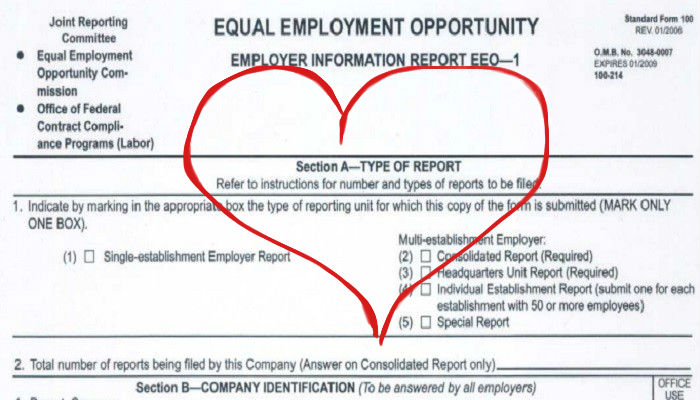
Happy Monday. Like my amateur Photoshop? No? Well, then, how about a little music….
(You can put your middle fingers down now).

Happy Monday. Like my amateur Photoshop? No? Well, then, how about a little music….
(You can put your middle fingers down now).
When was the last time that you trained your managers and supervisors on how to address disability accommodation requests? Or, how about the last time that you reminded your supervisors and managers that an employee with a disability needs to be treated respectfully?
If it’s been a while (or, maybe, I dunno, forever), have I got a case for you!

Like many other employers, you’ve got a handbook policy that says that non-exempt employees cannot work overtime unless they obtain prior approval from a manager or supervisor. If, without prior approval from a manager or supervisor, a non-exempt employee works overtime and reports those hours to you, the Fair Labor Standards Act requires that you pay that employee overtime. (However, you can discipline that employee for violating your work rules).
But what happens if that same employee works overtime without prior permission and fails to report those hours. Must you still pay that employee overtime?

Lest anyone consider me a heartless mongrel. (Other than you plaintiff’s lawyers, of course). I understand that many folks suffer from migraine headaches. Really bad, debilitating, serious health condition migraines. I get it. And, I sympathize. I’m sorry.
That said, poll a room of HR professionals. With hella-side eye, they’ll tell you stories of employees — often the ones with performance, attendance, and disciplinary issues — taking intermittent leave under the Family and Medical Leave Act for migraine headaches. The ones that get especially bad on Fridays and Mondays. You know what I’m talking about.
 “Are you a joint employer?”
No, that’s not my law school pickup line. That would be a terrible pickup line; I’d be a lonely, single, blogging employment lawyer, sitting alone by candlelight eating baked beans out of the can.
Actually, it’s the question that Dr. David Weil, administrator of the U.S. Department of Labor’s Wage and Hour Division, asks in this blog post. And, here’s his answer: “In a nutshell, joint employment exists when a person is employed by two or more employers such that the employers are responsible, both individually and jointly, for compliance with a statute.”
Does that sound like your business? Well, then, read Dr. Weil’s blog post.

There they are.
Those are my kids, after clearing our driveway with the discount shovels that I purchased from the dollar store. (I was tempted to splurge on the gas-powered snowblowers from the two-dollar store across the street; but, I’m not a monster). So, I did what any proud parent would do. I marketed posed them on a nearby snowmound and forced smiles (under threat of cancelling Disney Jr.) to attract other area homeowners in need of quality labor. Hey, daddy needs a new set of camouflage 22-inch rims.

Back when I had three kids — the one-year old (not pictured) is salting the sidewalk — I took some liberties with snow days and the Fair Labor Standards Act. I’m exempt of course (Executive exemption — like a boss!). For the kids, rather than worry about minimum wage or overtime, I just paid them in Pop Tarts. An honest day’s pay for an honest day’s work. Unless, they had dirty diapers. Then, I docked their pay.
Fast forward a few years. Now, I have four kids. So, with a big snow storm on the way, the older siblings can assume the position while the baby whips me up a hot toddy. Ok, coffee.
I like to pretend that I’m not in New Jersey. Let’s call it international waters. But for you folks in the “real world,” there are some Fair Labor Standards Act and Family Medical Leave Act implications if your business closes for the impending snow. Let’s break ’em down:
About three years ago, I blogged here about Genesis HealthCare Corp. v. Symczyk, a Supreme Court decision addressing a situation in which a Fair Labor Standards Act collective action could be dismissed if the lead plaintiff rejects a Rule 68 offer of judgment. However, the Supreme Court left open the issue of “whether an unaccepted Rule 68 offer that fully satisfies a plaintiff’s individual claim is sufficient to render that claim moot.”
Well folks, strap in, because yesterday, the Supreme Court answered that question.
Well, at least it was a phone interview.
Hey, one thing you guys know about me is that I’m all about the low hanging fruit and the cheap laugh. So, when I see that CareerBuilder has published it’s 2016 version of “Employers Share Strangest Interview Mishaps and Biggest Body Language Mistakes,” I’m bout it, bout it.
(Sorry, FMLA compliance nerds, you’ll have to wait for another post).

This Tuesday blog post is brought to you by the number 20. As in, when your non-exempt employees go on break for 20 minutes or less, you need to pay them for that time.