A recent survey by Workplace Options, shows that most Generation-Y employees believe that an office romance will have a positive influence on performance and overall workplace morale.
Sounds like a Cialis commercial.
Who says I need to wait for Valentine's Day for this post? Losers, that's who. Lock the broom closets and click through for more on this survey and ways to address the office romance...
A severance agreement helps to allow businesses to ensure that former employees don't sue. The concept is fairly simple: in exchange for $X, the former employee agrees to release the company from every claim under the sun from the beginning of time through the date the former employee signs the agreement (or seven days after the agreement is signed in cases where the employee releases claims under the Age Discrimination in Employment Act).
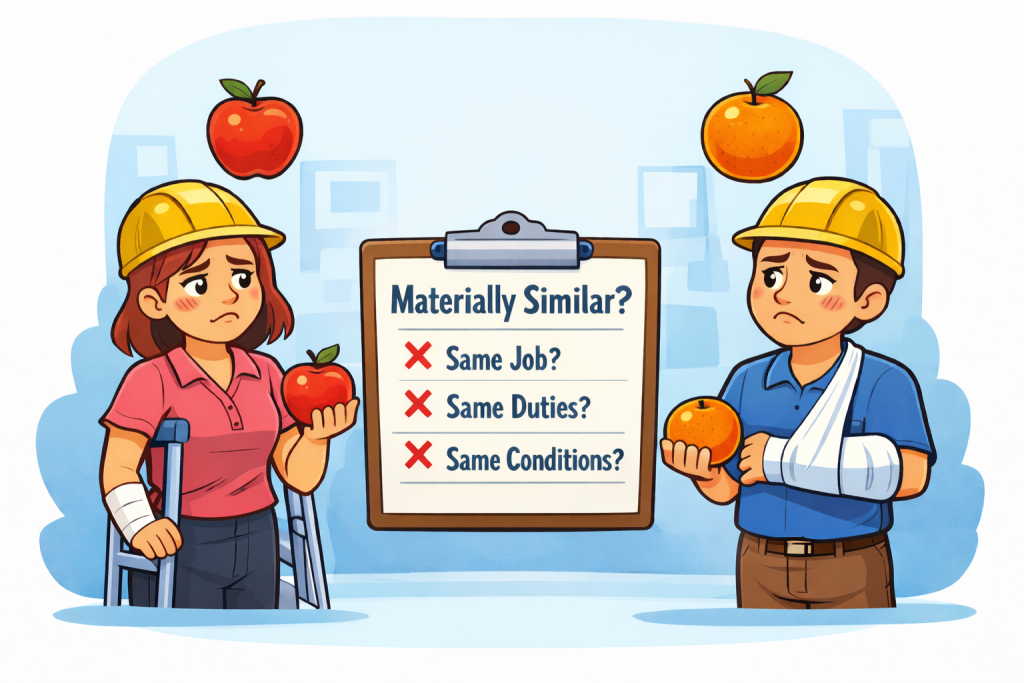
Where am I going with this? Let's take a hypothetical. Assume that ABC Company decides to lay off two employees: Bob and Mary. Both worked the same position, have the same seniority, and reported to the same supervisor. However, ABC offers Bob six weeks of severance and Mary only three weeks of severance. Does Mary have a potential gender discrimination claim against ABC?
As the year draws to a close, let's take a look back at the most popular posts at The Employer Handbook in 2011, based on number of hits:
5. Social media and the workplace. School teacher Natalie Munroe made several appearances on the blog this year. Remember her? She was the blogging school teacher who wrote that her students were "utterly loathsome in all imaginable ways." Although, Ms. Munroe eventually returned to work, her experience is a sound reminder to always think twice before hitting "send." You can read the fifth-most-popular post, "Yes, you CAN discipline employees who abuse social media" here.
4. I'm a poet and I don't even know it. I'm not sure what inspired the fourth-most-popular post. It must have been a slow news day. How else do I come up with the idea to Haiku -- verbing a noun, sorry -- about recent employment-law decisions from the U.S. Supreme Court?
3. FMLA remains a hot issue.This one surprised me. The third-most-popular post is about FMLA legislation in Pennsylvania that never passed.
2. Short and sweet. The second-most-popular post was one of my shortest. I merely announced that the EEOC had finalized its ADAAA regulations. (Note to self: keep it short)
1. Yeah, I know, you only clicked "by accident." This was a runaway. Not even close. To put things in perspective, nearly 4% of all page views at The Employer Handbook were on this one story. Not to come off as too vain -- I'm sure I've done that already in my other stellar posts -- but nearly four times as many viewers checked out the number-one post than my blog biography. What else can I say? In the end, sex sells. (Note to self: keep it sexy).
Thank you to everyone who made The Employer Handbook such a success in its first year. We'll be back on January 3, 2012, the official one-year anniversary of the blog, with something short and sexy employment-law related. But possibly short and sexy.
I have no idea. I was hoping that one of you could help me out.
Oh, wait, I'm supposed to be the expert here. Ok. Fine. I'll play some music and dish the deets -- hint, it has something to do with the picture -- after the jump...
Back in June, the United States Supreme Court ruled here that a class of 1.5 million women could not pursue gender discrimination claims together against Wal-Mart because they lacked a common injury.
If, at first, you don't succeed, file this Complaint in California on behalf of a class of only 90,000 plaintiffs. Will this small smaller lawsuit hold up? Find out after the jump...
At least that's what a federal court in Utah opined.
I promise that this is not a prurient post gratuitously conceived to drive internet traffic to The Employer Handbook.
And this case has nothing directly to do with Pennsylvania, New Jersey or Delaware employers
(Ok, that last line was shameless. Google, please do not index this post).
Oh, what the heck, index away. After the jump, I'll even throw in some good employer takeaways for all employers, including those in Pennsylvania, New Jersey and Delaware.
A federal court has bounced a woman's sexual harassment claims against her former employer because the court believed that the woman was not offended by the conduct about which she complained.
Some analysis and employer lessons after the jump...
As reported on this blog yesterday, as well as in a gazillion other news outlets -- but probably here first firstish -- the U.S. Supreme Court has overturned certification of a potential class of 1.5 million current and former female employees seeking relief against Wal-Mart for alleged gender discrimination.
After the jump, a break down of the Opinion and what it means for employers, big and small.
The United States Supreme Court has just overturned a Ninth Circuit decision that would have allowed 1.5 million female employees to pursue a class-action gender discrimination lawsuit against Wal-Mart Stores, Inc. You can read a copy of the Supreme Court's opinion here.
I'll have more on this decision tomorrow at The Employer Handbook.
If you read yesterday's post, you know that when deciding between a post about an NFL cheerleader who was fired for risque pictures mailed to the Indianapolis Colts versus labor law and Twitter, I chose labor law and Twitter.
***stupid Twitter!***
I won't make the same mistake twice. So, without further ado, I have the pictures federal-court complaint of the fired cheerleader and a brief rundown of her chances of success.
***Oh, Twitter. I can't stay mad at you. I'll give you a foot rub -- right after I finish this can of Four Loko.***
Don't judge me. Just skip past the jump. TGIF, yo.