Search
 The Employer Handbook Blog
Can employers make employees sign a contract shortening the time to bring Title VII and ADEA claims?


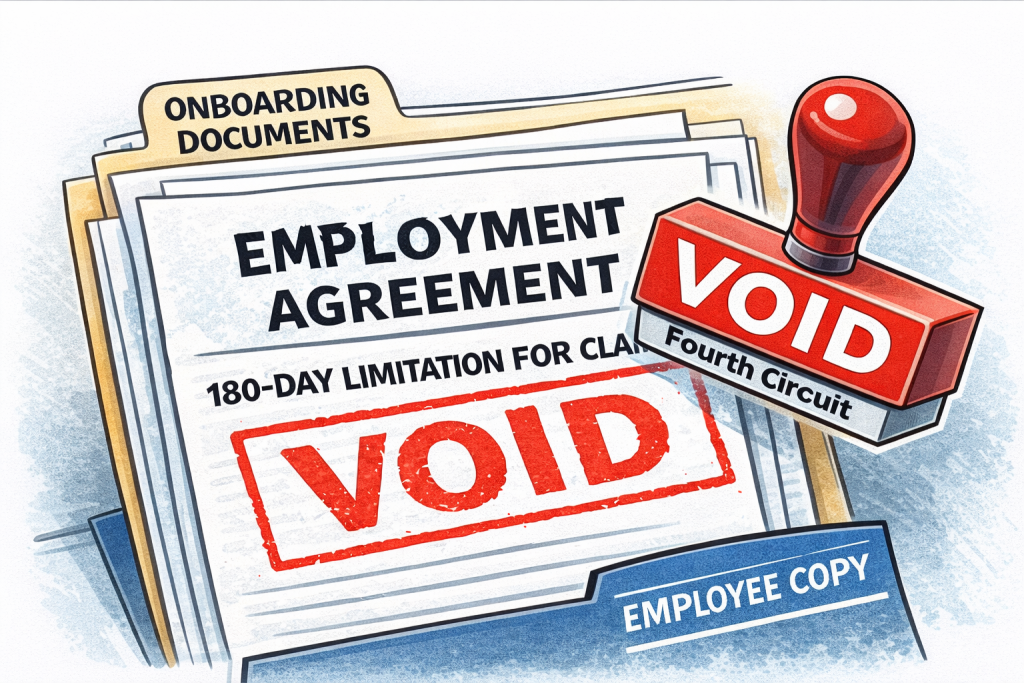
Some employers try. The Fourth Circuit just explained why that trick doesn’t work for these federal discrimination claims.
TL;DR: The Fourth Circuit held that employers cannot contractually shorten the time employees have to file discrimination lawsuits under Title VII of the Civil Rights Act of 1964 (Title VII) or the Age Discrimination in Employment Act (ADEA). Joining the Sixth Circuit, the court explained that these statutes contain a detailed enforcement scheme that runs through the Equal Employment Opportunity Commission (EEOC), and private agreements cannot prospectively render untimely a lawsuit that would otherwise be timely. The court vacated summary judgment on the federal claims but allowed dismissal of the employee’s Maryland state-law discrimination claim to stand.
An onboarding agreement that tried to shorten the clock
Before starting her job, an employee signed an employer-drafted agreement containing a 180-day limitations provision covering any lawsuit “relating to [her] employment.”
And wouldn’t you know it, the employer terminated her on November 9, 2022.
The employee filed a discrimination charge with the Equal Employment Opportunity Commission (EEOC) and the Maryland Commission on Civil Rights on February 23, 2023. The EEOC issued a right-to-sue letter on September 7, 2023.
She filed suit on December 6, 2023, asserting claims under Title VII of the Civil Rights Act of 1964 (Title VII), the Age Discrimination in Employment Act (ADEA), and the Maryland Fair Employment Practice Act (MFEPA).
The employer argued that the lawsuit was untimely because the employee had agreed to file any employment-related claims within 180 days. The district court agreed and granted summary judgment.
The Fourth Circuit rejects the workaround
The Fourth Circuit reversed in part. Joining the Sixth Circuit, the court held that employers cannot prospectively shorten the time employees have to bring discrimination claims under Title VII or ADEA.
Those statutes contain a carefully integrated enforcement scheme. Employees must first file a charge with the EEOC. The agency investigates the allegations and may attempt conciliation before litigation proceeds.
The statutes also contain specific timing rules. Employees generally have 180 to 300 days to file a charge with the EEOC, and once the EEOC issues a right-to-sue notice, they have 90 days to file a lawsuit.
Allowing employers to shorten that timeline through private agreements would interfere with the statutory framework Congress created.
As the court explained, parties may not prospectively render untimely a lawsuit that would otherwise be timely under Title VII or the ADEA.
The Fourth Circuit therefore vacated summary judgment on the federal discrimination claims and remanded the case for further proceedings.
The state-law claim came out differently
The employee also asserted a claim under the MFEPA.
On that claim, the Fourth Circuit reached a different conclusion. Under Maryland law, parties may agree to shorten a limitations period if the provision is reasonable and not otherwise prohibited.
Because the employee did not preserve an argument that the shortened period was unreasonable under Maryland law, the Fourth Circuit allowed dismissal of the MFEPA claim to stand.
Practical takeaways for employers
Contractual limitation clauses have limits
Many employers include provisions requiring employees to file employment-related lawsuits within 180 days or one year.
A clause that may work for certain state-law claims may not shorten the filing window for Title VII or ADEA claims — and it definitely will not in the Fourth and Sixth Circuits.
The EEOC process controls the timeline
Congress designed these statutes to funnel discrimination disputes through the EEOC before litigation begins. A contractual deadline that effectively compresses that process conflicts with the statutory framework.
Review template agreements carefully
Employers that rely on shortened limitations provisions in offer letters, employment agreements, or arbitration agreements should revisit those templates. A provision that may work for certain state-law claims may not apply to federal discrimination claims.
The bottom line
Employers can often manage litigation risk through contracts. But when Congress sets the enforcement timeline for Title VII and the ADEA, private agreements cannot shorten it in the Fourth Circuit.