Search
 The Employer Handbook Blog
Unauthorized overtime: Yes, you must pay for it. But yes, you can still fire someone for it.


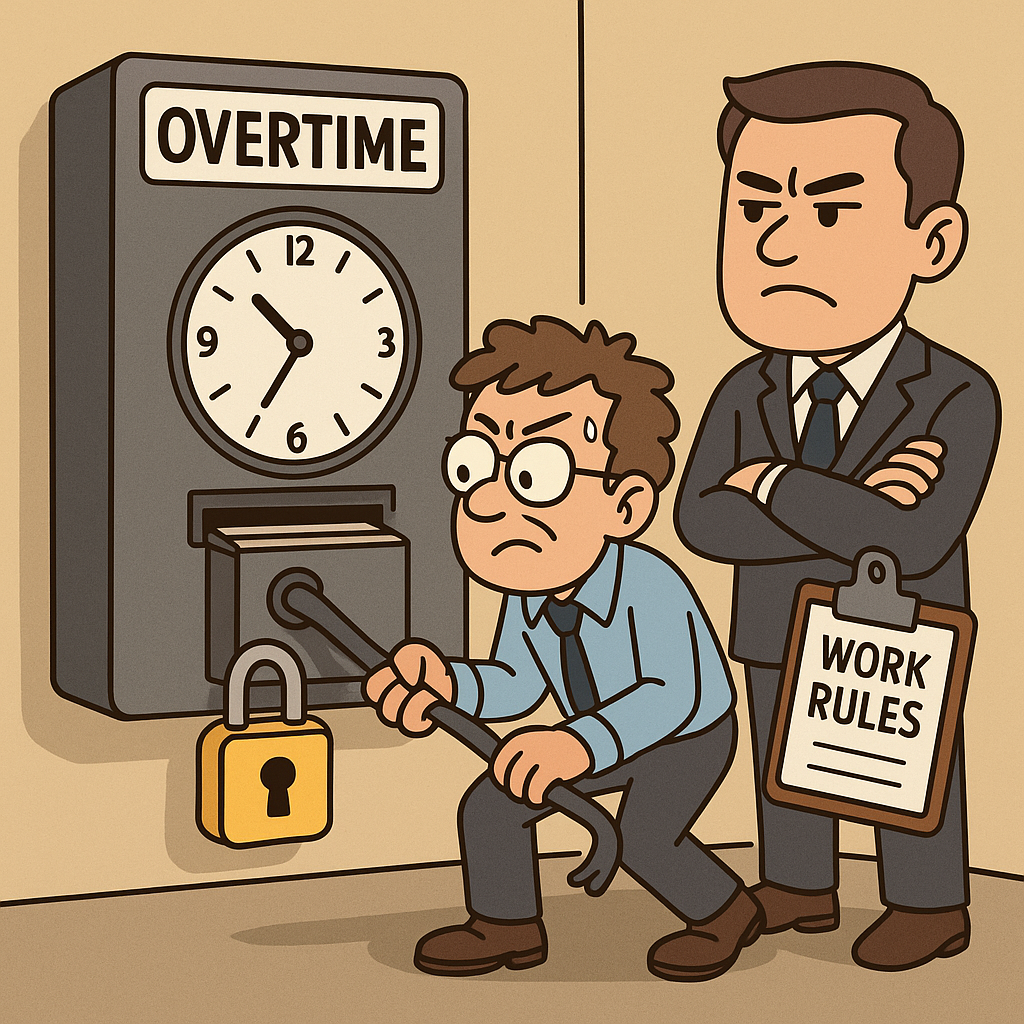
When employees rack up overtime without approval, it doesn’t make them look dedicated – it makes them insubordinate. And as one nurse at a VA hospital just learned, that can sink an age discrimination claim.
TL;DR: The Sixth Circuit affirmed summary judgment for a VA hospital where a nurse repeatedly worked overtime without preapproval despite counseling, a reprimand, and a suspension. The record shows she was paid for the extra hours, but her repeated insubordination torpedoed her ADEA claims. (Separately, as a matter of FLSA compliance, employers must pay for all hours worked, even if unapproved, and then discipline for the rule violation.)
A pattern of ignoring overtime rules
A VA nurse in Cincinnati “repeatedly worked overtime without permission.” Her supervisor first approved OT retroactively, then told her no more without preapproval. She kept doing it. The hospital escalated discipline: written counseling, then a reprimand, then a suspension. Yet she still worked unapproved OT again, claiming she needed to work overtime to provide proper care for veterans due to staffing shortages. But the OT was unauthorized, and she was fired in January 2020 at age 64, months before retirement eligibility.
She sued under the ADEA for discriminatory termination and age-based hostile work environment.
How insubordination – not age – drove the termination decision
- Insubordination is a valid reason. Repeatedly taking unapproved OT in defiance of instructions is a legitimate, nondiscriminatory reason to fire.
- No evidence of pretext. She admitted roughly 20 instances of unauthorized OT and offered no proof that age motivated the decision.
- No hostile work environment. Her supervisor’s pressure to finish work on time was not tied to age. She admitted nothing linked the criticism to her age.
- Business decisions are not bias. Even if she thought patient care justified extra hours, courts won’t second-guess employers’ operational judgments absent age bias.
The wage and hour piece: what the DOL says
The Fair Labor Standards Act has its own rule on unauthorized overtime: pay it. The Department of Labor’s Fact Sheet #22 explains that work not requested but “suffered or permitted” to be performed is work time that must be compensated. In other words, if an employee stays after their shift to finish tasks, the reason doesn’t matter — those hours are compensable.
But the DOL also makes clear that employers can set and enforce rules. You can discipline an employee for ignoring scheduling policies, just as the VA did here. The line is simple: pay the wages owed, then use your disciplinary process to address the rule-breaking.
Lessons for employers and HR
- Always pay for time worked – then enforce your rules. Unauthorized OT must be compensated, but discipline can and should follow.
- Document, document, document. Counseling → reprimand → suspension → termination showed progressive enforcement that held up in court.
- Be clear with managers. Instructions like “No OT without preapproval” need to be explicit and backed up with follow-through.
- Good intentions aren’t a defense. Employees may think they’re helping, but ignoring directives is still insubordination.
- Invest in systems and training. Have reliable tools to track hours worked and make sure employees are trained on how and when to record time, so you catch unauthorized hours early and avoid disputes later.
Bottom line
Overtime must be paid, but insubordination need not be tolerated. Clear rules, consistent documentation, and consistent discipline for violations go a long way toward defeating discrimination claims when employees ignore directives about overtime.