Search
 The Employer Handbook Blog
Rejected for a Positive Cannabis Test in New Jersey? Now Applicants Can Sue.


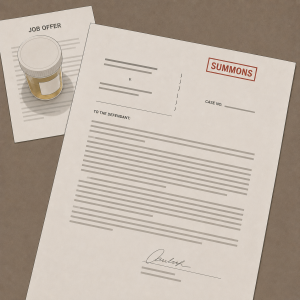 A federal appeals court ruled in 2024 that New Jersey job applicants had no legal recourse when employers rejected them over a positive recreational cannabis test. The New Jersey Appellate Division just disagreed.
TL;DR: In a first-impression ruling, the New Jersey Appellate Division held that the Cannabis Regulatory, Enforcement Assistance, and Market Modernization Act (CREAMMA) gives job applicants a private right of action to sue employers who rescind offers based on a positive cannabis test. The trial court’s dismissal was reversed and the case remanded. The ruling creates a direct split with a 2024 federal appeals court decision that sided with employers on the same question.
According to the complaint, a woman applied for a customer service representative position at a New Jersey company in December 2022, interviewed twice, and received a job offer. As part of the standard hiring process, the employee submitted to a pre-employment drug test. The results allegedly showed she had used cannabis within the prior thirty days — for recreational purposes, off duty, and not on the day of the test.
She further alleged that in early January 2023, she contacted the company’s HR department to ask about her start date. Instead of a start date, she alleged she was offered a chance to retake the test at her own expense within a week. She declined because she “did not have the funds.” The employer then rescinded the offer.
She sued under CREAMMA, which prohibits employers from refusing to hire individuals who test positive for cannabinoid metabolites, and later added claims for breach of contract, invasion of privacy, and negligence. The trial court dismissed everything, concluding her remedy was through the Cannabis Regulatory Commission (CRC). The New Jersey Appellate Division reversed on May 26, 2026, and the plaintiff won.
A Statute With No Enforcement Teeth — Until Now
The central question was whether CREAMMA’s hiring protections are enforceable by job applicants in court. The employer said no. The Appellate Division said yes — because without a private right to sue, those protections would be unenforceable against any employer that isn’t a licensed cannabis business. Regular employers fall outside the Cannabis Regulatory Commission’s reach entirely, leaving job applicants with no government agency to complain to — and therefore a right to go to court instead. The Appellate Division reached this conclusion despite a contrary 2024 Third Circuit ruling in Zanetich v. Wal-Mart Stores East, Inc., noting that the federal court examined only one of CREAMMA’s two relevant provisions, not both.
The plaintiff’s common law wrongful discharge claim didn’t survive; that doctrine protects employees from being fired, not applicants who were never hired. The contract and invasion of privacy claims were reinstated. On contract, it was unclear whether the demand for a second test was a legitimate condition of the offer or an attempt to manufacture a reason to walk away. On invasion of privacy, the plaintiff said she never would have taken the test if she had known the employer planned to use a positive cannabis result to pull the offer.
What New Jersey Employers Need to Audit Before the Next Hire
- Not every cannabis-based hiring decision violates CREAMMA. Federal contractors, grant recipients, and employers with documented safety-sensitive roles have narrow exceptions built into the statute. But employers rejecting applicants over a positive recreational cannabis test without one of those exceptions, including those still running pre-legalization drug policies they never updated, are exposed to exactly the kind of lawsuit this case just enabled.
- The “re-test at your own expense” approach doesn’t appear to be a safe harbor. The employer didn’t flatly refuse to hire; it offered a second test, just shifted the cost and timeline to the applicant. That was enough to reinstate both the CREAMMA claim and the breach of contract claim. Structuring a rescission as a conditional re-test doesn’t neutralize the exposure; it may add a contract theory on top of the statutory one.
- The Zanetich split creates a real forum-selection issue. That case involved a New Jersey plaintiff whose claim landed in federal court, and he lost. The same claim in state court now survives. Where a case gets litigated may determine its outcome, so employers facing CREAMMA claims should map out which forum controls before the next positive test result forces the question.
New Jersey legalized recreational cannabis in 2021 and built employment protections into the law from day one. It took until 2026 for a court to confirm that those protections come with a lawsuit attached.