Search
 The Employer Handbook Blog
The EEOC Just Told Employers Which Cases It’s Coming After. DEI Programs Made the List. What Else Did Too?


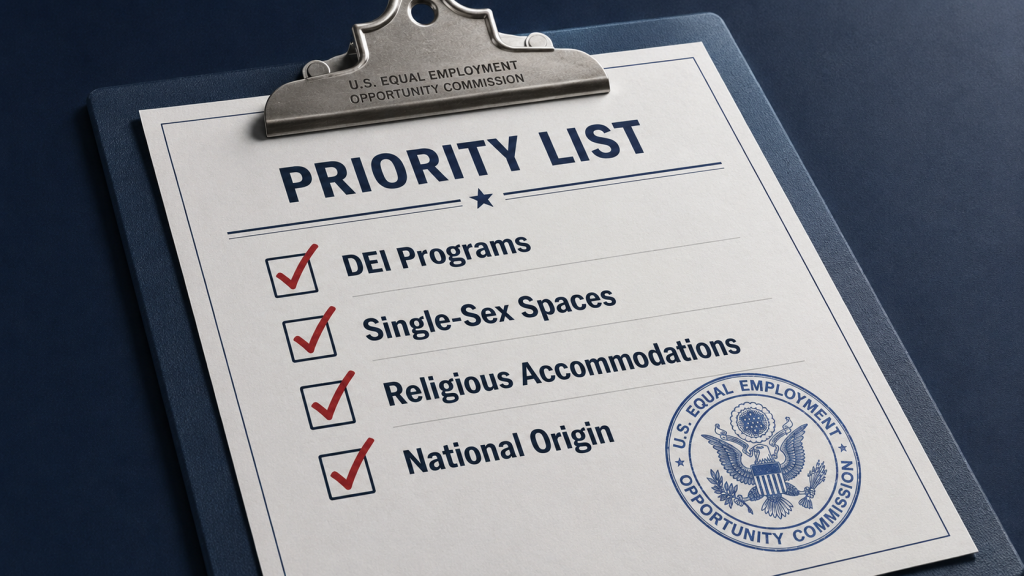
The EEOC approved a new National Enforcement Plan last week, and for the first time in recent memory ever, the agency has put DEI programs, religious accommodations, and national origin bias against American workers on the same priority list.
TL;DR: The EEOC approved a new National Enforcement Plan (NEP) for fiscal years 2025–2029, replacing the prior Strategic Enforcement Plan. The NEP deprioritizes disparate impact liability “to the maximum degree possible,” elevates intentional discrimination as its core enforcement focus, and identifies DEI-related policies as a named priority target. Religious accommodations, single-sex spaces, national origin discrimination against American workers, and the Pregnant Workers Fairness Act round out the Chair’s priority list.
📄 Read the National Enforcement Plan
What the NEP Actually Does
On June 4, 2026, the EEOC approved the National Enforcement Plan, a document that sets substantive priorities guiding the agency’s investigations, conciliation efforts, litigation, and amicus work through FY2029. The Chair posted a nine-point summary of the NEP’s global principles the same week, and two of them cut right to the chase: the EEOC is an executive branch agency and will advance Administration priorities accordingly, and the agency will prioritize disparate treatment liability, not disparate impact liability.
That second point has real teeth. The EEOC will eliminate disparate impact theories from its investigations “to the maximum degree possible” and will not commence, develop, or continue litigation advancing disparate impact claims. This is a significant departure from prior agency practice, where disparate impact was a routine enforcement tool.
DEI Is Now a Named Enforcement Target
The NEP explicitly targets policies, programs, or practices “labeled or framed as ‘diversity, equity, and inclusion’ (DEI) or similar euphemisms,” with particular attention to large corporations, prominent universities, and other prominent institutions. The specific practices in the agency’s sights include race- or sex-based quotas (including “aspirational goals” that function as quotas), diverse slate policies, hiring panel composition requirements, diversity statements required of candidates, and executive compensation tied to demographic goals.
The Other Chair Priorities
Beyond DEI, the NEP’s remaining Chair Priorities cover four areas: single-sex spaces and binary sex expression, including clarifying the scope of Bostock v. Clayton County on employees’ and employers’ rights to maintain single-sex intimate spaces such as bathrooms and locker rooms; religious liberty, with the Supreme Court’s 2023 ruling in Groff v. DeJoy cited as an active area of litigation interest; national origin discrimination against American workers, targeting policies that preference guest worker visa holders or PERM applicants; and the scope of the Pregnant Workers Fairness Act (PWFA), which the agency intends to develop through litigation.
One thing the NEP doesn’t change: disparate impact exposure from other sources. Individual claims brought by private plaintiffs, class suits, and state and local fair employment practices agencies are entirely unaffected by the EEOC’s enforcement posture.
Three Compliance Areas Worth Reviewing Before the Next Charge Lands
DEI Program Exposure Under Title VII Now Has an Agency Roadmap
The NEP doesn’t change what the law prohibits, but it signals where the agency will look. DEI programs remain lawful if executed without giving preference based on protected characteristics. The compliance question isn’t whether to have a DEI program; it’s whether the specific practices the NEP enumerates, such as diverse slate requirements, diversity statements, and demographically tied compensation, are operating as a proxy for protected-class preferences. That’s the analysis employers need counsel to run.
Religious Accommodation Processes Built Before 2023 Are Using the Wrong Standard
Religious accommodation decisions have always required individualized analysis, but Groff raised the bar for what counts as undue hardship. Employers whose processes haven’t been updated since 2023 are applying the wrong standard, and the NEP makes that a live enforcement risk.
State Pregnancy Accommodation Laws Often Exceed the PWFA. Build to Those Instead.
Several states have pregnancy accommodation laws broader than the PWFA, so employers operating in those states who calibrate solely to the federal floor are already behind. The better approach is to build accommodation procedures around the most demanding applicable standard and work down from there.
The EEOC still receives more than 80,000 charges per year with a fraction of the staff needed to investigate them all. The NEP is the agency telling you, in writing, which ones go to the front of the line.