Search
 The Employer Handbook Blog
The DOL Just Made It Official: The 2024 Overtime Rule Is Gone and the $684 Threshold Is Back.


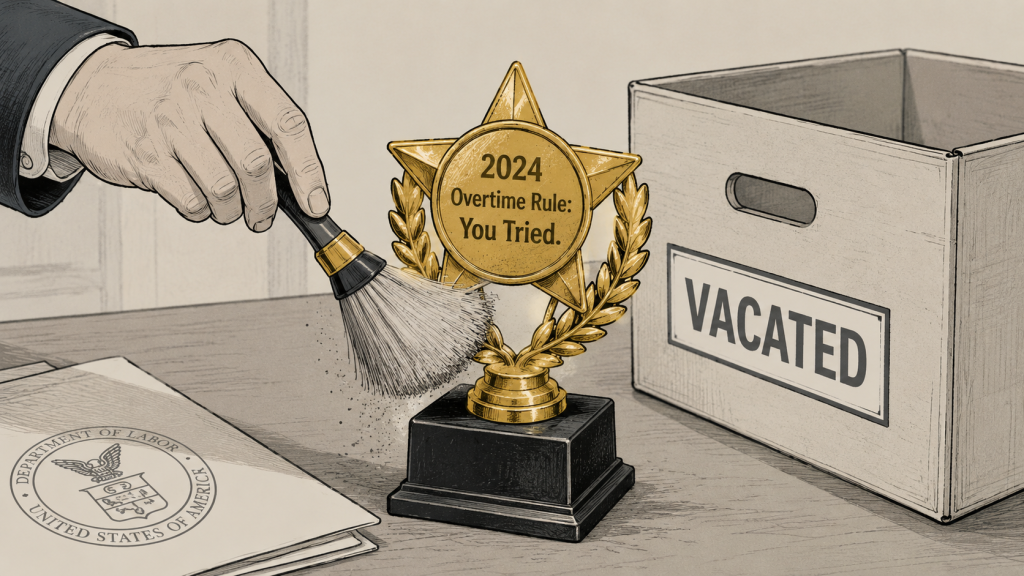
The 2024 overtime rule is officially gone from the federal rulebook. Courts killed it a year and a half ago; the DOL just got around to the paperwork.
TL;DR: Federal courts in Texas vacated the Biden administration’s 2024 overtime rule, which would have pushed the standard FLSA white collar salary threshold to $1,128 per week. With litigation concluded, the DOL today published a technical amendment cleaning the vacated rule out of the Code of Federal Regulations and reinstating the 2019 thresholds: $684 per week for most exempt employees and $107,432 per year for highly compensated employees, effective upon publication.
📄 Read the technical amendment
How the 2024 Overtime Rule Lived Fast and Died Young
Under the Fair Labor Standards Act (FLSA), executive, administrative, and professional employees can be exempt from overtime — but only if they satisfy three tests. The relevant one here is the salary level test, which sets the minimum weekly pay an employee must receive to qualify as exempt.
In 2019, the DOL raised that threshold from $455 per week to $684 per week. Fine. Then in April 2024, the Biden administration decided to go bigger: $844 per week starting July 1, 2024, jumping to $1,128 per week on January 1, 2025, with automatic increases every three years after that.
Litigation followed. In November 2024, a federal court in the Eastern District of Texas vacated the 2024 rule. A month later, a federal court in the Northern District of Texas did the same. The Fifth Circuit dismissed both appeals in early May 2026, making those rulings final. The 2024 rule was already dead; the technical amendment is just the DOL making the rulebook say what the courts already decided.
So What Does the CFR Actually Say Now?
The restored thresholds: $684 per week ($35,568 annualized) for the standard salary level, and $107,432 per year for the highly compensated employee (HCE) exemption. Those are the numbers that have been operationally in effect since the courts acted in late 2024, and they’re what the DOL has been enforcing. The amendment takes effect today and makes the written regulations match reality.
The DOL was also careful to note that nothing in this amendment prevents future rulemaking. A new rule raising the threshold again is not off the table. It’s just not happening right now.
Reversing a 2024 Reclassification Is Harder Than It Looks
Any employer still weighing whether to reverse a 2024 reclassification should run the duties test before acting on the salary change alone. Some of those decisions may have gotten the right answer for the wrong reason.
The same logic applies to the highly compensated employee exemption. The HCE threshold is back at $107,432 annually. If that changes anything for your workforce, confirm the duties test before acting on it.
One more wrinkle: restoring the federal $684 threshold doesn’t move the needle for employers in states with higher salary floors. California, New York, and Washington, among others, set their own thresholds above the federal level. If state law was driving the classification decision, this amendment changes nothing.
The Stability Won’t Last Forever
The salary level floor is stable for now. That won’t always be true — the DOL made clear this amendment doesn’t close the door on future rulemaking. Get the analysis right while the ground isn’t moving. In other words, don’t throw away those compliance memos. You’ll need them.