Search
 The Employer Handbook Blog
A “Repugnant and Racially Hostile” Blackface Doll Hung by a Noose At Work. It Still Wasn’t Enough for a Hostile Work Environment Claim.


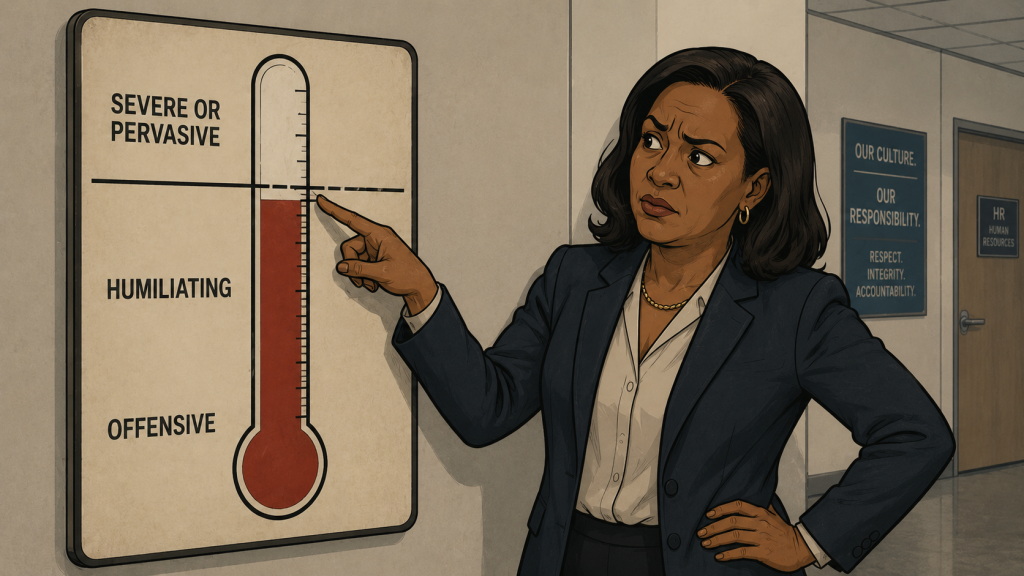
The court called it “repugnant and racially hostile.” It still wasn’t enough. A recent appellate decision affirming summary judgment for the employer on a hostile work environment claim is a useful reminder of how high the severe-or-pervasive bar actually is.
TL;DR: A Black employee alleged a racially hostile work environment under Title VII and Section 1981, pointing to three racial incidents over approximately two years: a blackface doll hung by a noose near her workspace, and two racially charged comments. The district court granted summary judgment to the employer on the hostile work environment claim — as well as on race discrimination and retaliation claims — and the 11th Circuit affirmed on April 23, 2026. Even accepting the blackface doll incident as established fact, three incidents over two years, two of which were not made in the employee’s presence, and none of which unreasonably interfered with her job performance, did not meet the severe or pervasive standard.
“Repugnant and Racially Hostile” — But Not Actionable
The employee worked for a healthcare employer and alleged that she was subjected to a racially hostile work environment. She identified several incidents as supporting her claim, but the court found that only three were arguably race-based: a blackface doll hung by a noose in her desk area in December 2019, and two comments — one about hair burning, one about a hoodie — made by a supervisor at some point in 2019.
The blackface doll incident is worth pausing on. The court accepted the employee’s version of events for purposes of summary judgment and described the conduct as “repugnant and racially hostile.” That acknowledgment did not save the claim. The court went on to evaluate the three incidents under the totality of the circumstances and found they were insufficient to meet the severe or pervasive standard required to establish a hostile work environment. The employer won on the HWE claim, as well as on the employee’s race discrimination and retaliation claims.
Why Three Incidents Over Two Years Fell Short
To establish a racially hostile work environment under Title VII, an employee must show that the harassment was severe or pervasive enough to alter the terms and conditions of employment. That test has both a subjective component — the employee must have perceived the environment as hostile — and an objective component: a reasonable person in the same position would have as well. Courts consider the frequency of the conduct, its severity, whether it was physically threatening or humiliating versus merely offensive, and whether it unreasonably interfered with the employee’s job performance.
Applying those factors, the three racial incidents fell short for several reasons. First, three incidents over roughly two years is a low frequency. Second, two of the three comments were not made in the employee’s presence. Third, none of the incidents unreasonably interfered with her job performance. Fourth, when the employee reported the blackface doll, a supervisor took prompt remedial action by telling her to throw it away — which, while not a model harassment response, counted as remedial action in the court’s analysis.
The court’s holding does not mean the conduct was acceptable. It means the conduct, evaluated under the totality of the circumstances, did not clear the legal threshold for a hostile work environment claim. Those are different things, and employers should not conflate them.
What This Means for Hostile Work Environment Claims
Severity and frequency are independent pathways — but both have real thresholds. Title VII requires harassment that is either severe or pervasive. A single incident can be severe enough to support a claim on its own — courts have found that in cases of physical assault or direct racial threats. The surprising part of this decision is that the court found a blackface doll hung by a noose did not clear the severity bar on its own. That is a fact-specific, non-precedential holding, and employers should not treat it as a reliable benchmark. The more defensible takeaway is that three incidents over two years, with no job performance impact, did not satisfy the pervasiveness pathway either.
Whether the conduct was directed at the employee matters. Two of the three incidents were comments not made in the employee’s presence. That factored into the court’s severity and pervasiveness analysis. Harassment that an employee learns about secondhand carries less weight than conduct directed at her — even when it reflects the same underlying animus. Employers investigating harassment complaints should document not just what was said or done, but to whom it was directed and who was present.
Prompt remedial action still counts, even when it is minimal. The supervisor’s response to the blackface doll — telling the employee to throw it away — was hardly a robust investigation. But the court credited it as remedial action. Employers who respond quickly to reported harassment, even imperfectly, are in a better legal position than those who do nothing. A documented response, however basic, is better than silence.
None of this is a green light for tolerating racial harassment. The court’s holding is narrow, fact-specific, and non-precedential. The more useful takeaway is that the severe-or-pervasive standard requires careful, documented analysis — not a headcount of incidents.