Search
 The Employer Handbook Blog
The DOJ Called the EEOC’s Disparate-Impact Guidelines Unconstitutional. The EEOC Basically Asked It To.


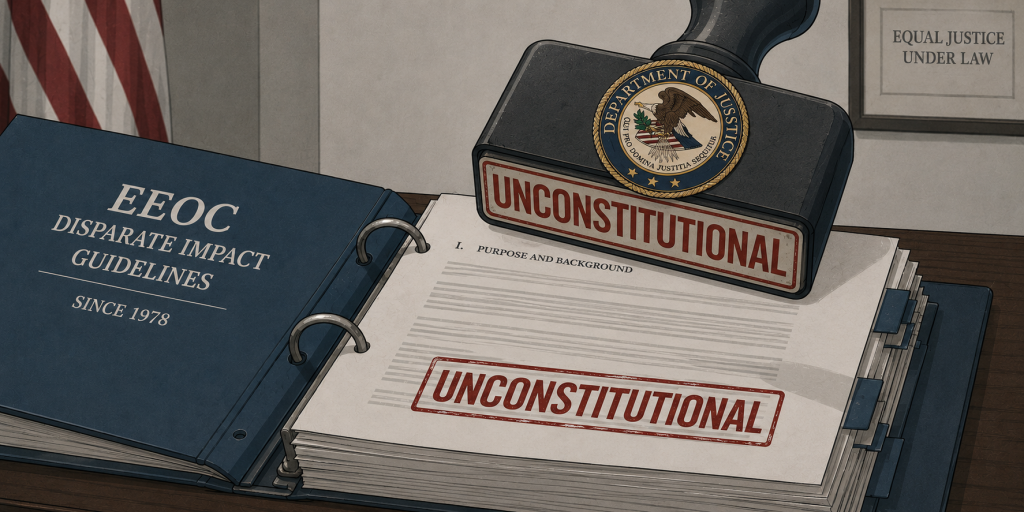
Yesterday, the U.S. Department of Justice told the U.S. Equal Employment Opportunity Commission that it has been applying its disparate-impact guidelines unconstitutionally.
That’s awkward, right?
Well, perhaps not. For most employers, it may be even less than that.
TL;DR: On June 9, 2026, the Justice Department’s Office of Legal Counsel concluded that the EEOC has been applying disparate-impact theory unconstitutionally. Specifically, the opinion invalidates the EEOC’s validation-study requirements and its affirmative action regulations, and identifies three limiting principles that any constitutional application of disparate-impact liability must satisfy: a low business-necessity bar, a robust causation requirement on plaintiffs, and a meaningful burden on plaintiffs to identify an equally effective alternative practice. This is a government legal memo, not a court ruling. The law hasn’t changed, employees can still sue, and the EEOC had already stopped bringing these cases before this opinion landed. For most employers: not much has changed.
This Opinion Didn’t Start Anything. It Formalized Everything.
Here’s what happened. The Justice Department’s Office of Legal Counsel, the arm of DOJ that issues formal legal guidance to federal agencies, published a memo concluding that the EEOC’s implementation of disparate-impact theory, specifically its validation-study requirements and affirmative action regulations, violates the Constitution.
Disparate-impact theory, in plain terms, says an employer can be sued for discrimination even without intending it, if a neutral hiring practice produces unequal outcomes across protected groups. The EEOC has enforced that theory since the late 1970s, requiring employers to run elaborate studies to justify their screening criteria and pushing race-, sex-, and national-origin-conscious hiring to close statistical gaps. The Justice Department’s argument: the way the EEOC implemented that theory, through onerous validation requirements and race-conscious hiring mandates, is itself unconstitutional.
The opinion targets two specific things: the EEOC’s validation-study requirements and its regulations encouraging race-conscious hiring. It also borrows its constitutional framework from voting rights law. Five days earlier, the Supreme Court issued a ruling in an Alabama redistricting case, and the Justice Department applied that Court’s language about a “colorblind Constitution” to employment law. Whether that transplant holds in employment cases is untested.
But here’s the context the headlines are missing. In April 2025, President Trump signed an executive order directing federal agencies to eliminate disparate-impact policies. On June 4, 2026, the EEOC Chair signed a new National Enforcement Plan (NEP) committing the agency to dropping disparate-impact theories from investigations and never filing a lawsuit based on them.
Five days later, the Justice Department issued this memo to supply the constitutional argument. The EEOC Chair had requested it and praised it upon receipt. Paper trail. Policy already in place.
What This Means for Employers (Probably Less Than the Headlines Suggest)
The EEOC wasn’t coming for you on this anyway. The new enforcement plan made that explicit five days before this opinion arrived, formalizing a posture employers have been living with for months.
Individual employees can still sue, and state agencies can still investigate. This opinion directs the EEOC. It has no authority over private lawsuits or state fair employment agencies, many of which have their own disparate-impact provisions under state law. Title VII hasn’t changed, and a plaintiff’s lawyer can still file a disparate-impact claim in federal court tomorrow.
The EEOC’s attention has shifted, and the new target is DEI. The new enforcement plan signals a hard turn toward anti-DEI cases: race- and sex-based hiring quotas, diverse-slate policies, pay tied to demographic goals. If you’ve been focused on the disparate-impact story, the NEP is worth reading in full.
Good documentation of job-relatedness has always been the right answer. Be able to explain why your screening criteria connect to actual job performance, regardless of who runs the EEOC. That hasn’t changed.
This opinion shapes what the EEOC does. Whether it changes what courts do is a much harder question, and the one that actually determines whether the litigation landscape shifts.