Search
 The Employer Handbook Blog
How Much Control Does It Take to Become a Joint Employer? DOL Proposes an Answer.


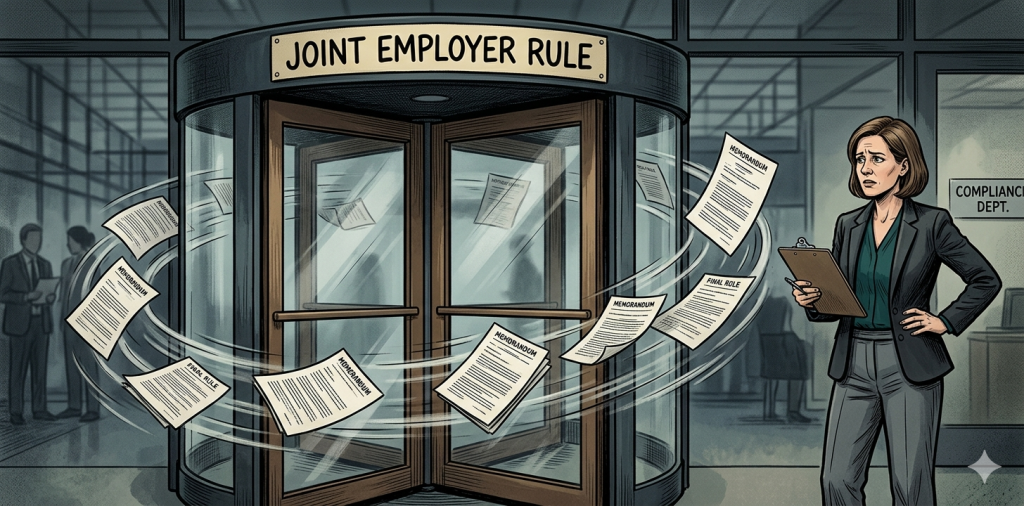
Three administrations, multiple rules, and still no settled federal standard on joint employment. The DOL’s new proposed rule is the latest attempt to end that uncertainty.
TL;DR: The U.S. Department of Labor has proposed a new rule establishing a single nationwide standard for determining joint employer status under the FLSA, FMLA, and the Migrant and Seasonal Agricultural Worker Protection Act (MSPA). The proposal sets out separate analyses for “horizontal” and “vertical” joint employment, adopts a four-factor test for vertical scenarios, and explicitly identifies business practices — including franchisor relationships, shared safety policies, and quality control standards — that do not, on their own, create joint employer liability. The 60-day comment period closes June 22, 2026.
📄 Read the proposed rule | Summary | Q&A
Five Years Without a Rulebook
Since the Biden administration rescinded the 2020 joint employer rule in July 2021, the Department of Labor has had no generally applicable FLSA regulation on joint employment. According to the DOL, its investigators have been applying a vertical joint employment standard consistent with applicable circuit precedent — which varies substantially across the federal circuits. The horizontal standard, by contrast, reflects the Department’s longstanding enforcement policy and is less of a departure from current practice.
If finalized, the rule would govern how DOL investigators assess joint employer status nationwide under the FLSA, FMLA, and MSPA — all of which share the same statutory definitions of employment. Courts are not required to defer to the DOL’s interpretation, but a well-reasoned final rule may influence judicial analysis over time.
Vertical vs. Horizontal: Two Different Questions
The proposal distinguishes between two structurally different joint employment scenarios. In horizontal joint employment, an employee works separate hours for two employers in the same workweek, and the question is whether those employers are sufficiently associated to be deemed joint employers. Sharing a vendor or being co-franchisees of the same franchisor is not, by itself, enough.
In vertical joint employment — the scenario that generates most of the litigation — a single employee works one set of hours that simultaneously benefits two entities, such as a staffing agency client or a general contractor above a subcontractor. The rule proposes a four-factor test for vertical cases: whether the potential joint employer (1) hires or fires the employee; (2) supervises and controls the employee’s work schedule or conditions of employment to a substantial degree; (3) determines the employee’s rate and method of payment; and (4) maintains the employee’s employment records. A unanimous finding on all four factors in either direction establishes a “substantial likelihood” on joint employer status.
The proposal also clarifies that reserved control — a contractual right to supervise or discipline that is never actually exercised — carries less weight than control that is actually practiced.
What Won’t Make You a Joint Employer
This is the part most employers will want to bookmark. The proposal explicitly identifies business practices that, standing alone, do not make joint employer status more or less likely: requiring anti-harassment policies or background checks through a contract, providing a sample employee handbook to another employer, offering an association health plan, participating in a joint apprenticeship program, operating as a franchisor, and imposing quality control standards to protect brand reputation.
These carve-outs give companies operating through franchisees, subcontractors, and staffing arrangements meaningful clarity that routine brand protection and compliance coordination won’t automatically drag them into joint employer territory.
These changes represent a genuine shift from the 2020 rule, and employers with complex business structures should map their relationships against the new four-factor framework before the final rule takes effect.
What Employers Should Think Through Now
The four-factor test rewards documentation of actual practice, not just contracts
Because reserved control matters less than exercised control, a franchise agreement that reserves the right to supervise employees is less relevant than whether a franchisor actually directed the day-to-day work. Employers should document who actually makes hiring, scheduling, and pay decisions — not just what the contract says.
Staffing agency and subcontractor arrangements face the most scrutiny
Vertical joint employment is where the real exposure sits. If a client employer’s personnel routinely set schedules, approve timesheets, or direct daily tasks for workers placed by a staffing agency, all four factors point toward joint employment. Audit those arrangements now and clarify the division of supervisory authority before the rule finalizes.
The FMLA alignment creates new compliance math for secondary employers
Because the proposal aligns the FLSA vertical analysis with the FMLA, an employer that qualifies as a vertical joint employer under the four-factor test may also need to count jointly employed workers toward FMLA coverage thresholds and potentially bear job restoration obligations. The overlap is not automatic, but it requires a closer look at arrangements where one employer supplies workers to another.
The comment period closes June 22, 2026. If your business model depends on franchising, staffing agency relationships, or subcontracting, this is one proposal worth submitting comments on — because the final rule will set the enforcement framework investigators will use.