Search
 The Employer Handbook Blog
Coming Soon: New Jersey’s Pay Transparency Rules Get Specific


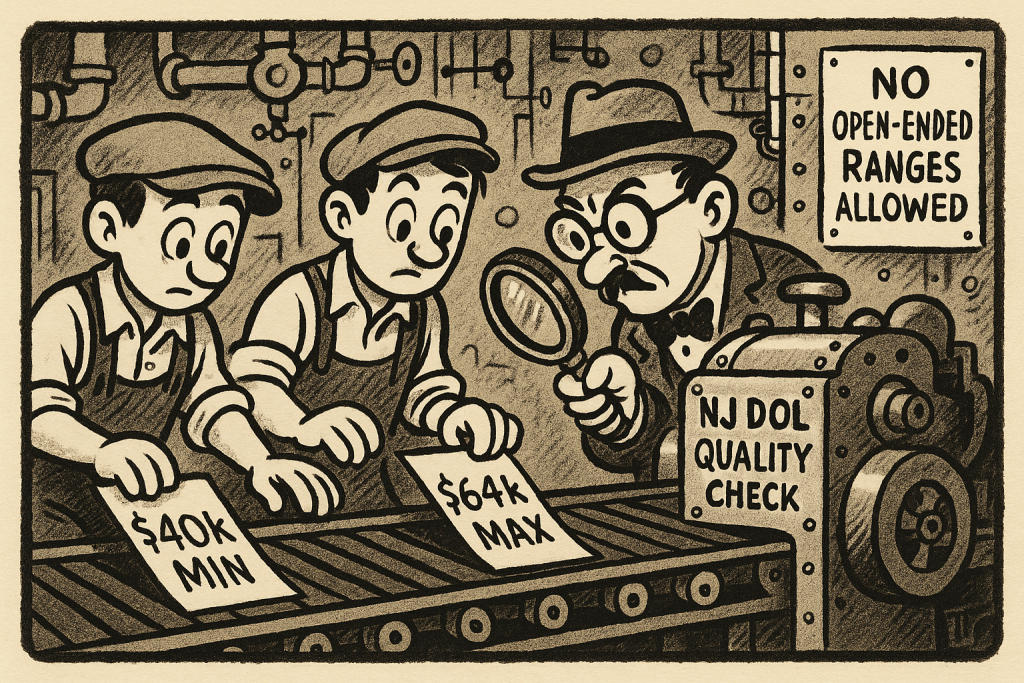
If you read my earlier post, you already know New Jersey’s new pay transparency law is here. Now the Department of Labor has proposed regulations that explain exactly how to comply.
TL;DR: The Transparency in Employment Listings Act is already in effect, and the state’s proposed regulations show employers what key terms like “reasonable efforts,” “pay range,” and “benefits disclosure” really mean. The rules clarify how to post promotions and job openings, limit how wide salary ranges can be, and set out complaint, hearing, and penalty procedures.
📘 Read the statute
📘 Read the proposed rules
A Quick Refresher
As I wrote in my earlier post, the law applies to employers with 10 or more employees over 20 calendar weeks who do business, employ persons, or take applications for employment within New Jersey, and it requires them to:
- Notify current employees of promotion opportunities that the employer advertises internally or externally before making a promotion decision.
- Include the hourly wage or salary, or a range, and a general description of benefits and other compensation programs in new job and transfer postings.
- Comply or risk civil penalties of up to $300 for a first violation and $600 for each subsequent violation.
The law took effect on June 1, 2025, and the new proposed rules now fill in the missing details.
What’s New in the Proposed Regulations
1. “Reasonable Efforts” Defined
Under the rules, “reasonable efforts” means two things:
- Posting the promotion opportunity conspicuously where eligible employees can see it, and
- If you have an employee intranet, posting it there too.
That is the baseline for compliance. Promotions based on seniority or performance, or those made in emergencies, remain exempt.
2. Job Postings Must Be Specific – No “And Up” Ranges
Every internal or external job or transfer posting must list:
- Either the hourly rate or salary, or a defined range, and
- A general description of benefits and other compensation such as bonuses or commissions.
If you post a range, the maximum can be no more than 60 percent higher than the minimum, unless a collective bargaining agreement or law sets it differently.
The proposal even explains how to calculate the range spread: subtract the minimum from the maximum, divide by the minimum, and multiply by 100.
The rules also outlaw vague “$17/hour and up” language. You must post a true range with both a top and bottom number.
3. Third-Party Posting Guidance
You are liable for a job ad’s content if you:
- Control what appears on the job board, or
- Contract with the site to create the ad for you.
If a third-party site automatically aggregates job listings without any direct involvement from the employer, the employer will not be cited for a violation. However, if the employer provides content to, contracts with, or otherwise controls what appears on that site, the employer remains responsible for compliance.
If your ad links directly to a page with the required pay and benefit information, it can be compliant so long as the primary ad identifies the employer’s name and location, the job title, and states that the link immediately takes the applicant to the required pay and benefits information.
4. Temporary and Consulting Firms
These firms do not have to post pay or benefit details when recruiting for potential future openings, but must provide them at interview or hire for any specific job.
5. Enforcement, Hearings, and Penalties
Violations are enforced by the Division of Wage and Hour Compliance:
- First violation – up to $300.
- Subsequent violations – up to $600 each.
Each promotion or job posting counts as one violation regardless of how many times it is listed.
Employers receive written notice, an opportunity for a hearing, and appeal rights. A request for a formal hearing must be received within 15 business days after receipt of the notice.
The Department will consider factors such as size, seriousness, prior history, and good-faith efforts when deciding penalties.
What Employers Should Do Now
If you are covered, now is the time to:
- Audit internal promotion practices and confirm that postings reach every eligible employee.
- Standardize pay ranges and benefit descriptions so they meet the 60 percent spread rule.
- Train HR and recruiting teams on the new posting content requirements.
- Review job-board agreements to clarify who controls ad content.
- Keep records of postings and internal notices to show compliance.
- Monitor for final rules, because the proposed regulations could still change before adoption. Written comments are due November 14, 2025.
The Takeaway
New Jersey has moved from “tell employees” to “show your math.”
If you have not yet updated your job-posting templates or internal notice procedures, do it now while the rulemaking process is still underway.