Search
 The Employer Handbook Blog
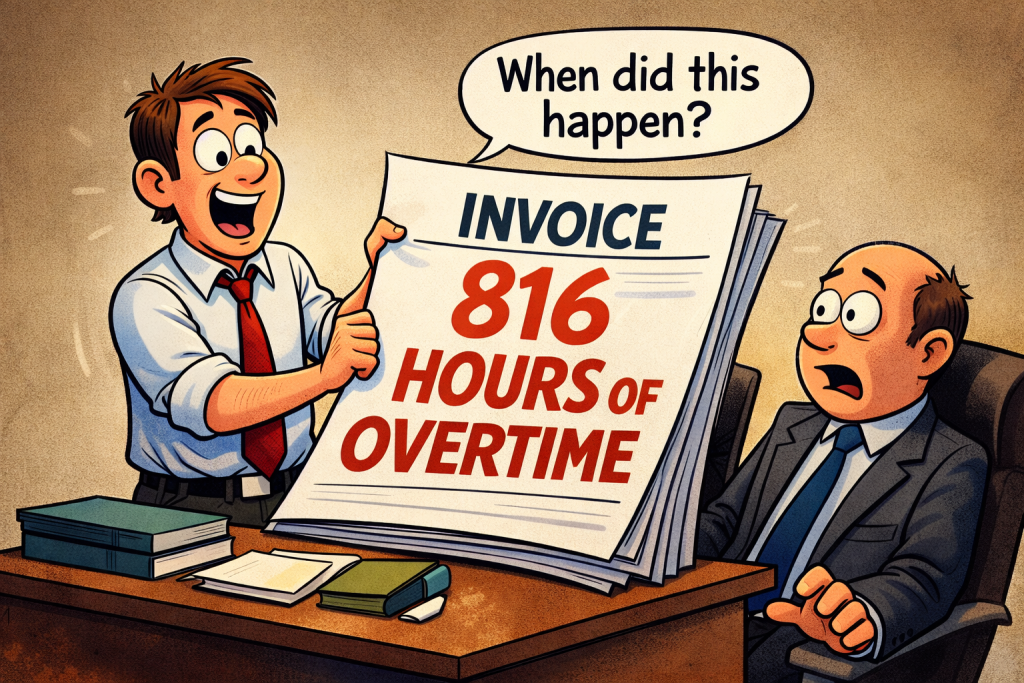
An employee worked 816 hours of overtime. The employer still didn’t owe it.


Can an employee secretly rack up overtime and sue for it later?
The Fifth Circuit says not without proof that the employer knew or should have known about those hours.
TL;DR: The Fifth Circuit affirmed a defense verdict in a Fair Labor Standards Act (FLSA) overtime case because the employee failed to prove the employer had actual or constructive knowledge of his overtime work. Even though the district court ruled the worker should have been classified as an employee and had worked at least 816 hours of overtime, the only issue for trial was whether the employer knew or should have known about those hours. The jury said no, and the Fifth Circuit upheld that verdict.
A six-figure insurance manager claims overtime
An insurance agency manager sued his employer claiming he had been misclassified as an independent contractor and was entitled to overtime pay under the Fair Labor Standards Act (FLSA).
In that role, the employee supervised a team of insurance agents across multiple agencies. He set his own schedule, decided how many hours he worked each day, and had no obligation to track or report his time. The employer did not supervise his hours or require him to log them. Instead, he was paid purely on commission for policies sold and renewed.
From 2016 through 2018, he earned between $552,000 and $627,000 per year.
On summary judgment, the district court ruled that the worker should have been classified as an employee rather than an independent contractor. The court also determined that he had worked at least 816 hours of overtime.
But that did not resolve the case.
The only question for the jury was whether the employer knew or should have known that the employee was working those overtime hours. The jury found that it did not.
Allowing unlimited hours does not eliminate the knowledge requirement
On appeal, the employee argued the employer should still be liable because it allowed him to work unlimited hours. The FLSA defines “employ” as “to suffer or permit to work,” and he argued that allowing him to work as much as he wanted meant the employer owed him overtime regardless of its knowledge.
The Fifth Circuit rejected that argument.
Allowing someone to work as much as he pleases does not mean the employer automatically owes overtime “regardless of [its] knowledge of those overtime hours.” Employees seeking overtime must still prove the employer had actual or constructive knowledge that the overtime work was being performed.
The employee also argued the employer should be deemed to have constructive knowledge because it did not maintain a timekeeping system requiring him to report his hours.
Again, the court disagreed. The burden remained on the employee to prove the employer knew he was working overtime. Treating the absence of a timekeeping system as automatic constructive knowledge would improperly shift that burden to the employer.
Because the jury reasonably concluded the employer lacked actual or constructive knowledge of the overtime work, the Fifth Circuit affirmed the verdict.
Practical takeaways for employers
First, overtime liability still turns on employer knowledge. Employees claiming overtime must show the employer knew or should have known the work was happening.
Second, misclassification alone does not guarantee overtime liability. Even when a worker should have been classified as an employee, the knowledge requirement still applies.
Third, clear reporting procedures can protect employers. When employees are responsible for reporting their own time and fail to do it, courts are reluctant to hold employers liable for hidden overtime.
The bottom line
The FLSA protects employees who are required or allowed to work overtime. But it does not impose liability when an employee works extra hours without the employer’s knowledge and without giving the employer a reasonable opportunity to stop it.
Sometimes the missing ingredient in an overtime case is not the hours worked.
It is notice.