Search
 The Employer Handbook Blog
🎷 ‘Careless Whisper’ Isn’t a Title VII Claim


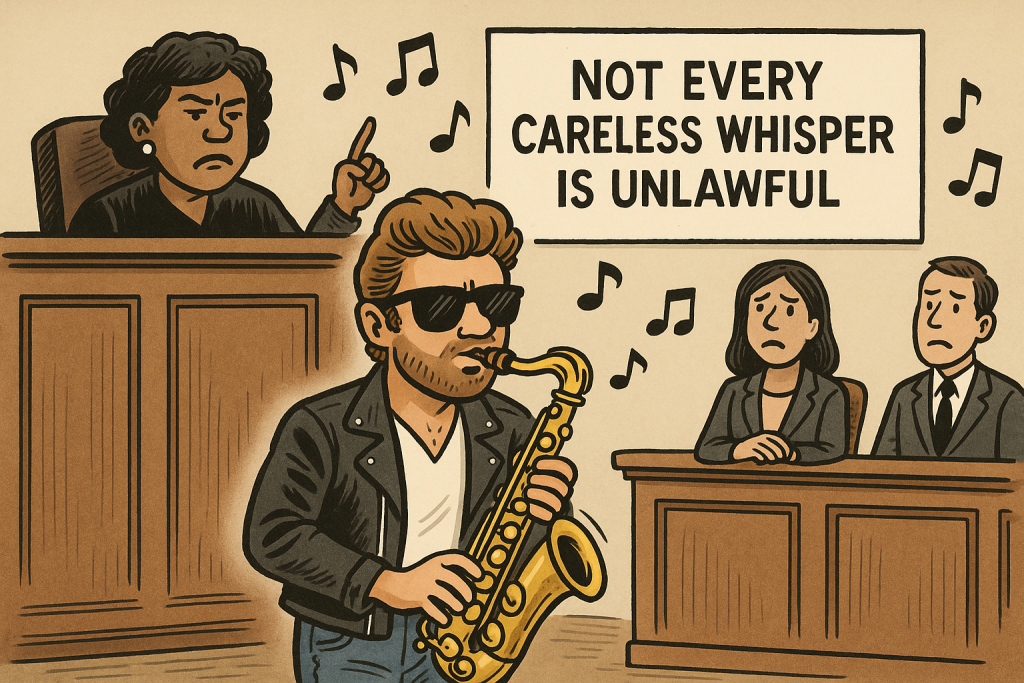
Before we get to the law, let’s admit it: anytime a case involves a supervisor leaning in to whisper in someone’s ear, you can almost hear George Michael’s sax riff in the background. But as this recent federal court decision shows, not every whisper, awkward or otherwise, creates a viable harassment or retaliation claim.
TL;DR: An employee said his supervisor’s whisper about his “distinctive” voice amounted to sexual harassment, then claimed retaliation when he complained. The court held the complaint was not objectively about unlawful discrimination, and the single incident was neither sex-based nor severe or pervasive. Summary judgment for the employer.
When a Whisper Isn’t Enough
A longtime biotechnician was disqualified from sterile-area work for a year after failing six contamination tests. Under the collective bargaining agreement, he could bid for new positions or be temporarily reassigned. During that process, he filed grievances, including one tied to a staff meeting where his supervisor, while distributing schedules, leaned in and whispered that he recognized him by his “distinctive voice.” He later claimed this was sexual harassment and that his reassignment and reduction in overtime were retaliation.
Why the Claims Fell Flat
The retaliation claim didn’t get off the ground because the employee’s grievance wasn’t about something that could reasonably be seen as unlawful discrimination. The court said a single comment about having a “distinctive” voice, whispered once during a meeting, might have been awkward but wasn’t offensive enough to count. Title VII isn’t meant to cover every slight or uncomfortable moment, and an employee’s personal belief that something felt discriminatory isn’t enough by itself.
The hostile work environment claim also fell short. The court explained that the whisper wasn’t tied to the employee’s sex and didn’t carry any sexual meaning. And one comment, by itself, is not “severe or pervasive.” The law requires either a pattern of bad behavior or one truly extreme incident. Since this was just one whisper, with nothing else suggesting harassment or sexual intent, the claim couldn’t move forward.
Takeaways for Employers 🎷
- Awkward ≠ unlawful. A one-off uncomfortable interaction is not the same as actionable harassment.
- Protected activity requires reasonableness. An employee’s complaint about discrimination or harassment must be based on conduct a reasonable person could see as unlawful, not just something subjectively upsetting.
- Documentation protects. Following clear policies, applying procedures consistently, and keeping good records strengthens the defense when employees complain about discrimination or retaliation.
Final Note
Sometimes a whisper is just a whisper.