Search
 The Employer Handbook Blog
You can’t miss work, get fired, and then try to call it FMLA leave.


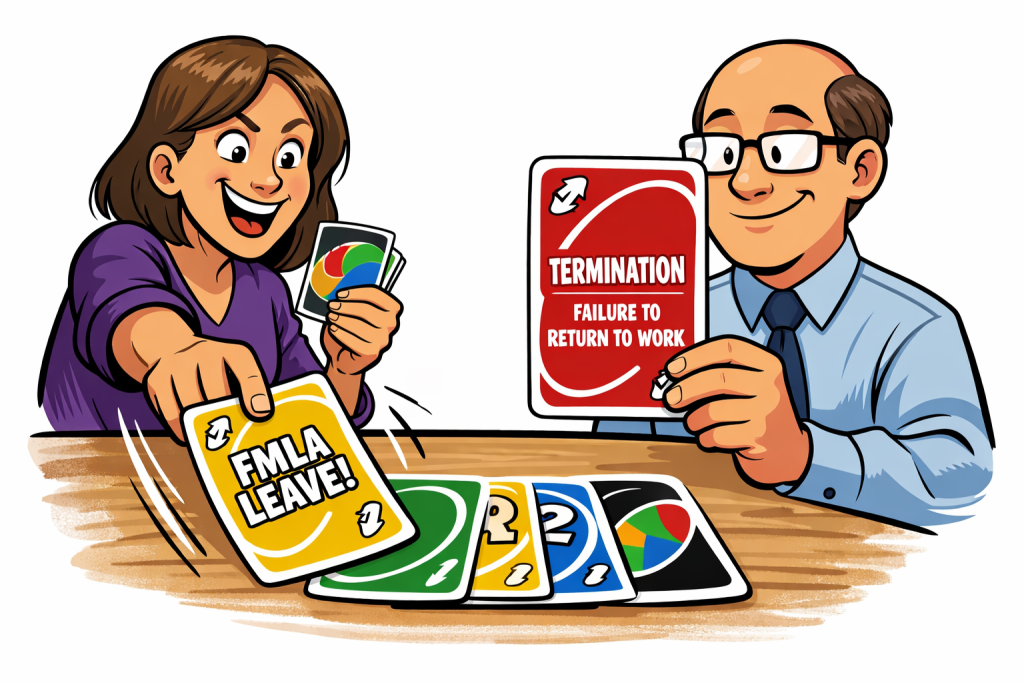
One employee tried exactly that. The Seventh Circuit explained why it didn’t work.
TL;DR: An employee failed to return to work after her approved leave under the Family and Medical Leave Act (FMLA) expired. After the employer terminated her for failing to return, she attempted to retroactively report several absences as intermittent FMLA leave. The Seventh Circuit affirmed summary judgment for the employer, holding that she was not denied FMLA benefits to which she was entitled and that she failed to comply with the law’s notice requirements.
When approved leave ends, the expectation is simple: return to work
The employee worked as a human resources specialist and had previously been approved for intermittent leave under the Family and Medical Leave Act (FMLA) for migraines. Later that year, she obtained approval for continuous FMLA leave to care for her son from August 31 through November 3.
When that leave expired, the employer told her multiple times to return to work on November 15. She did not return.
Instead, she called the company’s attendance line that morning, said she assumed she had already been terminated, thanked the company for the opportunity, and indicated she would return company property. The employer terminated her that same day for “Leave Exhaust/Failure to Return to Work.”
The lawsuit followed.
The next day, she tried to change the story by attempting to retroactively report intermittent FMLA leave for absences on November 11, 12, and 15. That strategy did not work.
The court’s analysis was straightforward
The employee alleged FMLA interference and retaliation, but both claims failed.
The interference claim collapsed because the employee attempted to report intermittent leave after she had already been terminated. At that point, she was no longer entitled to FMLA benefits.
Even setting that aside, the claim still had a notice problem. FMLA regulations require employees to provide notice of leave “as soon as practicable” and generally consistent with the employer’s normal reporting rules.
Here, the employer required employees to report intermittent FMLA absences the same day they occurred. The employee did not do that. Instead, she tried to report the absences the day after she was fired.
The retaliation claim failed for the same basic reason. The evidence showed the termination was based on her failure to return to work when instructed, not on her earlier use of FMLA leave.
As the court observed, the record told a simple story—the employer terminated the employee for an unexcused absence.
Practical reminders for employers
• FMLA notice rules matter. Employees generally must follow the employer’s usual reporting procedures unless circumstances prevent it.
• Retroactive leave requests may be risky. In certain instances, waiting to claim FMLA leave until after an absence—or worse, after termination—can defeat an FMLA claim entirely.
• Return-to-work instructions should be clear and documented. In this case, the employer repeatedly told the employee exactly when she needed to return.
• Termination for failure to return after leave expires is not retaliation. At least where the record shows the decision was based on the employee’s absence itself.
• Don’t forget the Americans with Disabilities Act (ADA). Even when FMLA leave is exhausted, a medical condition may still trigger the employer’s duty to consider reasonable accommodation, which can sometimes include additional leave.
The bottom line
FMLA provides powerful protections. But it does not allow an employee to miss work, get fired, and then retroactively label the absence protected leave.