Search
 The Employer Handbook Blog
When Speech Crosses the Line: Anti-Discrimination Laws Protect People, Not Their Opinions


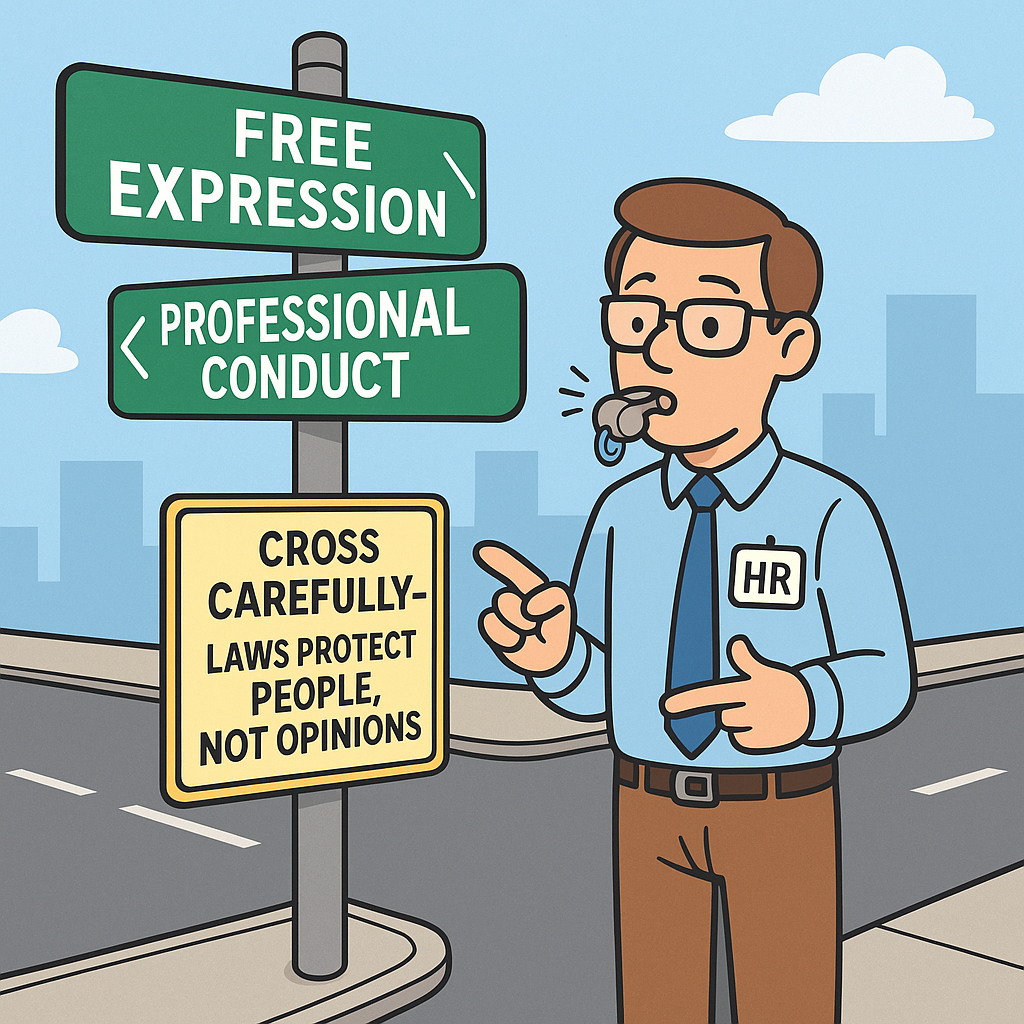
When a White Jewish university employee claimed discipline for racially charged remarks amounted to discrimination, the court disagreed. It called the case something else entirely, and in doing so, it drew an important boundary for every employer.
TL;DR: A federal court just clarified a point that often gets blurred when discipline involves speech: anti-discrimination laws protect people, not their opinions. These statutes guard employees from bias based on who they are, not from accountability for what they say. Employers can enforce civility and anti-harassment rules without fear of turning every disciplinary decision into a Title VII claim.
📄 Read the opinion (E.D. Pa. Aug. 27, 2025)
When “Free Speech” Meets Workplace Standards
A longtime faculty member at a private university faced discipline for what administrators called “flagrant unprofessional conduct.”
A charging letter and faculty hearing cited numerous public and classroom remarks that demeaned racial minorities, women, and LGBTQ individuals. Among them:
-
stating that the country would be “better off with more whites and fewer nonwhites”;
-
claiming it was “rational to be afraid of Black men in elevators”;
-
describing same-sex relationships as “selfish and not focused on family or community”; and
-
asserting that “the United States is better off with fewer Asians.”
A faculty board found that the comments violated university conduct and privacy policies and showed a lack of equitable respect toward students. The university imposed a one-year suspension at half pay, removed the employee’s named chair, and issued a public reprimand.
The employee then sued, claiming the discipline was race discrimination under Title VII, Title VI, and Section 1981, along with state-law claims for breach of contract and false-light invasion of privacy.
The Court Drew the Line: Status ≠ Speech
The judge dismissed the case outright: “The anti-discrimination statutes protect speakers, not speech.”
Federal civil-rights laws, the court explained, are designed to protect individuals from discrimination because of who they are — their race, color, religion, sex, or national origin — not because of what they say. There is no cause of action for “disparate treatment of speech conduct.”
The plaintiff had advanced two theories. First, she claimed she was discriminated against because of the racial content of her remarks, that the university punished her for speaking about certain races but not others. Specifically, she claimed that anti-Jewish speech was not subject to discipline while speech directed at other racial groups was. Second, she claimed she was disciplined because she is white and Jewish. The court found neither theory plausible.
On the first theory, the judge pointed to the plain language of the statutes. Title VII and its counterparts focus on the protected characteristic of the individual, not on the subject or viewpoint of the speech. Punishing offensive or racially charged comments is not discrimination against the speaker’s race; it is a response to conduct.
On the second theory, the court found no facts suggesting the employee’s race or religion motivated the discipline. Her allegations instead showed she was disciplined because of the content and impact of her remarks.
The court also rejected her attempt to compare herself to others who made controversial or antisemitic statements. Those individuals were not “similarly situated.” Their comments were isolated, political, and unrelated to the university community, while her remarks were repeated and directed at protected groups within it.
Finally, the judge dismissed an argument that her comments about affirmative action or minority groups were somehow “advocacy” for other races, calling that claim “implausible.” He wrote that “criticizing minorities does not equate to advocacy for them or for White people.”
Result: the federal discrimination claims were dismissed with prejudice, the state claims without prejudice, and the court denied leave to amend, finding any amendment would be futile.
What Employers Should Learn from This Decision
1️⃣ Discipline conduct, not viewpoints.
Employers may act on offensive or disruptive remarks when decisions are based on behavior, not beliefs. The law protects people, not opinions.
2️⃣ Offensive speech can still be harassment.
Racial or sexual comments, even in “discussion” form, can create a hostile environment. Free-speech arguments do not override workplace policies.
3️⃣ Consistency is your best defense.
Courts expect comparators to be nearly identical in role and conduct. Apply standards the same way to everyone.
4️⃣ The First Amendment rarely applies at work.
Private employers are not public forums, and even public entities can enforce professional standards when speech crosses the line.
Turning Principle into Practice
- Write and train for conduct. Keep policies focused on behavior, not ideology.
- Document the business reason. Tie discipline to policy violations, disruption, or unprofessional conduct.
- Teach supervisors to distinguish between speech as expression and speech as misconduct. Expression may be protected; misconduct disrupts or disrespects.
- Reinforce a respectful workplace culture through consistent enforcement.
The Bottom Line
Anti-discrimination laws protect people, not their opinions. Employers have both the authority and the obligation to act when speech undermines professionalism or respect in the workplace.