Search
 The Employer Handbook Blog
When an Applicant’s Medication Meets a “No Exceptions” Rule: What the EEOC Says Employers Can’t Do


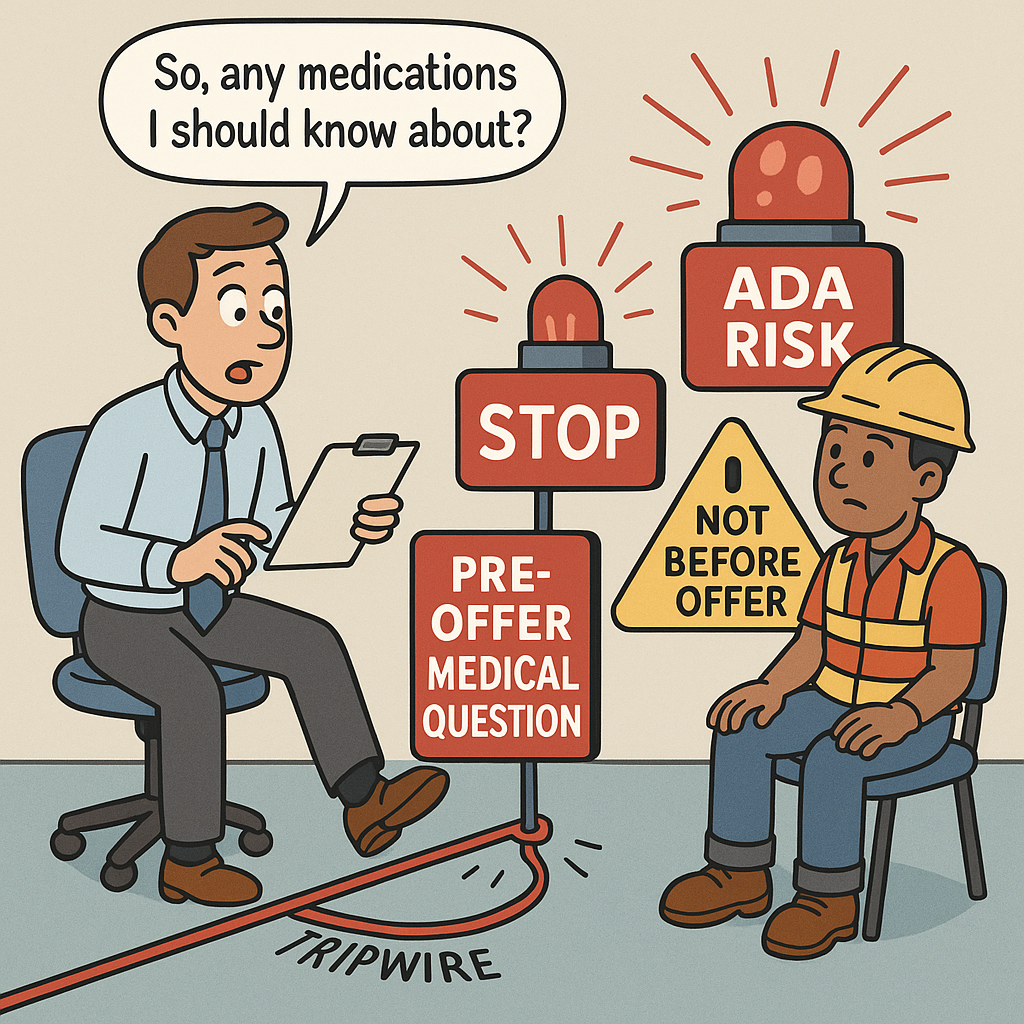
A single disclosure from a job applicant about her methadone prescription allegedly turned a routine interview into an ADA problem the EEOC now wants a court to resolve.
TL;DR: The EEOC has sued concrete-industry employers, alleging they refused to hire applicants who lawfully use methadone or other medication-assisted treatment (MAT) for opioid-use disorder, asked prohibited pre-offer medical questions, and enforced a blanket “no methadone” rule. This post also explains how a recent federal decision frames ADA claims involving MAT, why categorical bans often fail, and what the EEOC expects from employers navigating these issues.
📄 Read the official EEOC press release.
What the EEOC says happened
According to the EEOC, a job applicant for a laborer role was allegedly asked about her medications before any conditional offer was made. When she disclosed prescribed methadone, she was allegedly told she could not be hired due to an internal policy barring applicants who use methadone. A human-resources representative allegedly confirmed the same.
The EEOC also claims that a broader class of applicants was affected by this rule, which allegedly excluded individuals using methadone, Suboxone, or similar MAT medications.
The lawsuit asserts ADA violations tied to denial of hire, unlawful qualification standards, prohibited pre-offer inquiries, and the use of information obtained through those inquiries.
How a recent federal decision frames these issues — and how courts generally approach them
A federal decision involving similar allegations provides helpful context for understanding how methadone and medication-assisted treatment fit into the ADA framework. In analyzing the plaintiff’s claims, the court summarized how courts generally treat these issues.
First, the decision reiterates that methadone taken under medical supervision is not “illegal drug use” under the ADA. The statute excludes lawful, supervised use from the definition of illegal drug activity, and courts applying the ADA consistently recognize this distinction.
Second, the decision emphasized that blanket rules disqualifying applicants who use methadone can violate the ADA. Citing other cases, the court explained that applicants cannot be rejected solely because of prescribed methadone use without an individualized assessment tied to actual job requirements and safety considerations.
Third, the court noted that rescinding a job offer because of prescribed methadone use may support a “regarded as” disability claim. Courts evaluating similar scenarios have found that such actions often reflect assumptions about impairment rather than individualized, objective evaluation.
Finally, the court declined to dismiss a punitive-damages claim, observing that immediately withdrawing an offer after a methadone disclosure could plausibly show reckless indifference to federal rights. The court pointed to other decisions taking a similar approach and emphasized that whether punitive damages are appropriate depends on the factual record.
This decision does not resolve the EEOC’s new lawsuit, but it provides a framework for analyzing claims involving methadone and MAT — and why categorical rules often fail under that framework.
Employer takeaways
Review hiring and drug-testing practices
The EEOC has stressed that employers may not impose barriers that screen out applicants in recovery from opioid addiction — including those lawfully using methadone or other MAT medications. Automatic exclusions in this space are enforcement red flags.
Train interviewers to avoid pre-offer disability questions
The EEOC views pre-offer questions likely to elicit disability information as a serious violation. All applicants, with or without disabilities, are entitled to a hiring process free from those inquiries until a conditional offer is made.
Handle safety concerns with individualized, evidence-based assessment
The EEOC expects employers to evaluate actual, objective risks — not generalized assumptions about addiction or MAT medications. Safety concerns must be supported by individualized medical information obtained at the correct stage of the process.
Understand your responsibilities in labor markets affected by the opioid epidemic
The EEOC has emphasized its commitment to protecting workers in addiction recovery, particularly in industries and regions heavily impacted by opioid misuse. Employers in these environments should expect heightened scrutiny.
Recognize the risk of enhanced damages
Withdrawing an offer based on lawful MAT use — particularly without individualized assessment or in disregard of clear ADA rules — may lead to punitive damages claims the EEOC is prepared to pursue.
The bottom line
ADA compliance begins at the hiring stage. Employers relying on categorical restrictions or assumptions about methadone — rather than individualized, evidence-based assessment — risk exactly the type of scrutiny the EEOC is now bringing.