Search
 The Employer Handbook Blog
Unpaid Leave Won This ADA Case. It Shouldn’t Be Your First Move.


An excellent teacher with a progressive disability wanted paid leave to get a guide dog. Her employer offered unpaid leave instead. A federal appeals court just said that was enough.
TL;DR: A school district employee with Usher syndrome requested paid sick leave to attend a mandatory three-week guide-dog training. The district denied paid leave but granted unpaid leave as an ADA accommodation. The Sixth Circuit affirmed summary judgment for the employer, holding that unpaid leave was a reasonable accommodation because the employee offered no evidence linking paid leave to job performance, and the ADA does not require an employer to create a paid leave accommodation where none exists under its own sick-leave policy.
📄 Read the Sixth Circuit’s decision
A Twenty-Year Teacher, a Rare Disease, and a Guide Dog
The employee is an art teacher with more than two decades at an Ohio junior school. She suffers from Usher syndrome, a rare genetic disease causing progressive hearing and vision loss. The district had accommodated her for years: specialized lighting, a larger monitor, software to convert visual files to accessible formats.
By 2022, her mobility trainer recommended she apply for a guide dog. After a five-day orientation (approved as paid sick leave), she was matched with a dog. The catch: she needed a separate three-week residential training for deaf-blind individuals in Michigan. It could not be rescheduled, and missing it meant potentially waiting years for another placement.
She requested thirteen paid sick days. The HR director denied it: guide-dog training was not a “personal illness” under the district’s sick-leave policy, Ohio law, or the collective-bargaining agreement. He granted unpaid leave as an ADA accommodation. She attended, got the dog, and sued.
Why Paid Leave Was Never on the Table
The Sixth Circuit affirmed summary judgment for the employer.
As the court put it: “The ADA’s text makes clear that an accommodation must be work related, meaning that it will allow an employee to ‘perform the essential functions of the’ relevant job.”
The employee argued that paid leave was medically necessary. The court was unpersuaded: she continued to perform her job well, and she “[offered] no evidence linking” paid leave “to the performance of her job.” Her doctor’s letter said nothing about whether the leave needed to be paid or unpaid. Because pay was never connected to her ability to do the job, paid leave was not an available accommodation under the ADA. The district’s sick-leave policy didn’t cover guide-dog training, and the ADA didn’t require the employer to create one.
The employee’s fallback argument was that three weeks without income made unpaid leave inadequate. The court rejected it: that hardship arose “outside the work environment” and plays no role in the reasonableness calculus.
What Employers Should Take From This
What the doctor’s letter didn’t say cost the employee her case
Supporting medical documentation needs to do more than confirm a diagnosis or endorse a treatment plan. It should explain why the specific accommodation requested is necessary for the employee to perform the job. A letter that skips that connection doesn’t carry the weight employees expect it to.
Unpaid leave should be the last accommodation on the list, not the first
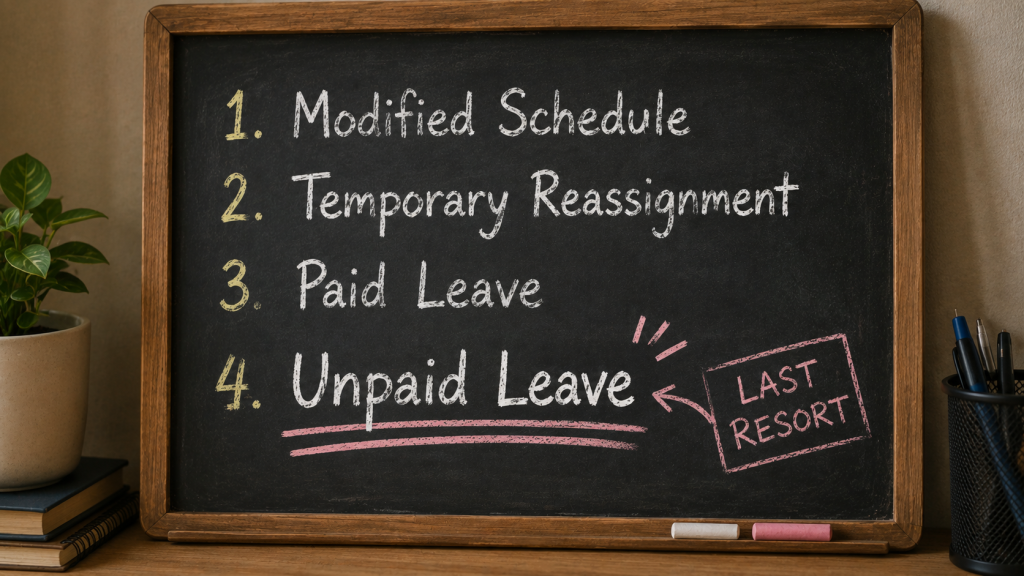
When options exist, prefer those that preserve pay and benefits: a modified schedule, a temporary reassignment, paid leave if the policy covers it. Unpaid leave is a last resort. This case’s outcome reflects the specific facts, not a general license to reach for unpaid leave whenever it’s cheaper.
Sick-leave policy language can shape the outcome
Vague terms like “medical reasons” or “health condition” give employees room to argue almost any medically connected absence qualifies for paid leave. The employer here won in part because its policy had a defined, consistent scope. Audit your language. And be careful about exceptions: employers that routinely make informal exceptions to their sick-leave policies may find it harder to deny one when a disability is in the picture.
The employer won this case. That doesn’t mean unpaid leave was the right first call — it means the employee couldn’t prove it was the wrong one.