Search
 The Employer Handbook Blog
Did Interviewers Say the Quiet Parts Out Loud? The EEO-1 Data May Have Confirmed the Rest.


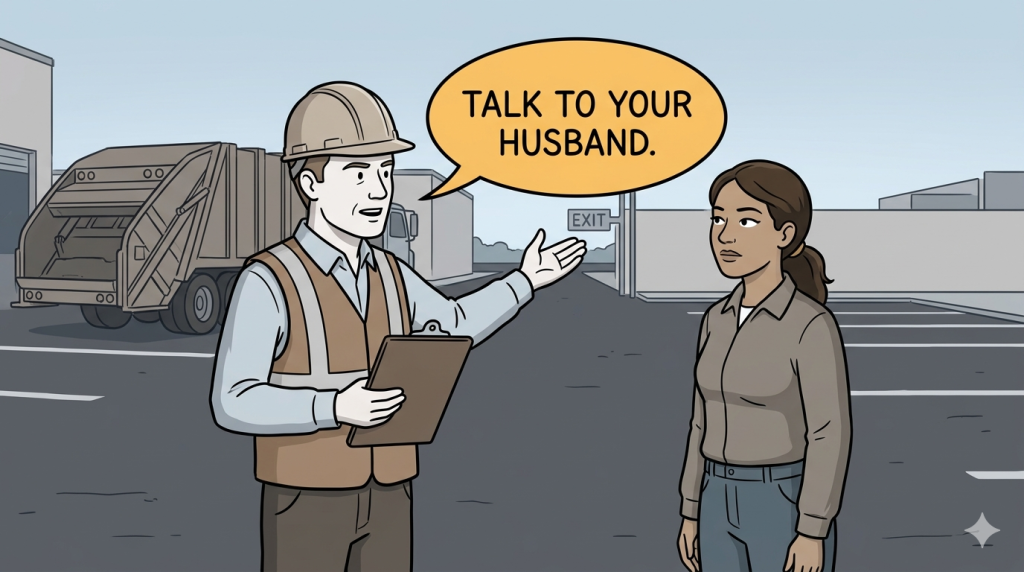
According to the EEOC, a waste management company hadn’t hired a female garbage truck driver in years, and its interviews showed why: a manager told one qualified female applicant to think carefully, talk to her husband, and let him know if she still wanted the job. She did. The company hired a man. The case settled for $200,000.
This week is EEOC Settlement Week on The Employer Handbook: one recent EEOC settlement per day, with practical takeaways for employers. Today is the final installment: a $200,000 Title VII consent decree over a waste management company’s alleged pattern of rejecting qualified female applicants for driver positions.
TL;DR: According to the EEOC’s complaint, a waste management company told a qualified female applicant during her interview that it had no female drivers, would have to build a women’s shower if it hired her, and that she should talk to her husband before deciding. She followed up; the employer went silent, sent a generic rejection, and hired a less-qualified male. EEO-1 data showed near-zero female drivers for four consecutive years. The EEOC sued under Title VII and the case settled for $200,000 just weeks before trial.
She Had More Experience Than the Man Who Got the Job. She Also Got Told to Talk to Her Husband.
According to the complaint, the applicant applied for a front loader garbage truck driver position at the employer’s Springfield, Missouri facility in April 2020. She had more CDL experience, more large commercial truck driving experience, and had held her CDL longer than the male candidate ultimately selected.
The interview was conducted by the operations manager and two other male representatives. According to the complaint, the men told her no female drivers were currently employed, noted that a prior female driver had quit without notice, and said the company would have to build a women’s shower if it hired a female driver. After a ride-along, the operations manager told her to think seriously about the job, talk to her husband, and call the next day.
She did. She left a voicemail and sent a text. According to the complaint, no one responded. She received a generic rejection email and the employer hired a male for the position. The complaint also alleged that EEO-1 data showed 54 to 59 male drivers per year from 2018 to 2021 and no female drivers in three of the four years, and that excluding women from driver positions was the employer’s standard operating procedure.
The EEOC sued in September 2023. The parties settled through a consent decree entered April 9, 2026, in the U.S. District Court for the Western District of Missouri, just weeks before trial. The $200,000 covers the primary plaintiff and four additional aggrieved applicants, and the three-year decree requires standardized interview questions, an applicant tracking system, annual Title VII training, and semi-annual EEOC reporting.
The Interview Did Most of the Work for the EEOC
Three things worth taking from what happened in that interview room:
Telling an applicant to consult her husband before deciding is sex stereotyping
Title VII prohibits employment decisions rooted in sex-based assumptions, including assumptions about household decision-making. This kind of comment doesn’t require discriminatory intent to create liability. Interviewers need to know which topics are prohibited, not just which outcomes are forbidden.
The shower comment was not a neutral operational observation
Framing a female applicant’s candidacy around the accommodations her gender requires signals that hiring a woman is a burden. Courts and the EEOC treat this as evidence of discriminatory intent. If an interviewer’s first reaction to a female applicant is to identify the complications her gender creates, that needs to be in training before it ends up in a deposition.
EEO-1 data can turn a single rejection into a pattern-or-practice claim
Four consecutive years of near-zero female representation in a job category is not just a compliance metric. In a discrimination case, it becomes evidence. Employers who don’t monitor workforce composition by job category may not see a pattern-or-practice problem developing until the EEOC identifies it for them.
This case settled weeks before trial. The facts in the complaint are the kind that tend to resonate with juries.