Search
 The Employer Handbook Blog
The $300,000 Mistake That Every Employment Defense Lawyer Should Read About


A jury awarded a sexual harassment plaintiff $831,028. The employer tried to knock that down to $181,028 using a Title VII damages cap. A federal appeals court just said: you waived it.
TL;DR: The Eleventh Circuit reversed a post-trial damages reduction, holding that Title VII’s employee-headcount damages cap is a waivable affirmative defense. Because the employer never pleaded the cap in its answer, never raised it in the pretrial stipulation, and never proposed jury instructions on it, it forfeited the benefit of the cap. The reinstated award is $481,028.
Four Months, a Lot of Harassment, and a Jury That Sided with the Plaintiff
The employee worked at a car dealership in Miami for about four months. During that time, the manager and colleagues subjected her to near-constant harassment. They called her “hot for an 18-year-old,” forced her to accompany male customers on test drives and use her looks to sell cars, and spoke to her in degrading tones. A manager once proposed she hand out business cards in a bikini. The harassment turned physical: managers massaged her shoulders, grabbed and kissed her in the parking lot after work, and touched her backside. She eventually quit and sued the employer under Title VII and the Florida Civil Rights Act (FCRA).
A jury awarded her $81,028 in compensatory damages and $750,000 in punitive damages. After trial, the employer moved to reduce the award, arguing Title VII capped its damages at $50,000 because it had fewer than 101 employees. The district court agreed and reduced the total to $181,028. The Eleventh Circuit reversed.
The Cap Is Real. So Is the Waiver.
Title VII limits the combined compensatory and punitive damages available against smaller employers. For employers with fewer than 101 employees, that cap is $50,000. For employers with between 101 and 200 employees, it’s $100,000. The cap scales up from there, topping out at $300,000 for employers with more than 500 employees.
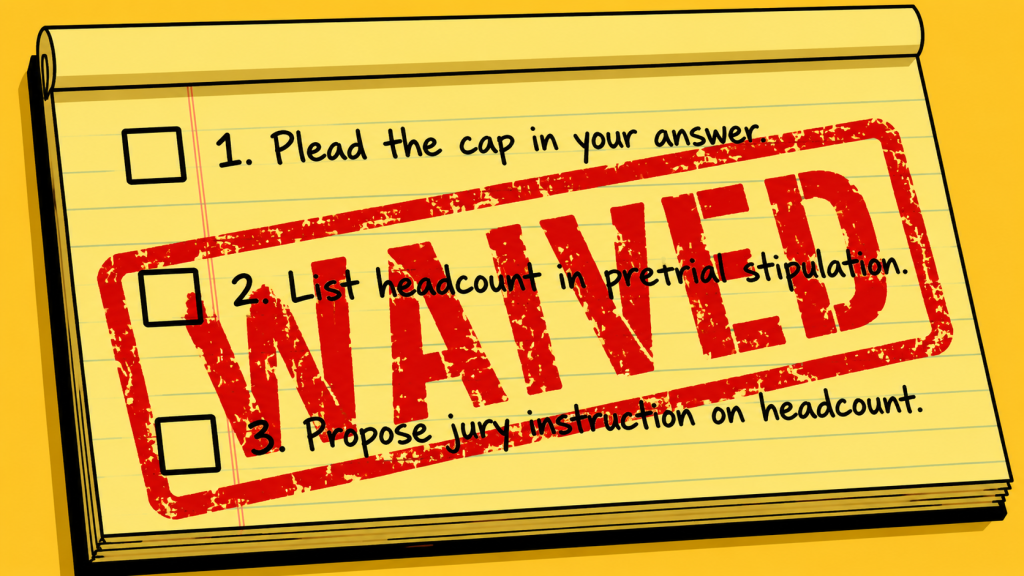
What the employer here missed, according to the appellate court, is that the cap is an affirmative defense, not an automatic protection. To use it, an employer must plead it in its answer, identify employee headcount as a fact issue in the pretrial stipulation, and submit jury instructions on it. This employer did none of those things. The manager testified at trial that the dealership employed around twenty people, but the jury never had the opportunity to make a finding on that number. By the time the employer tried to invoke the cap post-trial, it was too late. The court applied the correct maximum: $481,028, combining the available limits under both Title VII and the FCRA.
A Checklist for Defense Counsel: Three Ways to Avoid Losing the Title VII Damages Cap
The cap exists for a reason. Losing it through a procedural oversight is an entirely avoidable outcome.
The employee-headcount cap must be pleaded as an affirmative defense or it’s gone
This is now settled law in the Eleventh Circuit, and the majority of federal circuits that have addressed the question have reached the same conclusion. If your answer doesn’t include the cap as an affirmative defense, you’ve waived it. This applies even if the facts that would support the cap come out at trial. The plaintiff has to know early enough to contest the headcount, and without notice in the pleadings, that opportunity never arises.
Pretrial stipulations are where affirmative defenses live or die
The Eleventh Circuit identified the pretrial stipulation failure as a second, independent basis for the waiver finding here. The pretrial stipulation frames the issues for trial. If employee headcount isn’t listed as a disputed fact, the jury never decides it. That’s true regardless of circuit.
Witness testimony at trial doesn’t substitute for a jury instruction
The manager testified that the dealership had about twenty employees. The Eleventh Circuit said that wasn’t enough. Without a jury instruction directing jurors to determine the headcount, they never had the opportunity to make that finding, and the plaintiff never had the opportunity to contest it. Invoking the cap after the verdict, without any of the procedural groundwork, is too late in any court.
Title VII’s damages cap is a meaningful protection for smaller employers. It’s also one that requires careful attention to procedure well before the verdict comes in.