Search
 The Employer Handbook Blog
Join PierFerd’s Inaugural Immigration Forum: What Employers Need to Know About the New H-1B Landscape


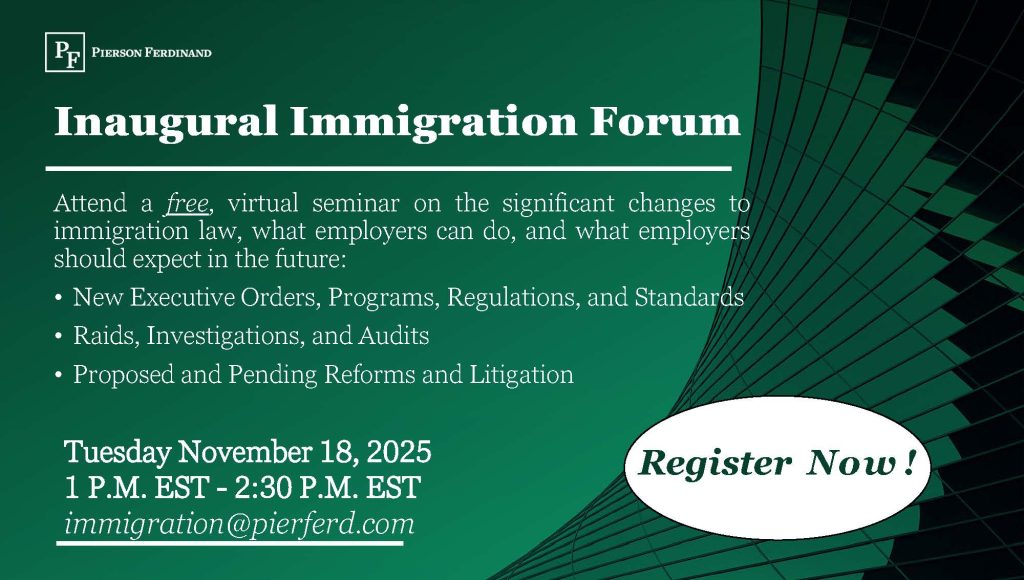
Recent federal actions targeting the H-1B visa program have raised new questions for employers. To help make sense of these developments, the Pierson Ferdinand immigration team — including the author of the firm’s latest client alert — will host a virtual forum on what employers should expect and how to prepare.
The Pierson Ferdinand Immigration Practice Group is hosting a free virtual forum for employers, HR professionals, and in-house counsel navigating significant changes in U.S. immigration law — including new H-1B rules, executive orders, audits, and litigation trends.
📅 Tuesday, November 18, 2025 | 1 P.M. – 2:30 P.M. EST
📧 immigration@pierferd.com
🖱️ Register now: https://bit.ly/PFImmigrationForum
Read Sanford’s full client alert:
https://pierferd.com/insights/president-trumps-h-1b-proclamation
Recent developments: Sanford’s client alert
In his October 27 client alert, Founding Partner Sanford Posner described how two recent federal actions have placed the H-1B nonimmigrant visa program “under the microscope,” creating uncertainty for employers and foreign nationals alike.
1. A proposed shift to a salary-based lottery
At the end of summer, a proposal was submitted to change how H-1B visas are allocated. Under current regulations, 85,000 slots are available each fiscal year — 65,000 through the general lottery and 20,000 reserved for advanced-degree holders from U.S. universities. Advanced-degree applicants are entered into the “Master’s Cap” lottery first and, if not selected, move into the general pool, giving them two chances at selection.
The new proposal, which entered a 30-day public comment period beginning September 24, 2025, would move the lottery from a degree-based system to one focused on salary level. The administration argues that this change would help prevent employers from undercutting U.S. wages by hiring foreign workers at lower pay rates.
Employers offering higher wages would receive more lottery entries. An employer paying a Level 4 (highest) wage would have four entries in the lottery, while one paying a Level 1 (lowest) wage would have only one. The aim, Sanford noted, is to promote higher wages within the program.
The proposal also directs the Department of Labor (DOL) to issue new wage tables once the regulations are finalized, likely resulting in higher salary levels. Employers would be required to pay the higher of either the actual wage or the prevailing wage for the position. Sanford expects litigation to follow once the rule is finalized.
2. The H-1B Proclamation and the $100,000 filing fee
Sanford also discussed the September 19, 2025 H-1B Proclamation, which requires employers to pay a $100,000 filing fee for H-1B petitions filed after September 21, 2025, including certain petitions for foreign nationals outside the United States.
The announcement triggered immediate concern among employers and industry groups. Over the following weekend, U.S. CIS issued guidance clarifying that the fee does not apply to current H-1B holders or those filing extensions, even if they later travel abroad to obtain a visa. Instead, it applies only to new petitions filed for beneficiaries outside the United States.
Several lawsuits were filed in October challenging the fee, which Sanford noted would have a disparate impact on universities, hospitals, and smaller employers compared with large technology companies. The administration sought to temper the rule by creating a carve-out for H-1B holders working in the national interest, followed by October 20 guidance further narrowing its reach:
“The Proclamation also does not apply to a petition filed at or after 12:01 a.m. eastern daylight time on September 21, 2025, that is requesting an amendment, change of status, or extension of stay for an alien inside the United States…”
Sanford explained that this clarification effectively limits the $100,000 fee to foreign nationals applying for new H-1B visas from outside the U.S., and that further exemptions are likely. His message to employers was straightforward:
“Employers should be wary of any new immigration proclamations. Do not follow a knee-jerk reaction. Wait for some of the dust to settle before charting a path forward. Cooler heads seem to prevail in this arena.”
The Inaugural Immigration Forum
The November 18 PierFerd Immigration Forum will expand on the issues raised in Sanford’s alert and offer employers practical steps for adapting to these and other immigration policy changes.
The 90-minute virtual program will cover:
- New executive orders, programs, and regulations affecting visa sponsorship;
- Worksite raids, investigations, and audits, and how to prepare; and
- Pending reforms and litigation likely to shape compliance strategies in 2026 .
Who should attend
- HR professionals managing visa sponsorship or global mobility programs;
- In-house counsel overseeing immigration compliance;
- Business leaders planning for international hiring or workforce changes.
Presenters
Pierson Ferdinand Immigration Practice Group:
- Sanford Posner, Founding Partner – policy, litigation, and advocacy
- Giovanni Antonucci Di Cesare, Partner – business immigration and cross-border employment
- Allison Bustin, Junior Partner – immigration strategy and compliance
For questions or topic suggestions, contact immigration@pierferd.com.
Bottom line
From salary-based lottery proposals to six-figure filing fees, employers face new challenges in the H-1B process.
Join the Inaugural Pierson Ferdinand Immigration Forum on November 18 at 1 P.M. EST for practical guidance from the firm’s immigration team on how to prepare for what’s next.
🖱️ Register here: https://bit.ly/PFImmigrationForum
And if you’d like a personal introduction to Sanford, Giovanni, or Allison, email me at eric.meyer@pierferd.com — I’ll be glad to connect you with our immigration team.