Search
 The Employer Handbook Blog
Is Your Hiring Assessment a Lie Detector in Disguise? It Could Be a Class Action Time Bomb⏰💣


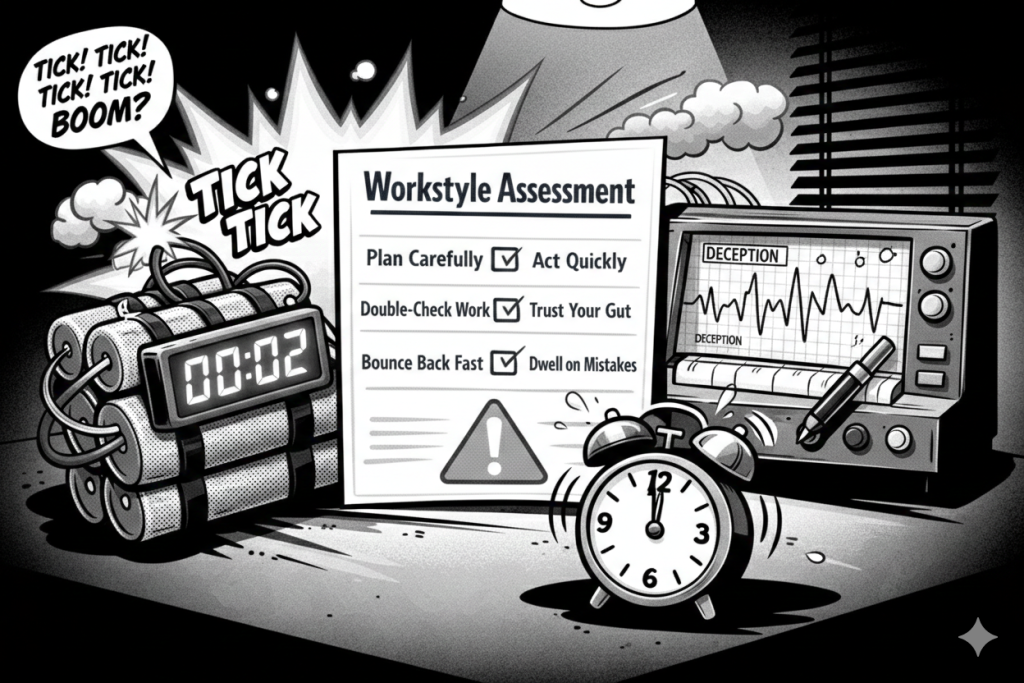
Many employers rely on hiring assessments to gauge fit. But what if those tools are viewed as unlawful lie detector tests? A recent Massachusetts ruling should give you pause before you rely on a “workstyle” assessment.
TL;DR: A Massachusetts federal court denied a motion to dismiss and allowed a putative class action to proceed, holding that a “workstyle” hiring assessment plausibly fits the state’s Lie Detector Statute (Mass. Gen. Laws ch. 149, § 19B). If your assessments touch on honesty, authenticity, or response consistency, they may create statutory risk.
How could a workstyle test become a “lie detector”?
Massachusetts law prohibits employers from using lie detector tests in hiring. The statute is not limited to polygraphs. It covers any device or written examination used to detect deception or verify honesty.
In this case, a job applicant alleged that a required “Workstyle Assessment” qualified as a prohibited lie detector test. The assessment asked applicants to rate statements about planning, persistence, reliability, and emotional awareness.
The employer allegedly also told applicants that it used mechanisms to detect suspicious behavior and responses, including attempts to fabricate or use outside assistance. The court held that, at the pleading stage, those allegations were enough to plausibly fit within the statute’s broad definition.
This was not a merits ruling. But the case moves forward.
The statutory language includes “any written examination” used to assist in detecting deception or verifying truthfulness. A personality or workstyle assessment that markets itself as measuring authenticity or flags inconsistent responses can be framed that way.
The class action risk
The case was filed as a putative class action on behalf of applicants who applied for Massachusetts-based roles and, in a subclass, those who completed the assessment.
If the theory sticks, exposure is not limited to one applicant. It extends to every applicant who took the assessment during the limitations period. The statute provides for damages, a minimum award per violation, and attorneys’ fees.
When the alleged violation is embedded in a standardized hiring process, scale is the risk.
Practical employer implications
- Review what your tools claim to measure. If your pre-hire assessments evaluate honesty, authenticity, or flag deception, consider whether they could fall within broad lie detector definitions, even if that was not your intent.
- Tighten the language. Do not describe personality or workstyle tools as verifying truthfulness or detecting dishonesty. Marketing copy, applicant disclosures, and internal documentation all matter.
- Assess exposure at scale. If the tool is used across roles or jurisdictions, a single statutory theory can multiply quickly in a class action.
This ruling is limited to Massachusetts and remains at the pleading stage. But it shows how easily a modern hiring tool can be recast under an old statute. If your assessments touch on honesty or response consistency, review them now, not after a class complaint is filed.