Search
 The Employer Handbook Blog
If Prayer Isn’t Enough to Support a Religious Exemption Request, What Is?


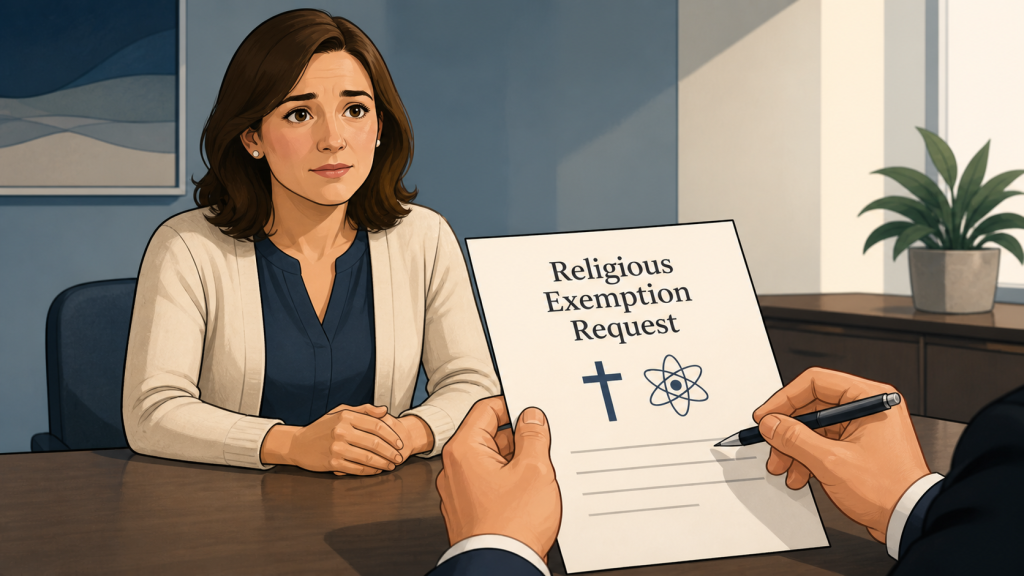
When does a religious exemption request stop being religious? A federal appeals court just answered that question in a way that eight of its own judges found alarming.
TL;DR: The Ninth Circuit denied rehearing en banc in a Title VII religious accommodation case, leaving in place a panel decision that dismissed an employee’s failure-to-accommodate claim arising from a COVID-19 vaccine mandate. The panel held that the employee’s objection to weekly nasal testing was “purely secular” because it rested on her interpretation of medical research, even though she framed it in religious terms and cited prayer. Eight judges dissented across two opinions, arguing the panel’s test requires courts to judge the authenticity of religious belief, which is precisely what Title VII forbids. The circuit split puts the Ninth Circuit at odds with most of the country.
The Employee, the Vaccine Mandate, and the Testing Condition
The employee was a data-privacy executive at a healthcare employer whose job did not require patient contact. She sometimes worked remotely. When Oregon implemented a healthcare worker vaccine mandate, she requested a religious exemption, citing her Christian belief that her body is a temple of the Holy Spirit. The employer approved it with conditions: wear PPE in the office and submit to weekly nasal antigen testing.
She then sought a second exemption, from the testing requirement. The only testing option involved a swab dipped in ethylene oxide, which she described as a carcinogen. After prayer, she concluded the testing conflicted with her Christian duty to protect her body. She offered alternatives: saliva testing or full remote work. The employer refused both and terminated her.
She sued for religious discrimination under Title VII. The district court dismissed the case, finding her objection was based on personal scientific judgment, not religious belief. The Ninth Circuit panel affirmed. The full court declined to rehear it en banc, with eight judges dissenting across two opinions.
What the Panel Held, and Why Eight Judges Pushed Back
The panel drew a line between religious belief and secular motivation. Prayer, it held, is not enough to elevate a personal medical judgment into a protected religious conviction. Because the employee’s core objection rested on her reading of scientific evidence about ethylene oxide, the panel found it “purely secular,” regardless of her religious framing.
The dissenters argued the panel’s test requires courts to evaluate whether a belief is “truly religious,” which is precisely what Title VII forbids. The First, Fourth, Sixth, Seventh, and Eighth Circuits have all recognized that a religious objection doesn’t lose its protected status simply because it also rests on secular considerations. The circuit split puts the Ninth Circuit at odds with most of the country.
Three Things to Get Right Before the Next Exemption Request Arrives
A belief rooted in both faith and science is still a religious belief in most circuits. The Ninth Circuit panel’s approach would strip Title VII protection from any exemption request that also rests on secular considerations. Most other circuits reject that reading. If your process screens out requests with a scientific or medical component, it’s out of step with most jurisdictions.
The sincerity inquiry is not the right place to spend your energy. Courts are deeply reluctant to second-guess a plaintiff’s account of her own convictions, and an aggressive sincerity challenge can itself become evidence of discriminatory intent. Focus on undue hardship instead.
The accommodation process is where this case should have been decided. When an employee proposes alternatives, the employer’s job is to engage with them in good faith, explore whether they work, document why they don’t, and build a record around undue hardship if the two sides can’t agree on an accommodation.
The circuit split on this standard isn’t going away. Until the Supreme Court weighs in, “purely secular” is not a safe harbor outside the Ninth Circuit.