Search
 The Employer Handbook Blog

Can an Employer Use Age to Decide Who Gets a Fitness-for-Duty Exam?


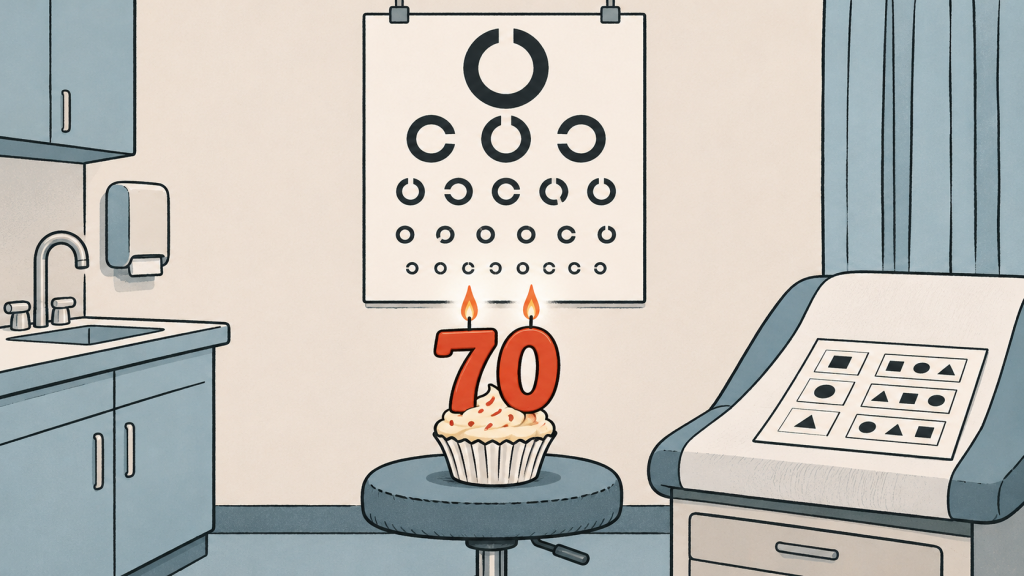
At one hospital, clinicians 70 and older needed vision and cognitive tests to get or keep clinical privileges. They had to take the tests every two years. The EEOC challenged the policy.
TL;DR: A federal court denied both sides’ motions for summary judgment in an ADA and ADEA challenge to mandatory testing for clinicians 70 and older. Disputes remain over whether the tests protect patients, whether 70 is a defensible cutoff, and whether individual assessments could do the job.
What happened when a clinician turned 70
Under the hospital’s 2016 Late Career Practitioner Policy, staff used birth dates to identify who had to be tested. For current clinicians, testing began at their next renewal after turning 70. An application was incomplete until both exams were done.
Clinicians booked their own eye exam and used a hospital-designated provider for cognitive testing. The cognitive tests looked at learning, memory, and skills such as planning and organizing. Concerning scores could lead to more testing and a medical staff review of the clinician’s privileges.
The hospital said screening could catch decline that clinicians themselves might miss. The EEOC sued in 2020, pointing to the hospital’s strong safety record.
Under the ADA, the hospital has to justify the test and its scope
Patient safety can justify a medical exam for a current employee. Under the ADA, the employer has to show that the exam relates to the job, is reasonably effective at addressing the safety concern, and is no broader or more intrusive than necessary. For group screening, the employer also has to show why the safety concern justifies testing that group.
The hospital’s experts saw the tests as a useful first step. The EEOC’s expert questioned whether the scores could reliably tell the hospital who could practice safely. The policy also covered some clinicians who taught and had no patients of their own. The hospital said those clinicians train the people who treat patients. The court wanted to know how many clinicians fell into that group and how their work affected patient care.
The EEOC argued that some clinicians kept practicing despite concerning scores. That could weaken the hospital’s argument that screening was necessary for patient safety.
Under the ADEA, the hospital also has to justify using age
The court had already found that the age trigger supported an initial showing of age discrimination. The hospital invoked the bona fide occupational qualification (BFOQ) defense. To succeed on that defense as argued here, the hospital had to show that age 70 was a reliable stand-in for whether clinicians could work safely and that assessing clinicians individually was impossible or highly impractical.
The EEOC questioned whether studies pooling people in their 70s, 80s, and 90s justified starting at 70. Its expert found no statistically significant difference in how often physicians below and above the cutoff were involved in peer review. The hospital’s expert disputed that analysis.
The EEOC also argued that existing reviews could assess clinicians individually. The hospital said those reviews might miss decline until a problem surfaced.
Before requiring an exam, ask what it tells you about the job, why you’re testing that group, and what your current reviews already catch.
What to check before requiring a medical exam
The test has to tell you something about the job
Before requiring a test, ask what a low score would tell you about the employee’s ability to perform a specific part of the job safely. The answer may differ for a clinician who treats patients and one who teaches.
The group you test needs a justification
If a policy singles out a group for testing, identify the evidence that links that group to the specific safety concern. If you’re using an age cutoff, ask what the evidence says about people at that age.
What would mandatory testing add?
Start with the reviews you already use to evaluate individual employees. If those reviews can flag the same safety concerns early, what would a mandatory exam catch that they miss?
Decide in advance what would warrant a closer look. A documented medication error or repeated trouble following a safety protocol could prompt a review. Record what happened and why it raises a safety concern.