Search
 The Employer Handbook Blog
A Railroad Thought It Had Cracked the Code on FMLA Dishonesty. A Jury Gets to Decide If It Did.


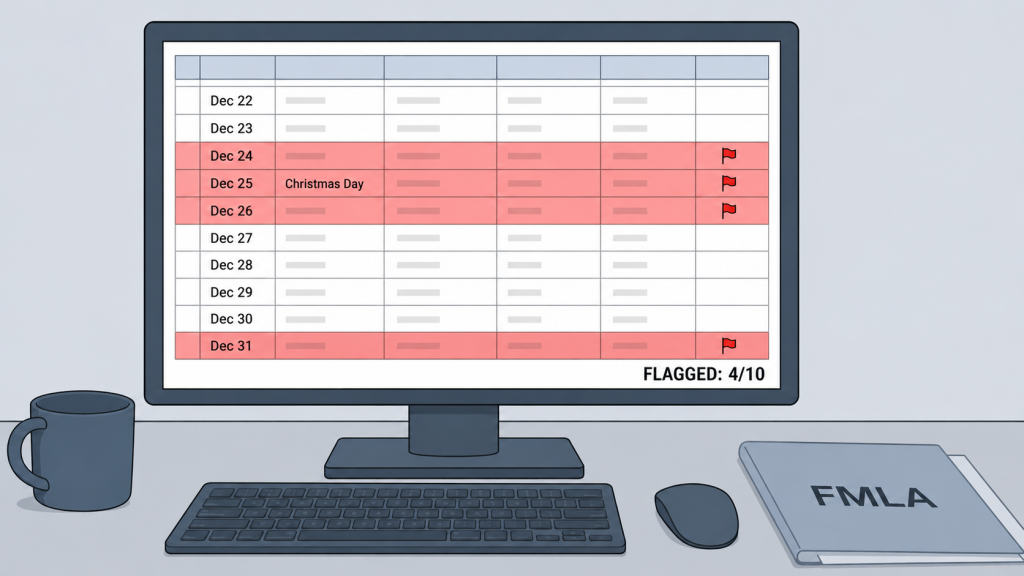
Roughly one in ten of a railroad’s train and engine employees marked off using FMLA leave on Christmas Day. The railroad ran that spike through an algorithm, then a hearing, then a dishonesty finding, and a federal court just said a jury needs to check that whole chain.
TL;DR: A federal court refused to hand a freight railroad a clean win on FMLA discipline, letting three employees take their retaliation claims to a jury while dismissing a separate interference claim built on the same facts.
An Algorithm Flagged the Holidays. A Jury Will Decide the Rest.
Three employees at a large freight railroad had approved FMLA leave, for a father with dementia, a chronic intestinal condition, and a mother needing extensive caregiving. All three marked off using that leave on multiple holidays over the 2017 to 2018 season, and a company algorithm flagged all three for suspected leave misuse.
A federal court has now ruled on that discipline: summary judgment for the railroad on the FMLA interference claim, but not on retaliation, which sends the plaintiffs to a jury trial.
The Hearing Officer Got His Questions From the Prosecution
About 10% of the railroad’s train and engine workforce marked off for FMLA leave on Christmas Day, versus fewer than 200 employees the week before. That spike caught a manager’s attention, and she built a leave-misuse-detection algorithm to flag anyone who used FMLA leave on four of the ten most recent holidays.
Each flagged employee was pulled from service, charged with dishonesty, and given a hearing. The hearing officer, a company manager, both ran the hearing and questioned witnesses, and the railroad’s own witness supplied him with the “talking points” to ask her. One employee won a not-proven finding from that hearing officer; labor relations reversed it anyway, without explanation, and fired him.
One Claim Folded. The Other Wasn’t So Simple.
Interference was the easy call. The employees never argued they’d been blocked from taking leave, only that they were punished for using it, and on those facts the two theories “effectively merge into one claim, which sounds in retaliation, not interference.”
Retaliation was the harder question. Under the “honest belief” doctrine, an employer can defeat an FMLA retaliation claim by showing it made a reasonably informed decision that an employee misused leave, even if that belief later proves wrong. The court found that “[the railroad]’s internal investigative process created a pervasive structural risk of pro-employer bias,” and agreed that “[the railroad] focused on employees’ use of FMLA leave on holidays without considering context.” Those two flaws were enough to send the honest-belief question to a jury.
Leave-abuse investigations are still fair game. The fix is structural: separate the people building the case from the people deciding it, and pull the full leave history before charging anyone, not just the holidays that make the case.
A Hearing Officer Working From the Investigator’s Script Isn’t Independent
The employee who built the case and testified against the accused worker also supplied the hearing officer’s questions, so the formally separate decisionmaker was really just reading a script. Separate those roles in practice, not just on the org chart, before the next investigation.
A Leave-Misuse Algorithm That Ignores Non-Holiday Leave Invites Its Own Rebuttal
The railroad’s tool flagged holiday use without comparing it to total leave for the year. Run any automated leave-misuse flag both ways, holiday-only and year-round, before relying on it at a hearing.
An Unexplained Reversal of Your Own Hearing Officer Is a Gift to Plaintiff’s Counsel
Labor relations overturned a hearing officer’s finding without stating a reason, and that silence became evidence for the jury. If a reviewer is going to reverse a factfinder, put the reasoning in writing, or expect a court to treat it as a foregone conclusion.
An algorithm can flag a pattern. Proving that pattern was dishonesty, and not just bad timing, is still the railroad’s job, and now it will have to do that in front of a jury.