Search
 The Employer Handbook Blog
A Bad Comparator and Ugly Timing Can Wreck a Good Layoff


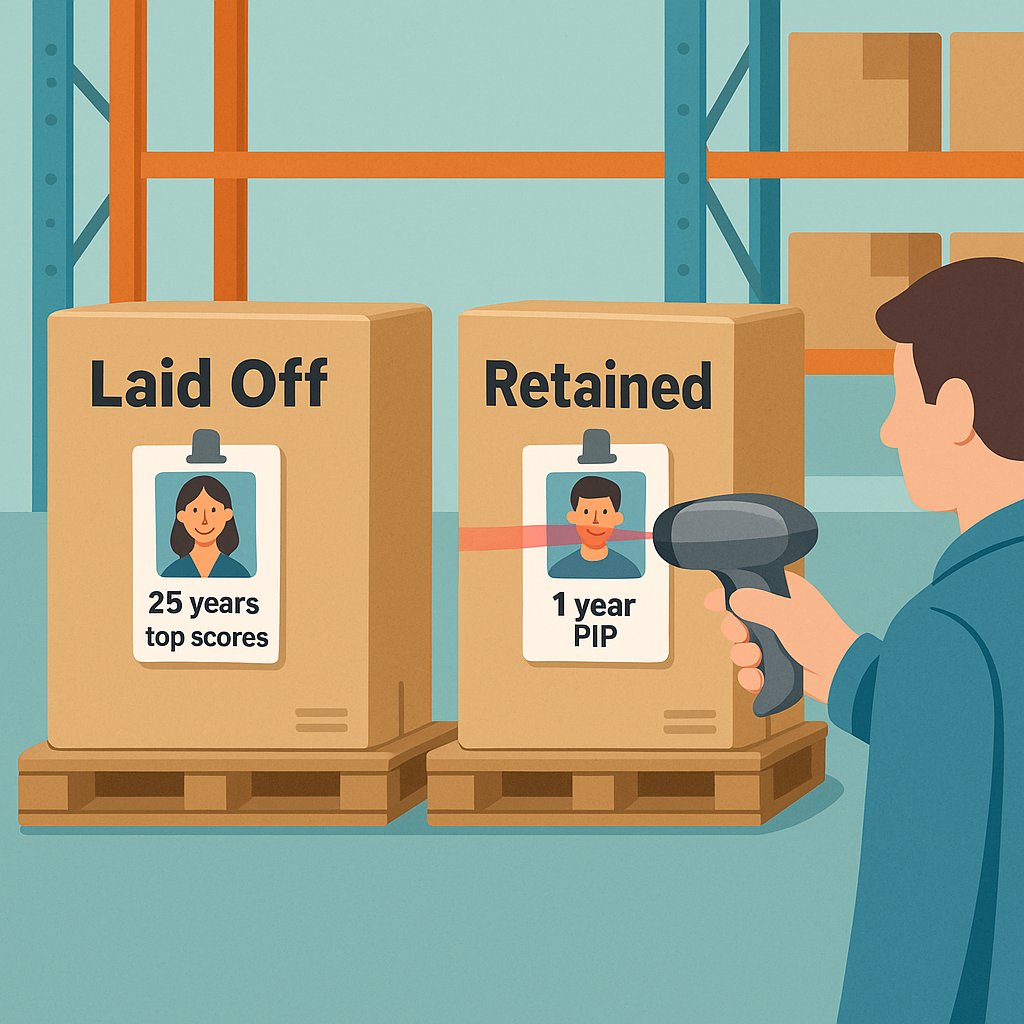
If you keep one employee and lay off another, you need to be able to explain why. Courts don’t expect employees to be identical, but they will take a close look at whether your comparisons—and your process—hold up.
TL;DR: A 25-year warehouse employee with a long record of strong reviews and near-perfect attendance was laid off during a reduction in force. Her less experienced male coworker—who had been demoted, placed on a performance plan, and earned more—kept his job. She sued for gender discrimination. The Sixth Circuit found enough inconsistencies to let a jury decide.
📄 Read the court’s decision
A longtime employee with strong reviews gets cut. Her less experienced coworker stays.
The plaintiff had 25 years of experience, near-perfect attendance, and consistently positive performance reviews. Just before the layoff, her direct supervisor rated her tied for the highest score in the department.
But on a separate rating sheet—completed by the plant manager after HR had already drafted and approved her severance agreement—she received the lowest score on the team. That conflict became central to the case.
The male coworker who was retained had:
- Less than a year of experience in the department
- Been demoted from a previous position
- Been placed on a performance improvement plan
- A higher hourly wage: $27 compared to her $21.58
She sued under Title VII and the Equal Pay Act. The district court granted summary judgment for the employer. The Sixth Circuit reversed.
Court Rejects Narrow View of Who Counts as a Comparator
The employer argued that the male coworker wasn’t similarly situated because he had a forklift license, more SAP experience, and prior supervisory duties. The Sixth Circuit disagreed.
The court noted that both employees worked in the same warehouse, reported to the same manager, were evaluated by the same decisionmaker using the same standards, and had overlapping job duties involving inbound and outbound materials, shipping, receiving, and labeling.
While one handled inbound and the other outbound, both roles fell within the same job family and shared the same expectations. The court also found that differences in SAP and forklift experience were minor, and the male coworker’s demotion and performance issues weakened the employer’s claim that he was more qualified.
What mattered to the court:
Title VII doesn’t require “exact correlation,” and comparators can’t be dismissed based on narrow distinctions. A jury could reasonably find that these two employees were similarly situated in all relevant respects.
Employer Takeaways
Expect heightened scrutiny of inconsistent documentation—whether from plaintiff’s counsel, judges, or juries.
If a performance review praises an employee’s teamwork but a layoff rating contradicts that without explanation, expect it to be challenged. In this case, that inconsistency helped keep the claim alive.
Don’t backfill your justification.
The rating sheet that supposedly justified the layoff was completed after the severance agreement had already been approved. That timing made it look like a justification, not a reason.
Choose comparators based on substance, not spin.
The employer pointed to differences in forklift licensing, SAP training, and supervisory experience. But the court noted that neither role required those distinctions, and the company never explained why they mattered. What did matter? That both employees did overlapping work, were subject to the same expectations, and were evaluated under the same process.
“Similarly situated” doesn’t mean identical.
As the court explained, employers can’t avoid liability by zeroing in on narrow differences. If the roles are materially similar, courts will treat them as comparable.
Bottom line
Courts don’t expect you to be perfect when making layoff decisions. But they do expect you to be consistent, timely, and fair. If the employee you cut had better performance, more experience, and worse treatment, you’d better be ready to defend that decision—to a jury.