Search
 The Employer Handbook Blog
Why Asking for an Accommodation Isn’t the Same as Being Disabled


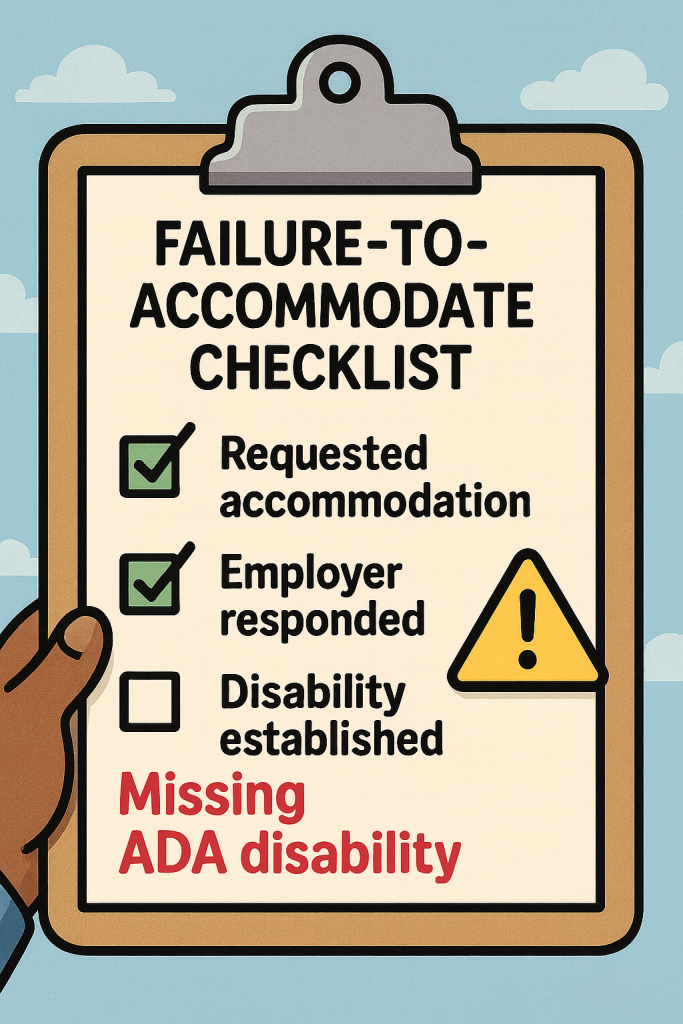
Failure-to-accommodate claims usually turn on what an employer didn’t do.
Here, the more interesting question was whether there was any ADA duty to begin with.
TL;DR: A request for an accommodation does not, by itself, establish that an employee is disabled under the Americans with Disabilities Act (ADA). Employers have obligations when a qualifying disability exists, but a short-term restriction, even one supported by a doctor’s note and honored by the employer, does not automatically trigger ADA liability. Where there is no underlying disability, failure-to-accommodate claims fail.
What happened
The employee worked in housekeeping and initially performed well. Over time, management documented performance issues, including absenteeism, incomplete work, and guest complaints.
After multiple warnings, the employee submitted a short-term “light duty” note from a chiropractor limiting bending and lifting for less than a week. The employer honored the request.
Days later, after another incident involving guest conduct, the employer terminated the employee. The employee sued, alleging disability discrimination and failure to accommodate.
Why the failure-to-accommodate claim failed
The claim did not fail because the employer denied an accommodation. It didn’t.
It failed because there was no evidence of a qualifying disability.
The record showed:
- No medical diagnosis establishing a physical impairment that substantially limited a major life activity
- No evidence tying the brief restriction to a chronic or long-term condition
- No notice to the employer of any qualifying disability before the restriction was submitted
An accommodation request alone does not establish ADA coverage.
If you’re wondering what the alleged failure to accommodate even was, that’s the point. The employee’s theory was that requesting light duty automatically created ADA protection. Once that premise failed, the claim collapsed.
Temporary restrictions don’t automatically trigger the ADA
Short-term limitations, especially ones measured in days, do not automatically qualify as disabilities under the ADA.
Just as important, an employer does not concede ADA coverage by temporarily honoring a restriction while assessing the situation.
Without proof of a qualifying disability, there is no accommodation duty to breach.
Employer takeaways
- Most accommodation requests involve real disabilities. In practice, the focus should usually be on engaging in the interactive process and identifying workable accommodations.
- A request is not proof. ADA obligations depend on an underlying disability, not the mere act of asking.
- Temporary restrictions are different. Short-term limitations may fall outside the statute.
- Flexibility is not a legal admission. Honoring light duty does not concede ADA coverage.
- Process still matters. Listen, document, and respond consistently to every request.
Bottom line
Accommodation requests matter. Most of the time, they involve real disabilities and should be treated seriously.
But asking for an accommodation is not the same thing as being disabled. And without a qualifying disability, a failure-to-accommodate claim will fail.