Search
 The Employer Handbook Blog
When the accommodation request admits the problem


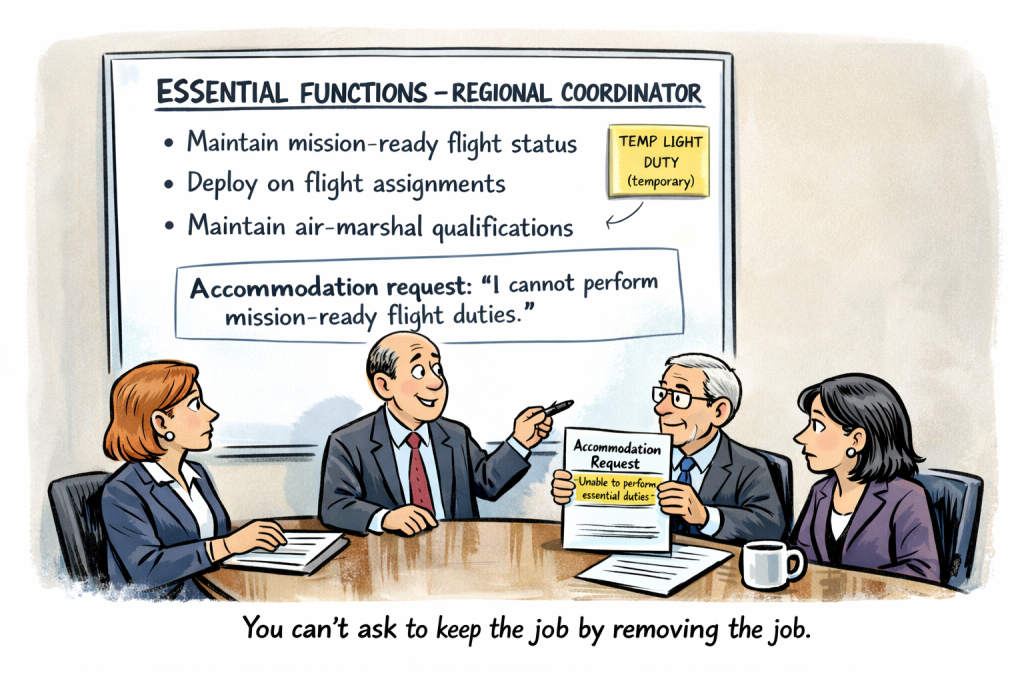
Sometimes the accommodation request itself tells the whole story.
In a recent Fourth Circuit Rehabilitation Act decision, a federal air marshal asked to stay in a ground-based role permanently after medical conditions prevented her from flying. But in doing so, she also acknowledged that she could not perform the essential duties of the job she wanted to keep.
TL;DR: The Fourth Circuit affirmed dismissal of a failure-to-accommodate claim brought by a former federal air marshal who admitted she could not perform the mission-ready flight duties tied to the position she wanted to keep permanently. Because she was not a qualified individual and the Transportation Security Administration (TSA) reassigned her to another federal job after exploring accommodations, her claim failed. For private employers, the same principles apply under the Americans with Disabilities Act (ADA): essential job functions still matter, employees cannot rewrite the job, and reassignment can satisfy the duty to accommodate. The opinion names the Secretary of Homeland Security at the time as defendant. Federal case captions sometimes age faster than the legal principles.
A temporary workaround did not become a permanent job
The plaintiff worked more than seven years as a Federal Air Marshal for the Transportation Security Administration (TSA). Over time, worsening medical conditions limited her ability to perform full duty.
TSA placed her on temporary light duty and later assigned her to a largely ground-based Regional Coordinator role. But even that job required employees to remain mission-ready and capable of flying assignments.
After a medical review raised concerns that she no longer met agency standards, TSA warned she could face removal and encouraged her to seek reassignment.
She submitted an accommodation request acknowledging her “inability to perform the essential duties” of her position and asked for reassignment. TSA found no suitable vacancies within the agency, so she identified openings at the Federal Law Enforcement Training Centers, another DHS component. TSA approved her reassignment there.
More than a year later, unhappy with the move, she sued and argued TSA should have kept her permanently in the Regional Coordinator role.
The district court dismissed the case, and the Fourth Circuit affirmed.
Her own allegations undermined the claim
To pursue a failure-to-accommodate claim under the Rehabilitation Act or the Americans with Disabilities Act (ADA), an employee must be able to perform the essential functions of the job with or without reasonable accommodation.
That requirement proved fatal here.
In her accommodation request, the plaintiff acknowledged she could not perform the essential duties of the role she wanted TSA to preserve permanently. Even the Regional Coordinator position required employees to remain mission ready and capable of flying assignments.
Because her medical condition prevented her from meeting that requirement, the court concluded she had effectively pleaded herself out of a claim.
Courts defer to employers on essential functions
The Fourth Circuit emphasized that employers generally define the essential functions of a position, and courts typically give those judgments significant deference.
That principle applies equally in the private sector under the ADA. An accommodation may help an employee perform a job, but it does not require the employer to eliminate a core function.
Reassignment satisfied the accommodation duty
The court also concluded TSA had already met its obligations.
The agency used temporary light duty, evaluated other positions, and ultimately reassigned the employee to another federal role she helped identify.
Under disability law, reassignment is generally treated as a last-resort accommodation when no reasonable option allows the employee to perform the essential functions of the current job.
Three reminders for employers
First, essential job functions still control. Employers do not have to eliminate core duties as an accommodation.
Second, employees cannot dictate the accommodation they prefer. The law requires a reasonable accommodation, not the employee’s preferred arrangement.
Third, reassignment may satisfy the ADA. When the employee cannot perform the essential functions of the current job, transfer to another role may fulfill the employer’s obligation.
Bottom line
Although this case arose under the Rehabilitation Act and involved a federal agency, the analysis should feel familiar to private employers handling ADA accommodation requests.
Engage in the interactive process and explore reasonable options. But the law does not require employers to convert temporary assignments into permanent positions or remove the essential functions that define the job.