Search
 The Employer Handbook Blog
When an Ultimatum Turns a “Resignation” Into a Jury Question


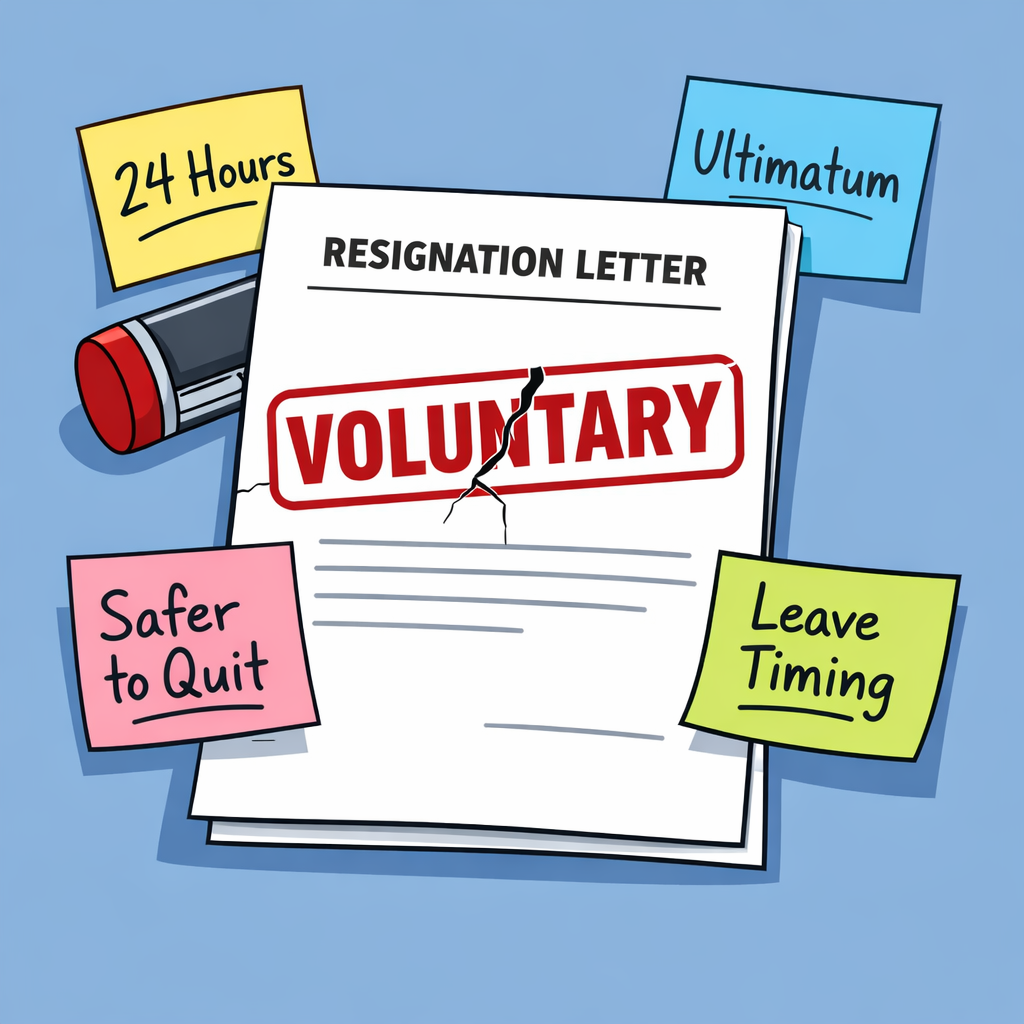
Constructive discharge is a high bar. But an ultimatum, delivered the wrong way and on the wrong timeline, can be enough to clear it.
That was the lesson from a recent federal court decision involving a pregnant employee who was told she could either keep working under at-will conditions or take six weeks of pay and leave immediately. The employer framed it as a choice. The court said a jury could see it as no choice at all.
TL;DR: A pregnant employee who resigned after being given a stay-or-leave ultimatum survived summary judgment because a jury could find she was constructively discharged. The court held that the short decision window, supervisor comments suggesting termination was inevitable, and surrounding context could support treating the resignation as an adverse employment action rather than a voluntary quit.
The ultimatum
The employee worked for a law firm and later informed supervisors that she was pregnant. Months later, after internal communications raising performance concerns and discussing her upcoming maternity leave, management presented her with an ultimatum: stay and give “100 percent” while remaining at-will, or take six weeks of pay and leave effective immediately.
She chose the severance option the next morning.
The employer argued that ended the story. She resigned voluntarily, under the same at-will conditions that had always applied.
The court disagreed that it could end the case there.
The constructive-discharge framework
Constructive discharge requires more than pressure or dissatisfaction. The standard is objective and demanding. The question is whether working conditions were so intolerable that a reasonable person would feel compelled to resign.
Critically, the inquiry is not whether the employer caused the resignation, but whether the employee had any other reasonable choice but to resign in light of the employer’s actions.
That distinction is where employers often lose the thread.
Why this “choice” could look like no choice at all
The employer relied on precedent holding that offering an alternative to quitting cuts against constructive discharge. The court acknowledged that rule, but found factual differences that could lead a jury to reach a different conclusion here.
First, timing. The employee was given only a day to decide. Whether an employee is afforded a reasonable amount of time to choose is a recognized factor in constructive-discharge analysis. A rushed deadline can look less like a choice and more like pressure.
Second, supervisor comments. The employee testified that she told her supervisor quitting felt like “the safer choice,” and the supervisor agreed. A jury could reasonably view that response as confirmation that staying meant termination, not a meaningful opportunity to continue working.
Third, the surrounding context. The court pointed to internal communications suggesting termination was inevitable, with discussion focused on timing because of maternity-leave optics. That backdrop matters. It can make an ultimatum feel like a formality rather than a real decision point.
Taken together, the court held there was sufficient evidence for a jury to find the employee was effectively told to quit or be fired, a recognized path to constructive discharge.
HR checklist to avoid a constructive-discharge mess
• Do not present “choices” you don’t actually intend to honor. If staying is not a real option, framing it as one creates risk instead of reducing it.
• Build in breathing room. Give employees meaningful time to consider options. Compressed timelines read as pressure, not voluntariness.
• If separation is on the table, and a separation agreement is in play, transparency matters. Surprise release language delivered after a rushed ultimatum can reinforce the perception that resignation was not truly voluntary. Give the employee time to review and consult counsel.
• Control the manager script. Train managers to avoid language that endorses quitting (“that’s probably safer,” “I’d do the same”). Those comments can become Exhibit A.
• Keep performance management and exit talks separate. Mixing “you’re under scrutiny” with “you can leave with pay” muddies intent and fuels constructive-discharge arguments.
The bottom line
If an employer wants a resignation to look voluntary, it should actually be voluntary. A rushed ultimatum, paired with signals that staying is pointless, is a risky way to get there.