Search
 The Employer Handbook Blog
When a “machismo” culture isn’t enough to prove discrimination


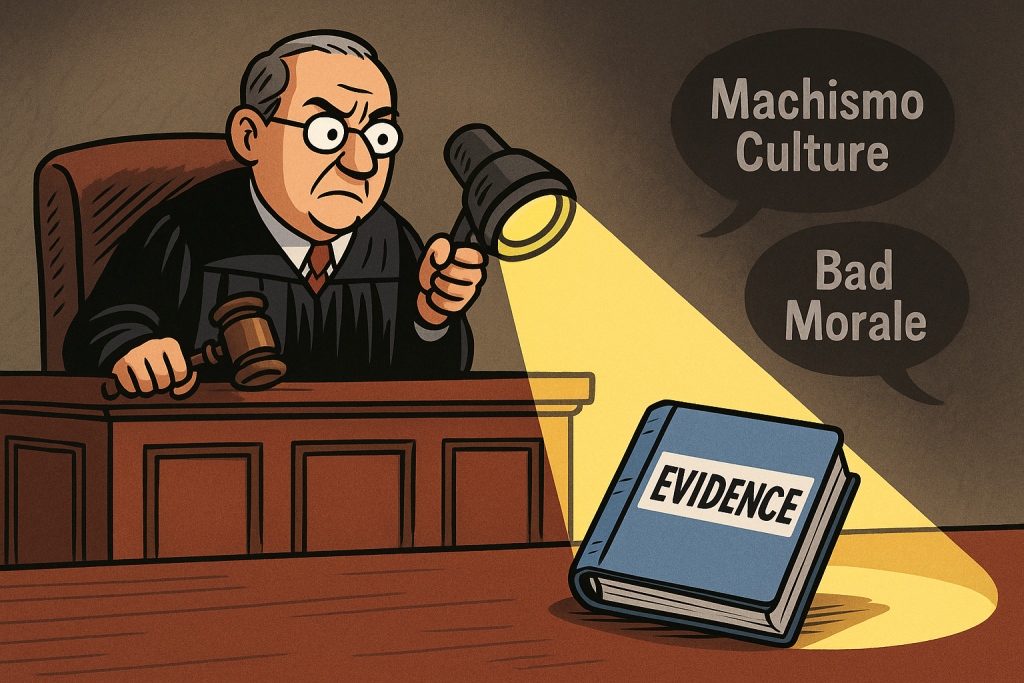
A toxic culture can make a workplace miserable. That doesn’t mean a court will find discrimination or retaliation when an employee sues. A new Seventh Circuit decision drives that point home.
TL;DR: An employee reported a “machismo” environment, inappropriate comments, and denied overtime. The employer investigated, paid back wages, and noted low morale but no discrimination. Performance problems that predated the complaints later led to a poor review and separation. The Seventh Circuit affirmed summary judgment: no favorable comparators, no pretext, and timing alone could not prove retaliation.
Complaints about culture and overtime
The employee worked as a customer service analyst at a company plant outside Chicago. After several years on the job, she began reporting to a new supervisor known for a demanding management style. He required pre-approval for overtime while raising expectations for productivity.
By 2018, she felt she could not keep up. Believing she was being set up to fail, she called HR’s hotline to complain that her supervisor was denying overtime even though the extra hours were needed to finish her assignments. She described the workplace as one of “machismo,” where people felt bullied and feared losing their jobs. HR investigated, confirmed she was owed overtime, and paid it.
In a second interview, she reported that her supervisors stared at women, winked, used derogatory language, and once made a comment about sitting on her lap. Other employees told HR morale was “extremely low” and that workloads were heavy, with some blaming management. One contractor even recalled being told his work was “garbage.” Still, HR concluded that no one had described age or gender discrimination or sexual harassment. The investigation was closed, and the employee later acknowledged that the inappropriate behavior stopped after she complained.
From complaints to termination
Even before the employee’s complaints, performance reviews had noted problems with communication and time management. Those issues persisted. The following year, she received the lowest possible performance rating, which triggered a process requiring her to accept a performance improvement plan (PIP) or severance.
At the review meeting, she excused herself and tried to return to her desk to finish the day. Management told her to go home; when she refused, they threatened to call authorities, and she eventually left. Her supervisor later reported that she raised her voice and repeatedly called him “sweetheart,” which he viewed as inappropriate. HR then withdrew the PIP option, citing her conduct at the meeting, and sent her a letter giving her until mid-September to choose severance or termination. She did not respond, and her employment ended shortly afterward at age 42.
Why “machismo” alone could not carry the case
The court acknowledged the employee’s description of a “machismo” environment and even noted evidence of inappropriate comments, winking, and staring. But without evidence tying the culture issues to the decision to terminate, they carried no weight. The remarks occurred nearly a year before she was fired, and HR’s investigation concluded that no one reported age or gender discrimination or sexual harassment. Without proof that the “machismo” atmosphere actually motivated her termination, the culture evidence could not carry the case.
The court also pointed to other key gaps in the record:
- Comparators: Contractors were not valid comparators, and the one true comparator received the same low rating and treatment.
- Performance record: Documented concerns about her work predated the complaint and continued afterward.
- Retaliation: Timing alone—nearly a year between complaint and termination—was insufficient to show causation.
Employer takeaways
- Investigate complaints seriously. No matter how they’re framed, concerns about workplace behavior deserve careful attention and documentation.
- Fix what you can. Paying owed overtime and addressing concerns showed responsiveness.
- Document consistently. Performance problems noted before and after complaints helped the employer’s defense.
- Culture vs. liability. A poor environment may drive lawsuits and turnover, but without proof of bias or comparators, courts look to evidence.
Bottom line
A “machismo” label is a red flag for morale and retention. But as this case shows, the legal risk depends on proof of discrimination, not atmosphere.