Search
 The Employer Handbook Blog
The Groundhog Day Problem in Workplace Investigations


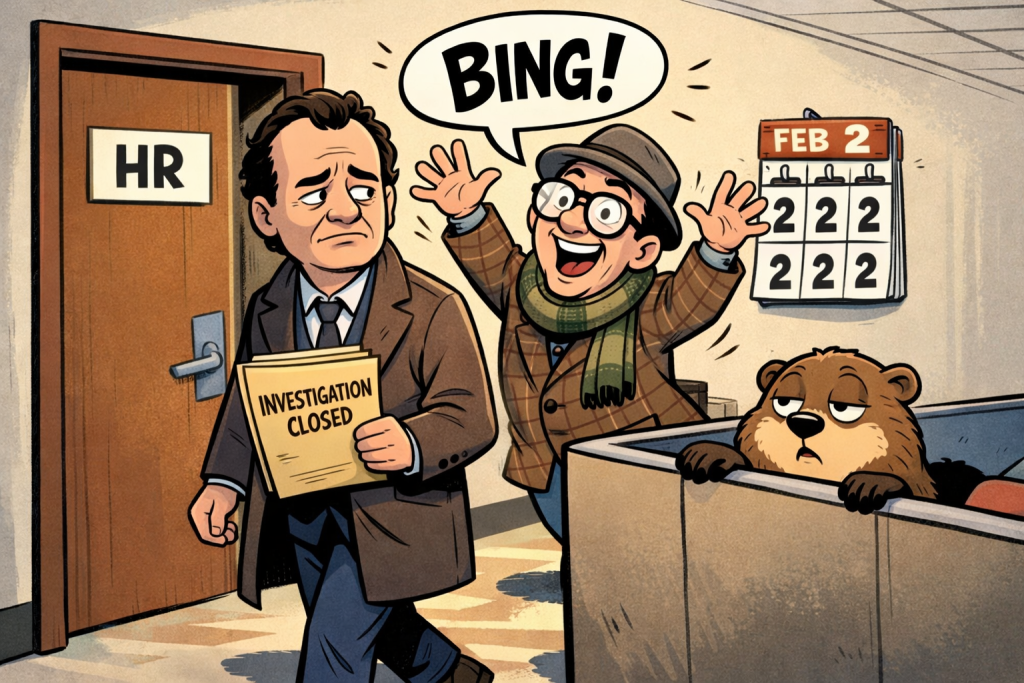
In Groundhog Day, the problem isn’t that the day repeats. It’s that nothing changes. At one point, Phil Connors captures the frustration perfectly: “What if there is no tomorrow? There wasn’t one today.”
That same problem shows up when employers investigate complaints about a supervisor, conclude the conduct is not actionable, and then respond the same way each time the issue resurfaces.
A familiar scenario
Several employees complain over time about the same supervisor.
The early complaints involve borderline behavior – inappropriate comments in meetings, jokes, interruptions, dismissive treatment. HR investigates, concludes the conduct is unprofessional but not severe or pervasive, and the company provides coaching.
The complaints continue. HR repeats the same investigation, reaches the same conclusion, and the employer imposes the same corrective step. The supervisor remains in place. The behavior does not stop.
Eventually, one employee experiences conduct frequent and serious enough to plausibly allege a hostile work environment. She reports it. The employer investigates again and takes action.
By then, the employer is defending more than its final response.
What these cases are about
These cases turn on the employer’s ability to show it exercised reasonable care to prevent and correct harassment by a known repeat offender.
When harassment is committed by a supervisor and no tangible employment action occurred, employers often rely on the Faragher–Ellerth affirmative defense. That defense depends on more than having a policy and running investigations. It depends on whether the employer’s response was reasonably designed to stop the behavior.
Repeated notice followed by an unchanged response makes that showing harder.
Why repetition changes the analysis
Each complaint increases what the employer knows about the risk. When the conduct continues despite repeated investigations and repeated counseling, earlier responses become part of the evidentiary record.
A jury may reasonably ask:
-
How many warnings did the employer receive?
-
What changed after each one?
-
Why did the behavior continue?
At that point, the employer is no longer defending the adequacy of a single investigation. It is defending whether its overall response reflected reasonable care once it knew it had a repeat problem.
The real mistake: freezing the response
Investigations are necessary. But repeating the same investigation and the same corrective step after repeated complaints can look less like diligence and more like inertia.
Reasonable escalation might include stronger discipline, closer supervision, role changes, or removing the supervisor from situations where the conduct has recurred.
Inertia is fatal to an affirmative defense built on reasonable care.
Employer takeaways
-
Patterns matter. Repeated complaints about the same supervisor change the analysis.
-
Escalation is part of reasonable care. Corrective action that doesn’t work must be reassessed.
-
Effectiveness matters more than form. The goal is to stop the behavior, not to document the same response.
-
Assume today’s decision will be judged later. Because it will be.
Bottom line
In Groundhog Day, the cycle only breaks when the response changes.
Workplace investigations follow the same rule. The employer controls whether the day repeats – and whether it can still claim it exercised reasonable care.