Search
 The Employer Handbook Blog
The EEOC’s Anti-American Discrimination Priority Gets a Red-Highlighted Example


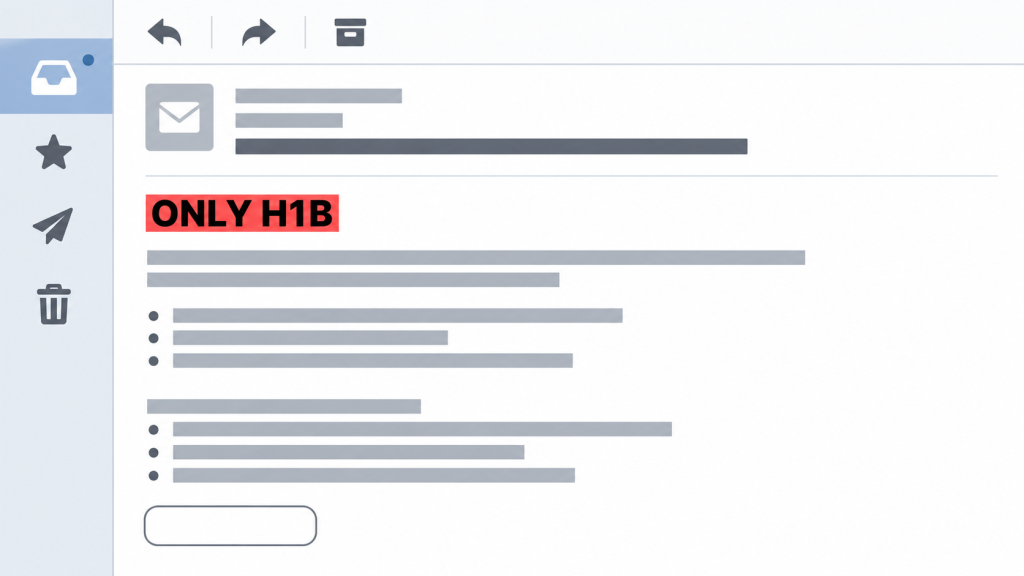
If you want the EEOC’s attention, do this: send an email — in red highlight — seeking “ONLY H1B” applicants. It’s one of the allegations in a new federal lawsuit, part of the agency’s push against anti-American bias.
TL;DR: The EEOC sued an IT staffing agency under Title VII, alleging a recruiter’s “ONLY H1B” email shut an American candidate out of a job lead because of national origin. These are allegations only, and no court has ruled.
The EEOC says that email was national origin discrimination, and on September 29, 2026 it sued the Texas-based IT staffing agency behind it in federal court in Northern California. Its position is that limiting a job to H-1B visa holders, without considering Americans, is national origin discrimination under Title VII. The complaint is the EEOC’s version of events, not findings by a court, and nothing has been decided.
Two words in red highlight, then a follow-up the recruiter allegedly never answered
According to the complaint, around July 29, 2025 a recruiter with about two years of experience and two weeks on the job emailed an American database developer with more than a decade of experience about a Business Data Analyst role in Mountain View, California. The email allegedly said “ONLY H1B” in large black font highlighted in red.
The complaint alleges that about a day later, the developer asked whether specifying that was legal. The recruiter allegedly answered “yeah.” When the developer followed up with “[C]an you show me where that is legal?”, the recruiter allegedly did not respond and stopped communicating. According to the complaint, the developer never sent a full resume, believing it futile.
How a visa requirement becomes a national-origin claim
Title VII bars an employment agency from refusing to refer people, or classifying them, because of national origin. In its press release, EEOC Chair Andrea Lucas said employers and employment agencies “cannot shut qualified Americans out of job opportunities by using unjustified visa requirements as a proxy for national origin discrimination.”
To tie the email to national origin, the complaint points beyond two words. It alleges the agency referred two candidates of Indian and Nepalese origin, and that its training materials focused on U.S. work-visa categories and on screening H-1B holders.
The complaint says the EEOC found reasonable cause on April 21, 2026, and conciliation failed by August 7. It seeks an injunction, back pay, front pay, and compensatory and punitive damages.
The EEOC’s guidance on anti-American discrimination defines national origin discrimination as treating workers “unfavorably or favorably because they are from a particular country or part of the world.” Its examples include ads that say “H-1B only,” terminating American workers between assignments at a higher rate than visa guest workers, and subjecting U.S. workers to “more laborious application methods” than H-1B visa holders.
Much of what the complaint points to, the email, the recruiter’s answer and the training materials, is within an employer’s control. Four fixes start there.
Visa language in a recruiting template can read as a national-origin screen
The EEOC treats an unjustified visa requirement as a potential proxy for national origin, and the email allegedly put “ONLY H1B” in highlighted type. Review outreach templates, job orders, and vendor instructions for visa-status language, and have counsel approve any limit before it reaches candidates.
An unscripted answer to a legality question can end up in a federal complaint
The complaint recounts the recruiter’s “yeah” and the silence that followed. Give recruiters a script that sends any question about a requirement’s lawfulness to HR or counsel.
Training materials that sort candidates by visa category become part of the national-origin case
The complaint relies on the agency’s training materials, the email and the referrals to support its national-origin theory. Review recruiter training and vendor onboarding for instructions that sort candidates by visa status.
A preference for Americans can draw the same national-origin claim
The EEOC defines national origin discrimination to include favoring workers because of where they are from, not only disfavoring them, so a preference for Americans over foreign applicants can violate Title VII too. Check job ads and vendor instructions for nationality preferences, and have counsel review any wording that favors one.
The EEOC’s guidance lists “H-1B only” ads among examples of anti-American discrimination. This suit starts with an email that allegedly said “ONLY H1B.”