Search
 The Employer Handbook Blog

The EEOC Rescinds Its Criminal-Records Guidance. What Changes for Employers?


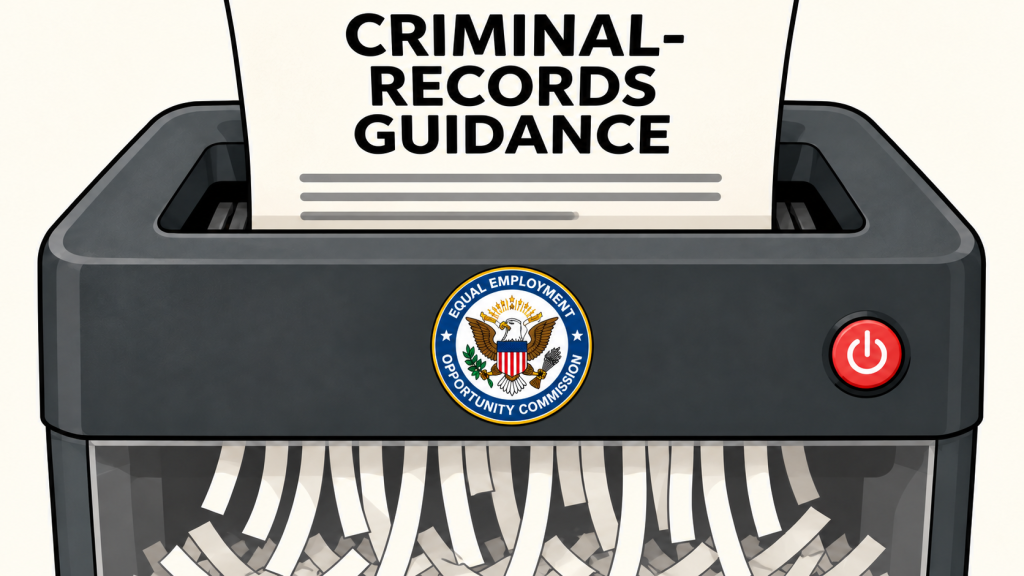
The EEOC’s retreat from disparate-impact enforcement now reaches criminal background checks. Employers considering changes to their screening procedures will need to look beyond the agency’s announcement.
TL;DR: The EEOC rescinded its 2012 criminal-records guidance, effective immediately, against the backdrop of the administration’s opposition to disparate-impact liability. The change signals a different federal enforcement approach. It does not change federal anti-discrimination law or eliminate separate state, local, and federal background-check requirements.
📄 Read the EEOC’s announcement
The old guidance addressed unequal hiring outcomes
On October 29, 2026, the EEOC announced that it had voted the previous day to rescind its guidance on arrest and conviction records. The agency also clarified that earlier policy statements superseded by the 2012 guidance do not spring back into effect.
A central concern behind the 2012 guidance was that broad criminal-record exclusions could disproportionately screen out Black and Latino applicants, given disparities in arrest and incarceration rates. Applying the same exclusion to everyone could still produce unequal hiring outcomes.
The EEOC therefore emphasized connecting exclusions to the particular job: the nature of the offense, the time elapsed, and the position’s duties. It also described individualized assessments, giving someone screened out a chance to provide information that could change the decision.
The guidance also distinguished arrests from convictions. An arrest alone did not establish criminal conduct, although evidence of the underlying conduct could support a job-related decision. A conviction generally established the conduct, subject to possible record errors. Individualized review could account for rehabilitation, references, and successful work after the conviction.
The guidance nevertheless acknowledged that Title VII did not necessarily require individualized assessment in every circumstance.
The administration is moving away from disparate-impact enforcement
That concern about unequal outcomes explains the guidance’s emphasis on disparate-impact liability, which can apply without proof of intentional discrimination. President Trump’s April 2025 executive order directed agencies to deprioritize that enforcement and pursue elimination of disparate-impact liability to the extent possible.
A June 2026 Justice Department opinion concluded that the EEOC’s interpretation was unconstitutional and endorsed a much narrower approach, expressly addressing background checks. The rescission fits that broader retreat. The announcement itself, however, cites constitutional and statutory limits without expressly naming disparate-impact liability as its rationale.
Private lawsuits and other screening laws remain
Rejecting one applicant while overlooking a comparable record for another because of race or national origin remains unlawful. Private applicants can also still bring disparate-impact claims.
Title VII itself contains the disparate-impact framework, including whether a screening rule is connected to the job, justified by business necessity, and replaceable by an effective, less discriminatory alternative. The administration’s narrower interpretation does not amend that text or bind courts deciding private lawsuits.
Other requirements have independent sources, too. Philadelphia’s fair-chance hiring requirements, for example, include individualized review and consideration of rehabilitation. And the Fair Credit Reporting Act (FCRA) imposes separate procedures when employers use background-screening companies, including disclosures, authorization, and notices surrounding an adverse decision.
Before deleting a screening step, identify why it exists and which law, if any, requires it. That review should reach the hiring team’s instructions and the screening vendor’s settings, where an automatic rejection may happen before HR reviews the report.
Three checks before changing a screening policy
The reason for exclusion should connect to the job
A blanket exclusion can be harder to defend when the same offense has little connection to some positions. Employers should be able to explain why a particular record creates a relevant risk for the particular job, rather than relying on the existence of a conviction.
Local law may still require individualized review
A national policy built around the rescission alone can miss local obligations. Before removing individualized review, map the requirements where the employer hires, including which records may be considered and what response opportunities applicants receive.
Automatic rejections can bypass required notices
When the FCRA applies, employers generally must provide the report and a summary of rights before taking adverse action, followed by a separate notice afterward. Confirm that any revised screening workflow preserves those steps before a rejection goes out.
An applicant’s lawyer can still pursue a claim that falls outside the EEOC’s enforcement priorities.