Search
 The Employer Handbook Blog
Sleeping on the job or sleeping on consistency?


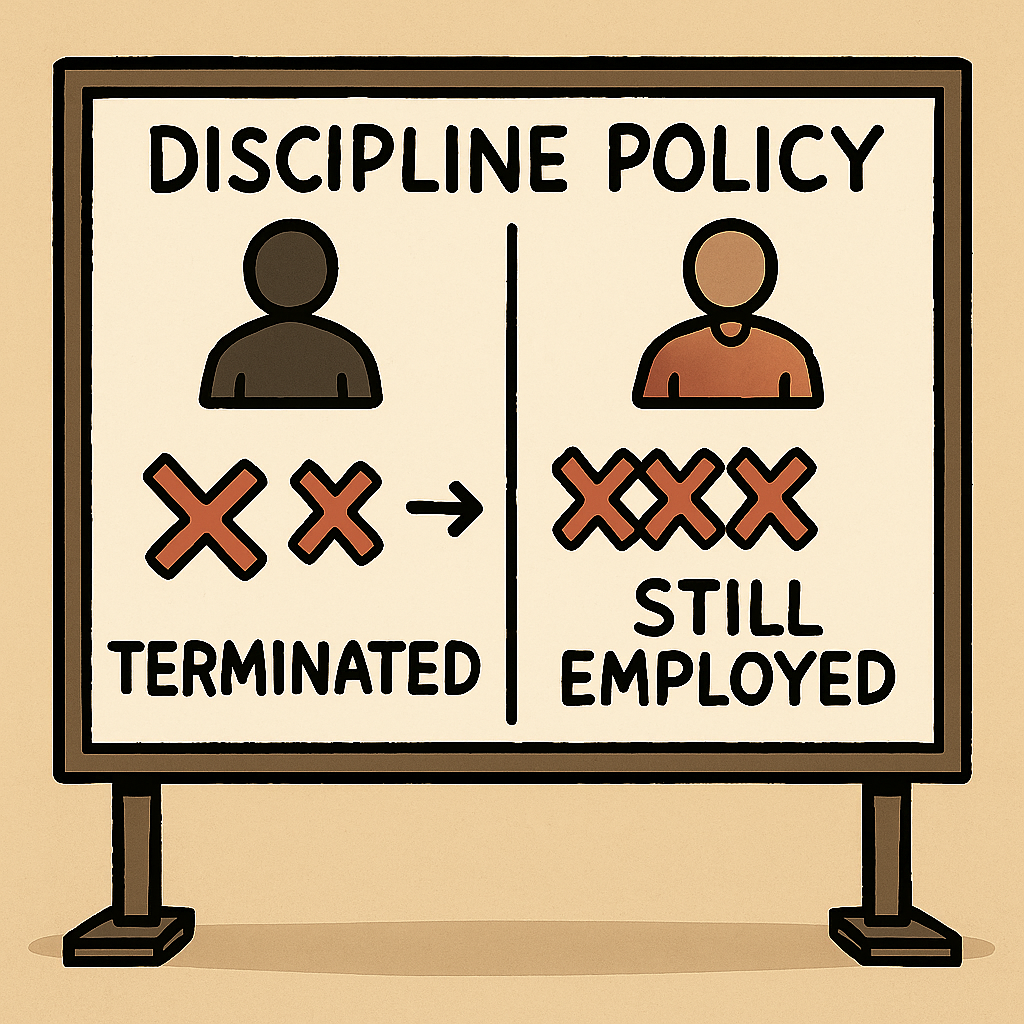
Two employees break the same rule. One gets fired. The other gets another chance.
That’s not just a management headache; it’s a discrimination lawsuit waiting to happen.
TL;DR:
A Michigan federal judge refused to dismiss a former security guard’s race discrimination claims after he was fired for sleeping on duty, while a white co-worker with four similar violations was not terminated at the time and was later rehired following a disputed termination.
The court found enough evidence of unequal discipline to send the case to a jury.
👉 Read the opinion
Same rule. Same boss. Different results.
The plaintiff, a Black security guard, admitted he fell asleep twice on duty. Company policy called for a suspension after the first offense and termination after the second. He got both.
But a white co-worker who repeatedly broke the same rule did not get the same treatment. He was caught sleeping on duty four times, received lighter discipline, and was even rehired later after a disputed termination.
When the fired guard complained about “blatant racism,” management stood by its decision. He sued under Title VII of the Civil Rights Act of 1964 and 42 U.S.C. § 1981.
The court was not convinced by the “same policy, different context” defense
The employer argued it followed the rules: two sleep incidents equal termination. The court saw more nuance.
Both guards held the same job, reported to the same supervisors, and were disciplined under the same policy. Yet only one lost his job for sleeping twice, while the other kept working despite four violations.
That inconsistency, the court explained, could allow a jury to conclude that race was a motivating factor. As the Sixth Circuit has put it, “a two-strikes policy for firing Black employees and a three-strikes policy for firing white employees would plainly constitute disparate treatment.”
The employer’s explanations about a disciplinary “points reset” and an informal rule barring discipline before the reset date were disputed and not documented, which also undercut its claim of consistency.
So the case moves forward.
What employers and HR should take away
- Consistency counts. Apply discipline the same way across the board. Deviations invite scrutiny.
- Explain exceptions. If a rule is not applied evenly, document why. Performance history, client complaints, or other factors can justify differences, but only if they are recorded at the time.
- Train your leaders. A policy is only as fair as the managers enforcing it.
- Audit discipline decisions. Compare outcomes before finalizing a termination to ensure similar conduct has drawn similar consequences.
The bottom line
It is not just about sleeping on the job.
If your policies are not applied consistently, your defense may not hold up when the case goes to trial.