Search
 The Employer Handbook Blog
New Jersey Doubles Down on Disparate Impact as Federal Enforcement Pulls Back


At a moment when federal agencies are actively dismantling disparate impact enforcement as a policy matter, New Jersey just went in the opposite direction – loudly, deliberately, and in writing.
Last month, the New Jersey Division on Civil Rights finalized new rules that spell out how disparate impact claims work under the New Jersey Law Against Discrimination in the employment context. These rules do not create new liability. What they do is remove any remaining ambiguity about how neutral workplace policies will be judged under state law.
TL;DR: In New Jersey, employment policies that disproportionately harm protected groups can violate state law even if there was no intent to discriminate. Employers must be able to show that a challenged policy truly matters to the job and that there is no less discriminatory way to achieve the same goal. This clarity arrives as federal agencies move away from disparate impact enforcement.
📄 The official announcement, adopted rules, and supporting materials are available from the New Jersey Office of the Attorney General.
What Disparate Impact Means for Employers
Disparate impact is about results, not motives.
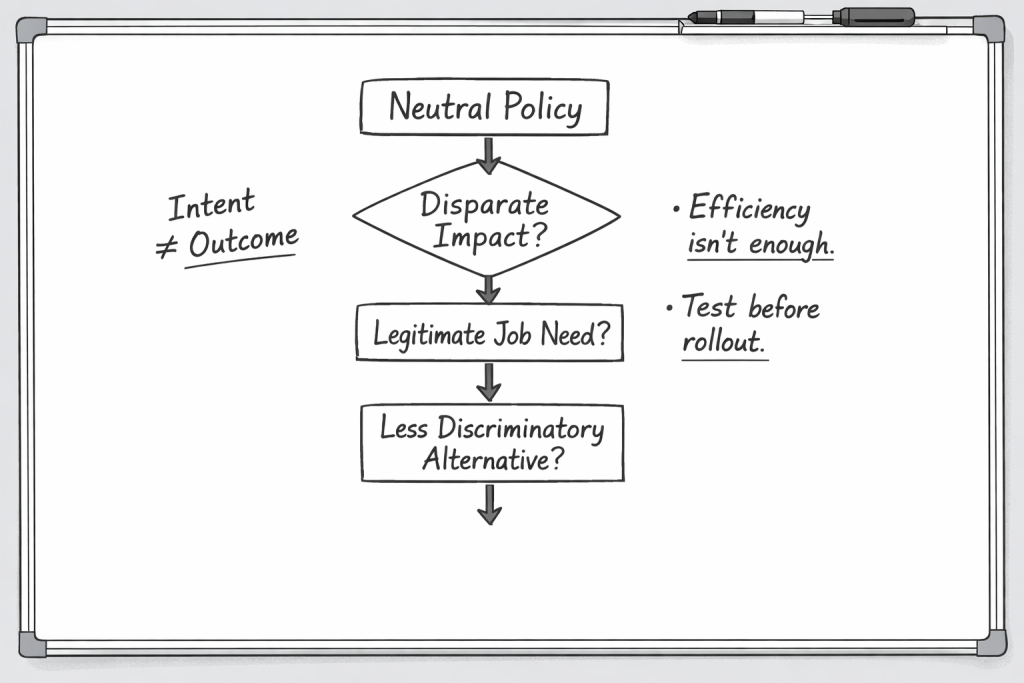
A policy can be neutral on its face and still be unlawful if it disproportionately excludes people in a protected group and the employer cannot justify it. The new rules walk through that analysis step by step.
First, an employee or applicant must point to a specific policy or practice and show that it hits a protected group harder than others.
If that happens, the burden shifts to the employer.
The employer must show that the policy is actually necessary. In plain terms, that means the policy must be job-related and tied to a real business need, not habit, convenience, or “this is how we have always done it.”
Even then, the analysis does not stop. If there is another way to achieve the same goal with less harm to protected groups, sticking with the original policy can still create liability.
This framework has existed in case law for years. New Jersey has now put it into black-and-white regulations.
Employment Practices Most Likely to Draw Scrutiny
The Division did not leave employers guessing about where problems tend to arise. The rules repeatedly flag employment practices that often create disparate impact issues, including:
- Criminal background screening
- Language and citizenship requirements not required by law
- Dress, grooming, and appearance standards
- Hiring and screening criteria built into automated tools
- Resume filters and algorithmic scoring systems
One important point that often gets missed: a policy does not have to be in use to be challenged. If it has been approved, announced, or finalized, that may be enough.
AI Hiring Tools Are Not a Safe Harbor
One of the clearest messages in the rules is about technology.
If an employer uses software to screen applicants, rank resumes, analyze facial expressions, or otherwise influence hiring decisions, the employer owns the outcome. It does not matter that a vendor built the tool.
If the tool disproportionately screens out protected groups, the employer is responsible. The rules expressly require employers to take reasonable steps to make sure third-party tools comply with the Law Against Discrimination.
Blaming the algorithm is not a defense.
New Jersey Is Moving One Way. Federal Enforcement Is Moving Another.
The timing of these rules is not accidental.
At the federal level, disparate impact still exists on paper, but enforcement priorities have shifted. Federal agencies have narrowed guidance, rolled back regulations, and placed greater emphasis on intent-based discrimination instead of outcome-based claims.
New Jersey has made clear that none of that changes state law.
For employers, that means relying on federal enforcement trends as a risk gauge is no longer enough. In New Jersey, disparate impact remains very much alive and very much enforceable.
Practical Takeaways for Employers
Neutral policies still need scrutiny. “We did not mean to discriminate” is not the test.
Be ready to explain the why. Employers should be able to show how a policy actually relates to job performance or business needs.
Efficiency is not the trump card. A faster or cheaper policy can still be unlawful if there is a less discriminatory alternative.
AI requires oversight. Automated tools need testing and validation, not blind trust.
State law now drives risk. Federal pullback does not reduce New Jersey exposure, and it does not insulate employers from private lawsuits.
Bottom Line
New Jersey has drawn a clear line. Neutral employment policies that quietly exclude protected groups are no longer gray areas.
For employers, this is not about panic. It is about preparation. If hiring criteria, screening tools, or background check policies have not been looked at through a disparate impact lens, now is the time.
Waiting for a federal enforcement signal will not help in New Jersey.