Search
 The Employer Handbook Blog
“I Wonder How That Would Work”: The Interview Question That Reopened a Sex-Discrimination Case


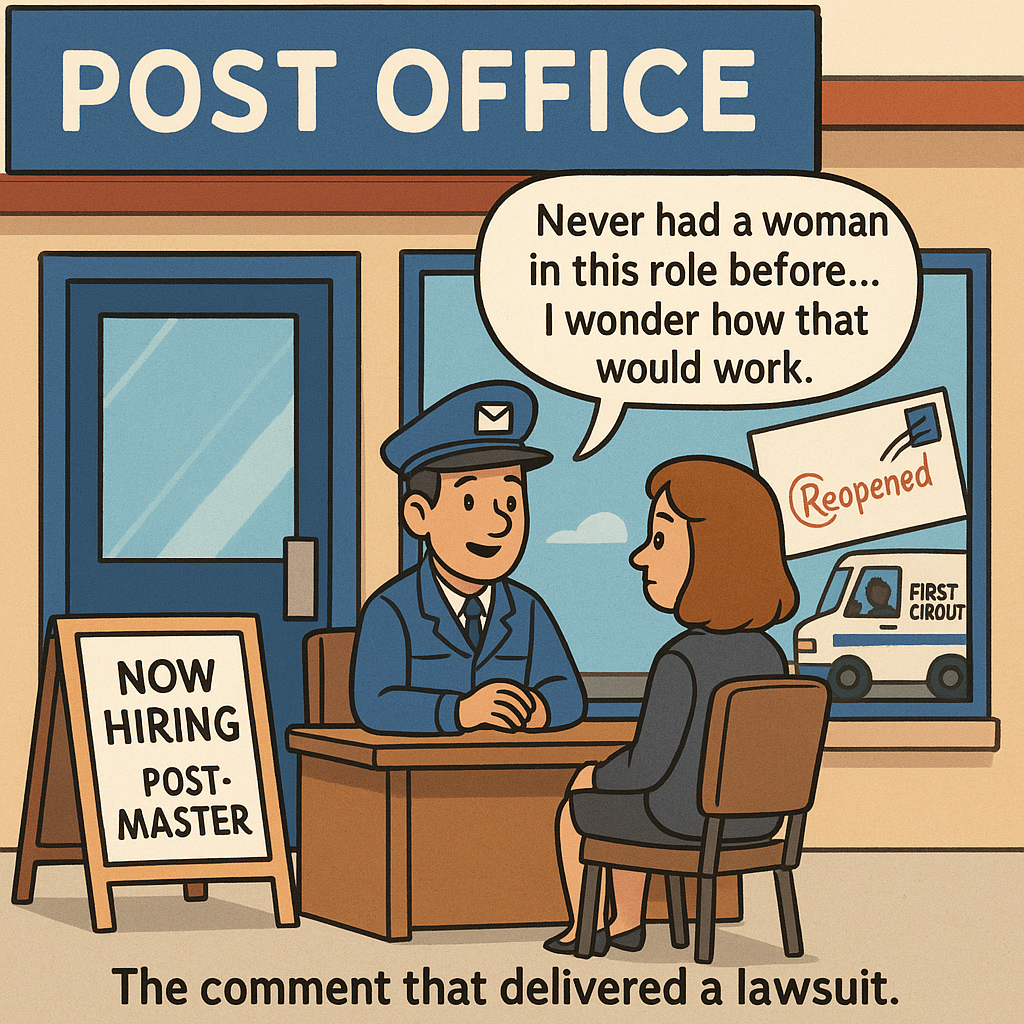
It’s the kind of line you say when you’re thinking out loud, not realizing that your thoughts are about to become Plaintiff’s Exhibit A.
TL;DR: A First Circuit panel revived a federal postal employee’s Title VII sex-discrimination claim after her supervisor, while interviewing her for a promotion, remarked that the office had never had a female postmaster and she “wondered how that would work.” That one sentence was enough to send the case back for trial.
📄 Read the decision (No. 24-1414, 1st Cir. Sept. 4, 2025)
The comment that delivered a lawsuit
After twenty years with the Postal Service, the employee applied for two higher-level postmaster jobs, first in Durham, New Hampshire, and later in Somersworth. The same supervisor interviewed her both times, and both promotions went to men.
During the second interview, the supervisor remarked that the Somersworth post office had never had a female postmaster and “wondered how that would work.” When the employee later sued for age and sex discrimination, the district court dismissed everything. The First Circuit saw it differently.
The appellate court focused on three things that made this comment legally significant.
First, timing. The remark was made during the interview, not years earlier or in casual conversation. Courts treat statements made in the middle of the decision-making process as direct insight into motive.
Second, speaker. The person who made the comment was not a coworker or peer but the actual decisionmaker. Remarks by the person with authority to hire or promote carry far more weight than office gossip.
Third, meaning. The panel said the comment could be understood in more than one way. It might have been harmless wondering aloud or a clumsy acknowledgment of the office’s all-male history. But a jury could also reasonably hear it as doubt that a woman could do the job.
That last point was critical. The First Circuit said that when you combine this remark with other evidence, such as the supervisor’s record of promoting more men than women and the fact that a man got the job, it created a “mosaic of circumstantial evidence” that justified sending the case to a jury.
The court didn’t find discrimination, but it did find uncertainty. That uncertainty, it said, belongs to the jury. As a result, the sex-discrimination claim for the Somersworth promotion was revived, while the earlier Durham promotion and all age-related claims stayed closed.
“Energy” is not code for “youth”
The employee also alleged age discrimination, arguing that her supervisor questioned whether she had the “energy” for the position.
The First Circuit rejected that claim. While “energy” can sometimes sound like a polite stand-in for “youth,” the court explained that the word “does not necessarily connote youth or other age-related characteristics.”
Not every remark about stamina or enthusiasm is ageist code. Without a clear link between “energy” and age, the comment wasn’t enough to prove bias. Sometimes “you don’t have the energy” just means you look tired.
Employer takeaways
- Do not narrate your thoughts.
Interviewers are not there to brainstorm aloud. If a question begins with “I wonder how that would work,” and involves a candidate’s protected class, stop wondering and stick to the candidate’s qualifications. - Context counts, but phrasing matters.
Even neutral comments can sound discriminatory when phrased poorly. Train managers to speak precisely during interviews. - Practice before the depositions.
Interviewers who rehearse their questions rarely have to explain them under oath. - Curiosity is not an alluring defense.
A remark that feels harmless in conversation can sound like bias once it’s written in a complaint or read aloud to a jury.
The bottom line
Many discrimination cases end at summary judgment. This one almost did, until a manager decided to think out loud.
The First Circuit’s message: if you are going to “wonder how that would work,” keep it to yourself, or be prepared to explain it to a jury.