Search
 The Employer Handbook Blog
Filed under “duh”: Throwing paper clips at work undermines a retaliation claim. Secretly filming your boss doesn’t help either.


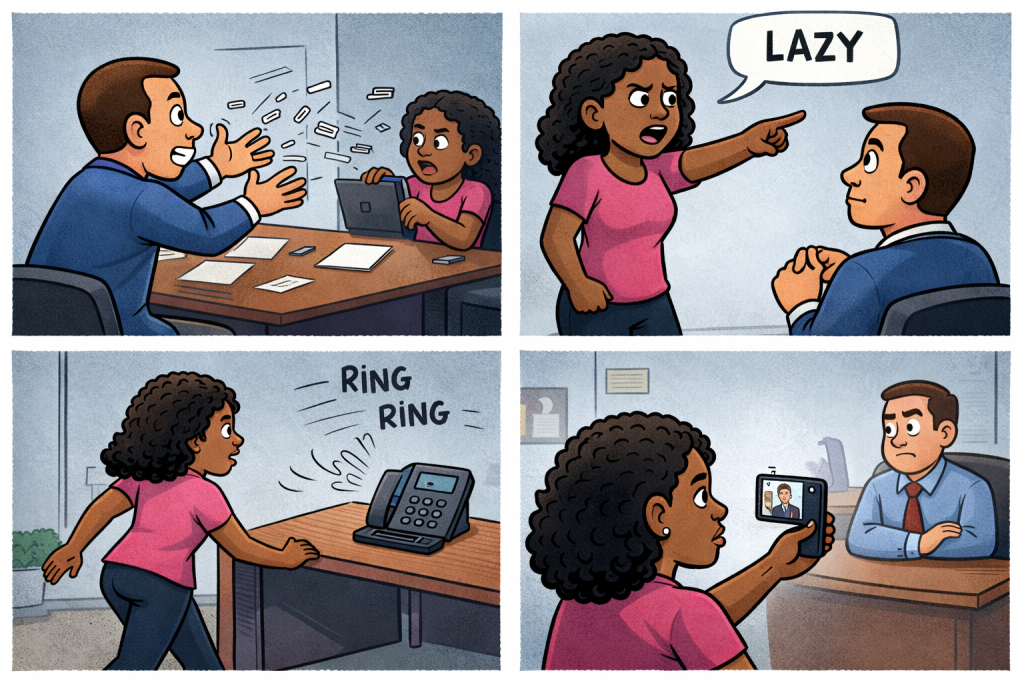
Some employment cases turn on close calls, messy comparators, or shaky documentation.
This one turned on something simpler: an employee who admitted to a string of workplace misconduct and still tried to turn the termination into a discrimination, retaliation, and hostile-work-environment case.
TL;DR: An Illinois federal court granted summary judgment to a state agency that terminated an employee after investigating multiple workplace-misconduct incidents, including throwing paper clips and clip binders at a coworker’s desk, calling another employee lazy, leaving her workstation while assigned to phones, and filming her supervisor without permission. The court held that the employee could not show she was meeting legitimate expectations, could not identify proper comparators, and could not prove pretext or a hostile work environment.
The misconduct record buried the discrimination case
The employee worked in the agency’s information department and claimed that she was fired because of her race, national origin, and color. She also claimed retaliation and hostile work environment.
The problem was the record.
The court noted that the employee admitted several incidents that led to her discharge. She admitted throwing paper clips and clip binders at another employee’s desk. She admitted an altercation in which she told another employee, “Well, you’re just lazy, and I’m not.” She admitted leaving her workstation while assigned to answer telephones. And she admitted using her cell phone to film her supervisor without permission and refusing to stop.
After reviewing the incidents, the employer concluded that multiple violations had been substantiated and that termination was the appropriate next step under its progressive discipline system. By then, the employee already had two oral reprimands, one written reprimand, and eight prior suspensions.
That is not a great record for a plaintiff trying to argue that the real reason for termination was unlawful bias.
The court focused on what the employer honestly believed
The employee argued that a subsequent investigation into the allegation of misconduct was biased and incomplete. The court rejected that argument.
Why? Because pretext is not about whether the employer made a perfect decision. It is about whether the employer lied about or had a “phony reason” for the decision.
Even if the investigation could have been cleaner, the employee admitted much of the conduct, and the employer had a documented basis for concluding that she violated workplace policies. That was enough to defeat discrimination and retaliation claims.
The retaliation claim ran into the same wall
The employee also claimed that the agency fired her in retaliation for an earlier EEOC charge, an earlier lawsuit, and complaints of harassment during the termination process.
That theory failed too.
The court emphasized that prior protected activity does not insulate an employee from discipline for later misconduct. Once the employer had evidence of intervening workplace misconduct, the retaliation theory lost steam fast.
That is a useful reminder for employers. Protected activity does not create a free-pass period.
The language-comments theory was not enough
The employee also relied on comments about her English and accent, along with workplace scrutiny and criticism from her supervisor.
The court held that even taking those allegations in the employee’s favor, the comments and conduct were too isolated and too weakly connected to the termination decision to create a triable discrimination or hostile-work-environment claim.
What employers should take from this one
First, investigate misconduct promptly and tie the final decision to specific conduct, not vague frustration.
Second, keep progressive discipline records in order. A termination decision looks much more defensible when it follows a documented history instead of arriving out of nowhere.
Third, do not panic just because an employee has filed an EEOC charge or prior lawsuit. Protected activity does not block later discipline where new misconduct is real, documented, and independently serious.
The bottom line
If an employee admits to a series of workplace-rule violations, courts are not eager to let the case drift to trial on a theory that the employer must have secretly meant something else.