Search
 The Employer Handbook Blog
Employees Spent 14 Minutes Walking to and From Lunch. The DOL Says the Employer Still Didn’t Have to Pay Them.


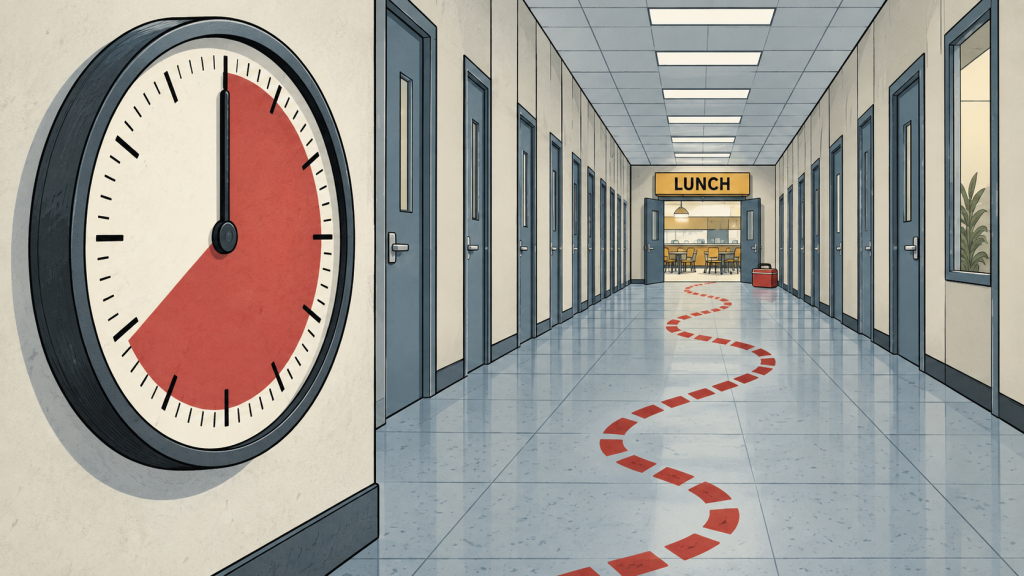
Apparently, even the walk to lunch can become a federal wage-and-hour question. The answer depends less on the distance traveled than on what remains when employees arrive.
TL;DR: Employees at a detention facility spent between six and 14 minutes of an unpaid 60-minute meal period walking to and from a designated break area. The Department of Labor concluded that the entire period could remain unpaid because the employees performed no work and still had between 46 and 54 minutes for eating and personal activities.
📄 Read the DOL opinion letter.
The dispute started with a 60-minute lunch
Can a 60-minute meal period remain unpaid when a required walk consumes as much as 14 minutes of it? According to the Department of Labor, yes, at least under the facts presented in a new opinion letter.
Security therapy aides at a detention facility could not bring food beyond the entry building or eat at their work areas. Their collective bargaining agreement provided a 60-minute unpaid meal period, but employees had to walk three to seven minutes each way to reach the designated break area.
That left them between 46 and 54 minutes in the break area. One employee argued that the walking time should be paid and that the collective bargaining agreement entitled employees to spend the full 60 minutes there.
The DOL disagreed on the FLSA question. It concluded that the entire meal period could remain unpaid. It expressly declined to decide whether the employer was satisfying its separate obligations under the collective bargaining agreement.
Forty-six duty-free minutes carried the day
The FLSA generally does not require employers to provide meal periods, but a meal period may remain unpaid only when employees have enough time for a regular meal and are relieved from work under the applicable legal test.
Here, even the longest round trip left employees with 46 minutes for eating or personal activities. According to the facts presented, they had no work responsibilities during that time, and nothing indicated that the employer required them to work while eating.
The DOL contrasted those facts with a Fifth Circuit case involving a 30-minute meal period. Employer-required travel consumed as much as 12 minutes, leaving employees only 18 minutes to eat. The court did not hold that 18 minutes was automatically insufficient, but it concluded that a jury could find the shortened period inadequate.
The difference was not that 14 minutes of travel is always acceptable while 12 minutes is not. The DOL focused on the time remaining after the required travel and whether employees remained free from work. Most courts apply a predominant-benefit analysis, although the Ninth and Eleventh Circuits apply a complete-relief-from-duty standard.
That makes meal-period compliance a practical inquiry. Employers should examine how much usable time employees actually receive and whether travel requirements, frequent interruptions, or other restrictions substantially reduce it.
The FLSA is only part of the analysis. Some states independently require meal periods and regulate their duration, timing, and conditions. In those states, an employer must determine whether employees received the full uninterrupted, duty-free period required by state law after accounting for mandatory travel. The 46 to 54 minutes remaining here may satisfy many 30-minute requirements, but the answer depends on the particular state’s rules.
Three checks before treating meal time as unpaid
1. Usable time matters more than scheduled time
A policy may promise 30 or 60 minutes, but the real question is how much time employees retain after required walking, security procedures, or similar restrictions. The DOL considered 46 minutes more than sufficient. A materially shorter period could produce a different result.
2. Permission to eat does not necessarily make employees duty-free
Employees who remain responsible for work or experience frequent or lengthy interruptions may not receive a bona fide meal period. Employers should evaluate what employees must do during the break, not merely whether they are allowed to eat.
3. Federal approval is not a fifty-state answer
States with mandatory meal-period laws may regulate the length, timing, and duty-free nature of the break. Employers must determine whether required travel reduces the usable meal period below the state minimum or otherwise interferes with the break. State law may also define compensable time differently from the FLSA. Finally, the collective bargaining agreement may provide greater rights, an issue the DOL expressly declined to decide.
The DOL treated this required round trip as part of an unpaid meal period because employees still had at least 46 duty-free minutes. With a shorter break, longer trip, or added work responsibilities, the answer could change.