Search
 The Employer Handbook Blog
Denied Every Religious Exemption Request, Attempted No Accommodations, and Still Won


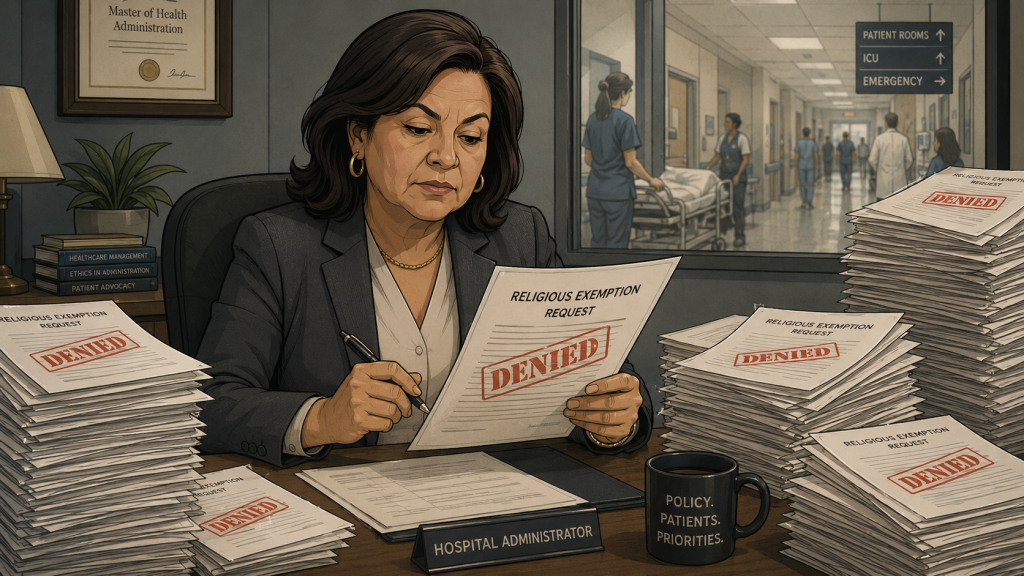
Sometimes the facts supporting a religious accommodation denial are so strong that skipping the accommodation process doesn’t sink you. This healthcare employer found that out — and the 9th Circuit’s reasoning tells you exactly why.
TL;DR: A regional healthcare system operating eight hospitals denied religious exemptions from its vaccination policy. Several employees sued under Title VII and Washington state law. The district court granted summary judgment to the employer on undue hardship grounds, and the 9th Circuit affirmed on May 6, 2026. The court held that the employer’s showing of substantial health, safety, and operational risk was sufficient under the undue hardship standard established in Groff v. DeJoy — and that the employer did not need to attempt accommodation before invoking that defense.
Eight Hospitals, Patient-Facing Roles, and a Hard Line on Exemptions
A regional healthcare system operating eight hospitals across Washington and Oregon instituted a COVID-19 vaccination requirement in August 2021, as the Delta variant was driving a surge in hospitalizations. The policy allowed employees to request religious or medical exemptions and established a working group to review those requests.
A group of employees at one of the system’s Washington facilities — roles included physician assistant, respiratory therapist, nurse, and technician — all submitted religious exemption requests. All were denied. The employer placed the plaintiffs on administrative leave and notified them that termination would follow. One employee received the vaccine and returned to work. The rest were terminated.
The employees sued under Title VII and Washington state law, claiming religious discrimination. The district court granted summary judgment to the employer, finding that the exemption denials were justified by undue hardship. The 9th Circuit affirmed.
What the Groff Standard Actually Requires — and What It Does Not
Title VII requires employers to reasonably accommodate an employee’s religious beliefs unless doing so would cause “undue hardship” to the conduct of the employer’s business. In Groff v. DeJoy (2023), the Supreme Court raised the standard, holding that “undue hardship” requires a burden that is “substantial in the overall context of an employer’s business” — not merely more than de minimis, as prior doctrine had suggested.
The employer’s undue hardship showing identified three distinct risks from granting exemptions: the risk that unvaccinated employees would become ill and cause staffing shortages; the risk of transmission to other staff needed to treat patients; and the heightened transmission risk to patients with comorbidities. The employer’s unrebutted epidemiological expert concluded that there was “no effective alternative to vaccination” in the healthcare context, given the close personal contact that all of the plaintiffs’ roles required.
The 9th Circuit found that showing sufficient. Health and safety costs count toward undue hardship, not just financial ones. And a realistic risk of hardship is enough — the employer does not need to wait until the harm is realized.
Healthcare employers who face religious exemption requests from patient-facing employees now have a strong appellate template for documenting and defending a denial. Specific, contemporaneous evidence tied to the nature of the employer’s business is what carries the day. Generalized assertions about transmission risk do not.
Three Things This Decision Clarifies for Employers
Undue hardship is a complete defense — even without any accommodation attempt. The plaintiffs argued that the employer’s blanket denial of all exemption requests precluded an undue hardship defense. The 9th Circuit rejected that squarely. If any accommodation would impose undue hardship, the employer has no obligation to work through the options one by one. Attempting accommodation when no accommodation is possible is an exercise in futility — and courts will not require it.
What other employers did is irrelevant. The plaintiffs pointed to other hospitals that granted religious exemptions from vaccination requirements. The court gave that argument no weight. The undue hardship inquiry is specific to the particular employer before the court, accounting for its nature, size, and operating costs. A competitor’s policy decision in a different operational context does not change the analysis.
Hindsight evidence of lower actual risk does not undo a contemporaneous, reasonable decision. The plaintiffs speculated that post-vaccine COVID data might have shown that accommodating a small number of religious objectors posed little risk. The court rejected that reasoning directly. The question is whether the employer relied on the scientific evidence available at the time of the denial — not what data might have emerged later. Employers who documented their risk assessment contemporaneously are in the strongest position to make that showing.
The facts here are specific to a pandemic, but the undue hardship framework applies to every religious accommodation request that lands on an HR desk. An employer that can show specific, well-documented hardship tied to its particular business has a viable defense. One relying on generalized assertions does not.