Search
 The Employer Handbook Blog
Ctrl-Alt-Delete that theory: Sixth Circuit rejects retaliation claim after arrest over unreturned laptop


That escalated quickly.
A university fired its HR director and asked him to return his work laptop. He refused for months. Campus police eventually obtained a felony arrest warrant. When the former employee finally showed up with the laptop, officers arrested him. He then sued for retaliation.
TL;DR: The U.S. Court of Appeals for the Sixth Circuit affirmed summary judgment for a public university in a Title VII race discrimination and retaliation case. The plaintiff claimed the university caused his arrest in retaliation for filing discrimination charges after he refused to return a university laptop. The court held that the university had a legitimate, non-retaliatory reason for involving police – recovering its property – and the plaintiff produced no evidence that explanation was pretext.
The laptop dispute
The plaintiff worked as a director responsible for labor relations and HR compliance. Less than a year into the job, the university terminated his employment after documenting multiple performance concerns, including problems with organization, responsiveness, and work product.
Although he remained on payroll during a 90-day termination notice period, the university instructed him to stop working immediately. Soon afterward, the university directed him to return his university-issued laptop.
He refused.
The plaintiff argued that because he remained on payroll, he could keep the laptop until the end of the notice period. The university disagreed and repeatedly instructed him to return the computer earlier.
Months passed. The laptop still had not been returned.
Campus police get involved
By April the university referred the issue to campus police. A detective contacted the plaintiff, who acknowledged that he still had the laptop and said he would return it.
He did not.
After several unanswered calls and voicemail messages, and with the laptop still unreturned even after the plaintiff’s employment ended, police obtained a felony arrest warrant for theft of government property based on the laptop’s value.
The plaintiff eventually contacted the detective and offered to return the computer. But he still did not bring it back until weeks later. When he arrived at the police station with the laptop, officers executed the warrant.
He spent several hours in jail before being released. Prosecutors later dismissed the criminal charges.
The retaliation claim failed
The plaintiff argued that the university caused his arrest in retaliation for filing discrimination charges with a state civil rights agency.
The Sixth Circuit disagreed.
Even assuming the plaintiff could establish a prima facie case of retaliation, the claim failed at the pretext stage. The university offered a legitimate explanation for seeking the arrest warrant: the plaintiff had refused to return its laptop despite repeated requests and even after his employment ended.
The plaintiff produced no evidence that this explanation was false or a cover for retaliation.
The court also rejected the plaintiff’s attempt to rely on Supreme Court precedent involving First Amendment retaliation claims under 42 U.S.C. § 1983. Title VII retaliation claims follow a different analytical framework.
The discrimination claims failed too
The plaintiff also alleged race discrimination based on the employer’s decision not to promote him and its later decision to terminate his employment.
Those claims failed as well. The employer produced evidence that the candidate selected for the promotion had stronger support from the hiring committee and broader qualifications. As for the termination, the employer documented multiple performance concerns, while the plaintiff largely relied on unsupported allegations.
Takeaways for employers
Start with the basics: get company property back quickly. Employers should clearly communicate when and how departing employees must return laptops, phones, badges, and other equipment. Put the expectation in writing and follow up promptly if something does not come back.
Shut off system access immediately. When an employee separates but still has company hardware, disable network, VPN, email, and other system access right away.
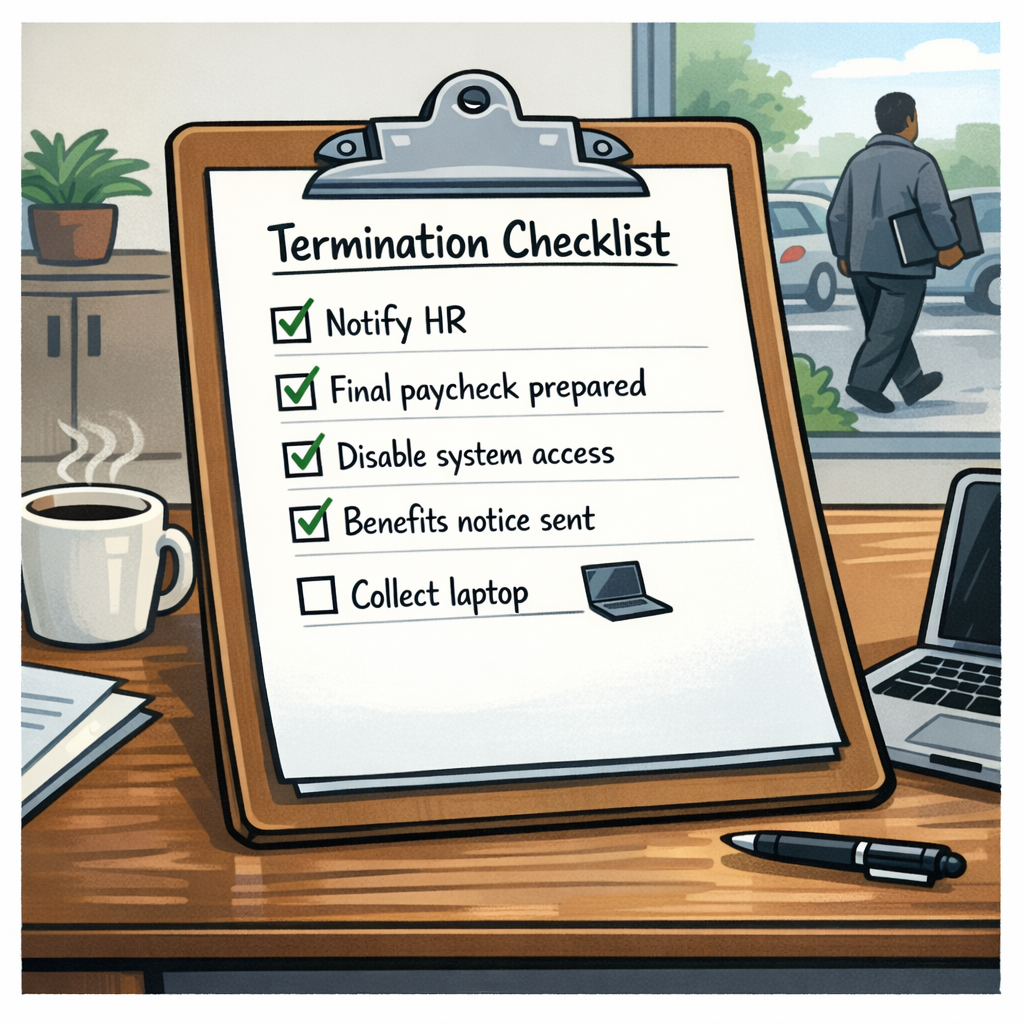
Use a consistent termination checklist. Offboarding should not be improvised. A structured checklist helps ensure the employer collects company property, disables system access, addresses benefits and final pay, and communicates the departure internally and externally in an organized way.
If it would help, I’m happy to share my termination checklist. Just email me at eric.meyer@pierferd.com, and I’ll send it along.
Bottom line
Holding onto company property after termination is rarely a winning strategy.
This version of the Return of the Mac ended with handcuffs and summary judgment.