Search
 The Employer Handbook Blog
Congress Wants Employers to Report How Many Jobs AI Is Creating… and Killing


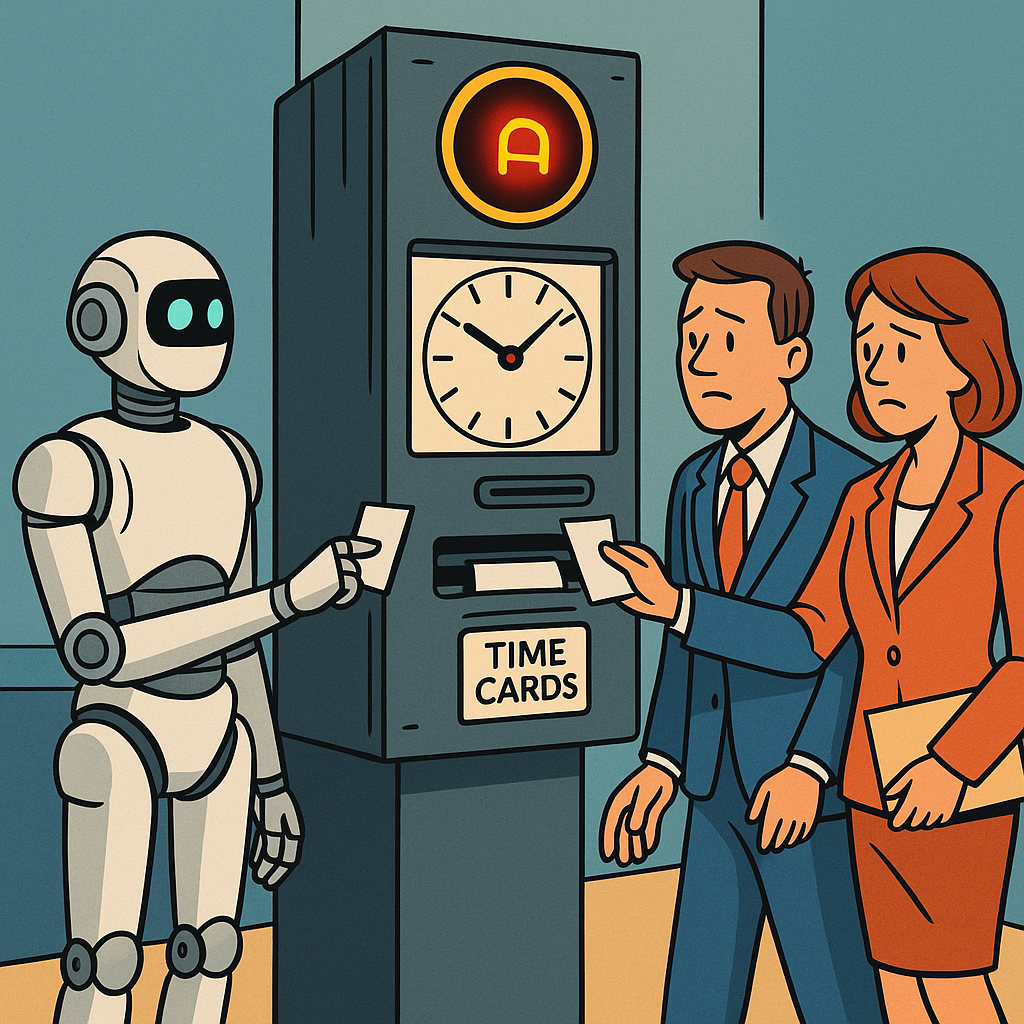
Artificial intelligence is changing everything from hiring to customer service, and now Congress wants to know exactly how many American jobs it’s creating… and killing.
TL;DR: A bipartisan Senate bill called the AI-Related Job Impacts Clarity Act would require large employers and federal agencies to report quarterly on job gains, losses, and retraining related to artificial intelligence. The Department of Labor would then publish quarterly and annual summaries online.
🤖Read the bill here.
🤖Read the press release here.
What the Bill Would Do
The proposal, co-sponsored by Senators Josh Hawley (R-MO) and Mark Warner (D-VA), would require publicly traded companies (and later, some large private ones) to file quarterly reports with the Department of Labor disclosing:
- The number of employees laid off because AI replaced their jobs.
- The number of new hires created because of AI adoption.
- Any vacant positions left unfilled because automation made them unnecessary.
- The number of workers retrained or assisted because of AI.
Each report would include industry codes and could be folded into existing Labor or Census Bureau surveys to minimize duplication.
The Department of Labor, through the Bureau of Labor Statistics, would then publish the data online each quarter and send summaries to Congress. Every other quarter, it would analyze the net impact of AI on U.S. jobs.
Who’s Covered (and Who Isn’t)
Not every employer would have to do this.
At least for now, the bill applies only to:
- Publicly traded companies, and
- Federal agencies.
Within six months of enactment, the Department of Labor, working with the SEC and Treasury, would decide which non-public companies must also report. The agency would likely focus on large private employers that have significant workforces, revenue, or regional or national employment impact.
The rules would also require that reporting obligations be proportionate to a company’s size and capacity and that data be submitted confidentially to protect proprietary information.
In other words, this would not apply to small or midsized private employers. But it could easily expand. Even if your organization is not initially covered, it is worth watching how regulators define “large private company.” What starts with Fortune 500 employers could later reach farther down the chain.
Why It Matters for Employers
For now, this is just a proposal, but it shows where policymakers are heading.
If enacted, employers would need systems to track why jobs were eliminated or created, and to document retraining efforts tied to AI. Think of it as a new reporting layer similar to EEO-1 or WARN Act data, but focused squarely on automation.
That means HR, legal, and IT teams would have to collaborate to:
- Define what counts as an “AI-related” change,
- Attribute job movement correctly, and
- Manage quarterly data submissions.
The Bigger Picture
The sponsors frame this as transparency, not punishment. Senator Hawley said the bill would “shine a light on how many jobs big corporations are cutting in favor of automation.” Senator Warner added that it is about making sure “AI works for the American worker, not just the bottom line.”
Still, this could evolve into something much more consequential, especially if Congress or agencies start using the data to shape workforce policy, tax incentives, or retraining mandates.
Takeaways for HR and Employers
If this bill moves forward, or if Congress takes up a similar idea, smart employers will start thinking ahead now.
- Ask where AI fits into your story. You don’t need a robot army to start paying attention. Take stock of how automation or AI tools are already touching your operations, even quietly, and what that means for jobs, training, and skills.
- Loop in your people early. HR knows the headcount. IT knows the tools. Legal knows the rules. If AI reporting becomes a reality, those three groups will need to be in sync. Building that coordination now will save stress later.
- Play the “what if” game. Pretend the reporting rule is already in place. Could your company track who was laid off, retrained, or hired because of AI? Would you even know where that data lives? Thinking through those gaps now gives you a head start if this ever becomes law.
The Bottom Line
Congress is not banning AI. It is watching it.
And soon, employers may have to prove, quarter after quarter, how artificial intelligence is really changing their workforce.