Search
 The Employer Handbook Blog
Can an Employee Turn a Completed PIP Into an Age Discrimination Claim?


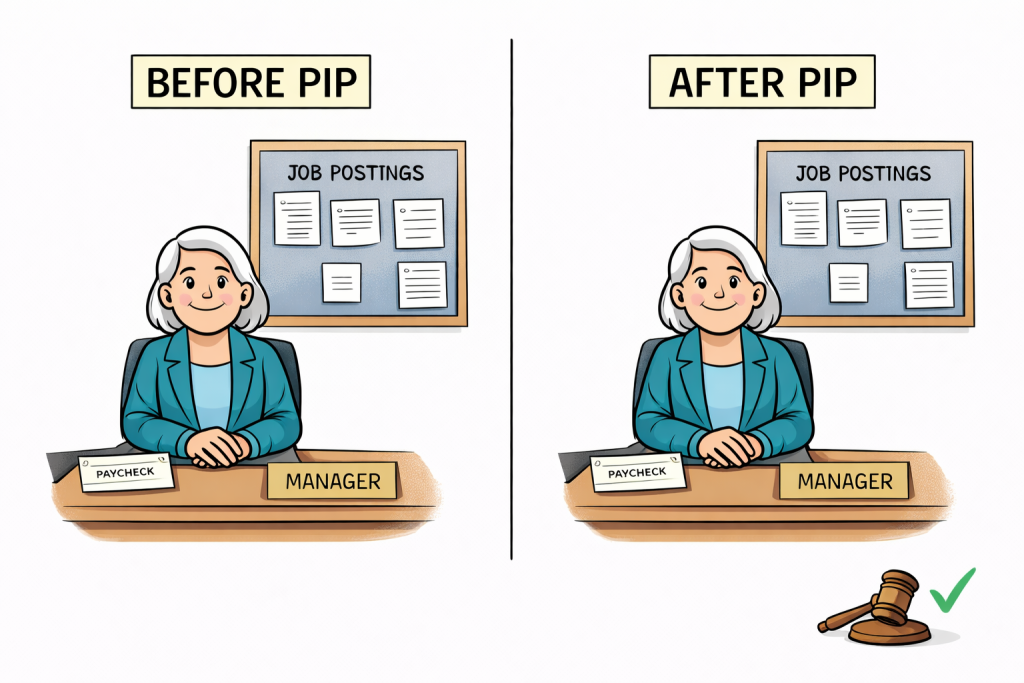
Put simply, a performance improvement plan is designed to improve performance, not expose employers to liability. Courts used to see it that way too. That changed when the Supreme Court redefined what counts as an adverse employment action — and suddenly PIPs were in play.
TL;DR: An IT employee placed on a three-month performance improvement plan that she successfully completed did not suffer an adverse employment action under the ADEA. The First Circuit, applying the Supreme Court’s 2024 decision in Muldrow v. City of St. Louis, held that a PIP constitutes an adverse action only if it actually changes the terms or conditions of employment — and this one didn’t. The court also rejected the employee’s constructive discharge claim, finding that quitting ten months after finishing the PIP, with no one telling her to leave and no evidence of intolerable conditions, did not amount to a forced resignation.
📄 Read the First Circuit’s decision
A Long-Tenured IT Employee, a PIP, and a Comment About “Younger, Cheaper People”
The employee was a longtime IT employee at a company with offices in Boston. In August 2019, her managers placed her on a three-month PIP. It described her as “contentious,” noted she “hid in the IT room,” and identified required improvements. It did not change her title, duties, pay, or ability to pursue other opportunities. During the PIP, a team leader told her she could “be replaced with younger, cheaper people.” She completed it, he became her supervisor, and ten months later she and a colleague “quietly” walked out. No one had asked them to leave. She sued under the ADEA, claiming the PIP was an adverse employment action and that she had been constructively discharged.
Muldrow Applies, But the PIP Still Loses
The district court granted summary judgment for the employer, and the First Circuit affirmed.
Before Muldrow v. City of St. Louis, courts required employees to show that an adverse action was “material” — more than a mere inconvenience. Muldrow scrapped that standard. Now, an adverse action is any employment event that leaves an employee worse off with respect to the terms or conditions of employment. That’s a lower bar, and employees are using it to argue that PIPs qualify.
The First Circuit disagreed here, and the reasoning matters. The inquiry is “fact-intensive and PIP-specific.” A PIP that imposes new duties, blocks transfers, or damages promotion prospects can be an adverse action. But a PIP that identifies performance problems and maps out a path to fix them — without touching title, pay, or job responsibilities — is something different. The court called it “nothing more than ‘documented counseling.'” The existence of a PIP, even one the employee believes was motivated by discriminatory intent, is not enough on its own. The employee still has to show that it changed the terms or conditions of employment. This one didn’t.
What Employers Should Take From This
Three things worth internalizing:
Make the PIP’s purpose explicit and defensible. If the document identifies a legitimate performance gap and lays out a reasonable path to improvement, it is much harder to frame as pretext. Vague PIPs with no clear connection to job requirements create exactly the ambiguity plaintiffs exploit.
Review your PIP policy for automatic compensation consequences. A policy that freezes raises or bonuses during a PIP period is not unlawful — penalizing poor performance is legitimate. But if a protected characteristic motivated the PIP in the first place, that compensation freeze becomes part of the adverse action. Under Muldrow, the employee no longer needs to show significant harm, just that the PIP left her worse off on pay. A discriminatorily motivated PIP that also costs the employee a raise is a much stronger case than one that changed nothing.
Document the outcome carefully. The company’s records showed the employee completed the PIP, and a post-PIP review noted her technical skills were “very solid.” Sloppy documentation of the same facts could have told a different story.
A PIP that looks like performance management and functions like performance management will generally survive legal scrutiny. The problem is when the paperwork says one thing and the managers’ behavior says another.