Search
 The Employer Handbook Blog
Retaliation Requires Protected Activity. Is a Subpoena Enough?


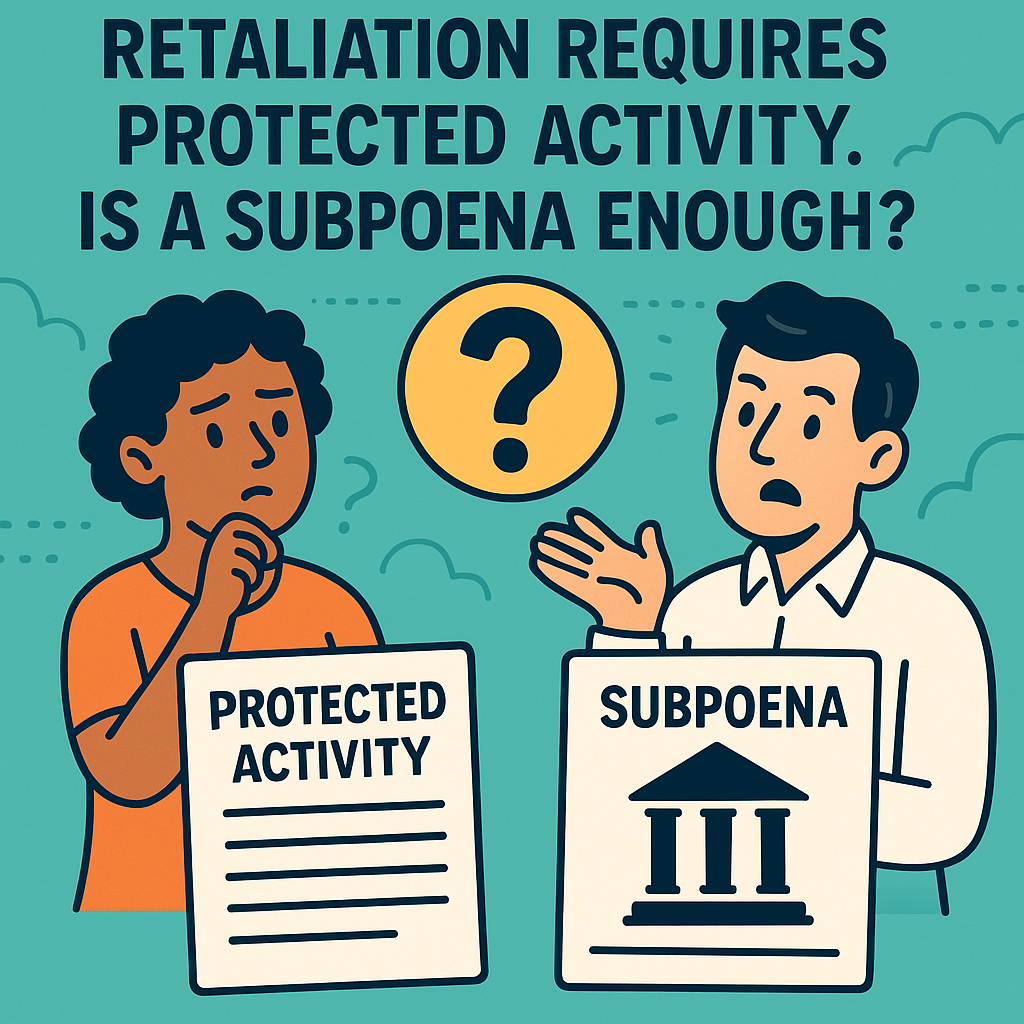
Some workplace retaliation theories sound plausible at first glance. But Title VII’s protections are far narrower than many employees assume. A recent Eleventh Circuit decision digs into a niche but important point: whether a criminal subpoena can qualify as Title VII “participation.”
This is part one of two. Tomorrow, we look at the court’s take on whether two unwanted physical encounters created a hostile work environment.
TL;DR: An employee received a subpoena to testify in a municipal criminal case involving two former coworkers. She argued this counted as Title VII “participation.” The Eleventh Circuit disagreed. The participation clause applies only to proceedings under Title VII, such as Equal Employment Opportunity Commission (EEOC) charges and investigations. A criminal subpoena is not one of them, and merely receiving a subpoena does not amount to taking part in a Title VII proceeding.
A criminal subpoena with no Title VII connection
The employee worked in a loose, unfiltered workplace where crude jokes were common. Early in 2020, another employee reported that a coworker made unwelcome physical advances. Management investigated, demoted the coworker, restricted his contact with the complainant, and warned that further misconduct would end his employment.
After the coworker was later terminated, the complainant initiated a municipal criminal proceeding for sexual battery. Several employees received subpoenas, including the employee who would later sue. She never testified, and the hearing did not take place until after her employment ended.
During this same period, the company was frustrated with declining sales performance, most notably the loss of a longstanding customer. A tense phone call followed, and the employee’s role ended shortly after. She later argued that the subpoena made her a protected participant under Title VII’s anti-retaliation provision.
Why the subpoena did not trigger participation protection
The Eleventh Circuit wrote that the employee “is wrong for two reasons.” First, “participate” requires an active role. She never testified, appeared, provided information, or took any affirmative step indicating involvement in a civil rights enforcement process. Simply receiving a subpoena is not participation, even under the phrase “participated in any manner.” Second, the subpoena involved a municipal criminal case, not a proceeding “under this subchapter.” Participation protection applies only to Title VII or EEOC processes, and only after someone files an EEOC charge or otherwise initiates a Title VII proceeding. No such charge was ever filed here.
Retaliation still fails on causation
The employee also pointed to earlier internal complaints about inappropriate conduct. The court agreed those complaints were protected activity, but they occurred about four months before her termination. Under Eleventh Circuit precedent, that timing alone is too remote to establish causation.
Meanwhile, the employer pointed to performance problems and the loss of a major account as the reason her role ended.
What employers should take from this
- The participation clause is narrow and tied only to Title VII and EEOC processes.
- A criminal subpoena is not protected activity under Title VII.
- Still document decisions carefully when employees are involved in outside legal proceedings.
- Remember that opposition activity is broader, and internal discrimination complaints remain protected.
A subpoena in an unrelated criminal matter is not Title VII participation. But employers should always ensure that a termination following any legal proceeding is grounded in documented, non-retaliatory reasons.