Search
 The Employer Handbook Blog
Maybe Don’t Tell the EEOC You Removed Someone From Work for Her “Introduction of Race”


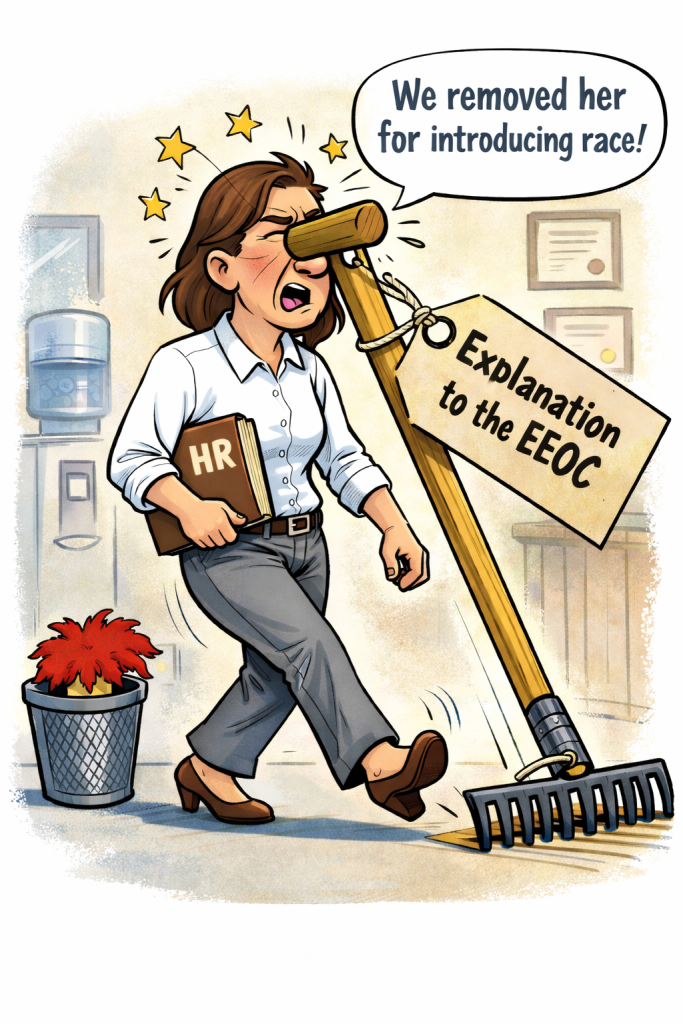
Me? I probably would not tell the EEOC that I removed a Black employee from work because of her “introduction of race” into the workplace. Especially after she complained about race discrimination triggered by a question about attending a Black Lives Matter protest.
But that is exactly what happened here.
And it is exactly why the employer lost on retaliation at summary judgment.
TL;DR: After a Black employee complained about a racially charged workplace comment involving a Black Lives Matter protest, management immediately placed her on unpaid administrative leave. During the EEOC’s investigation, the employer stated that the decision to remove her from work was for her “introduction of race” into the workplace. The court held that explanation itself was direct evidence of retaliation, granted summary judgment on liability, and left damages for later proceedings.
📄 Read the decision
A race-related comment, followed by immediate unpaid leave
The employee worked as a dental assistant at a community health clinic. During the summer of 2020, amid nationwide racial justice protests, the clinic’s dental director asked her whether she had attended a Black Lives Matter protest. She was the only Black employee present.
She testified that the question upset and humiliated her and that she believed it was racially charged. She complained internally.
Management’s response was swift and explicit. The CEO sent a text message placing the employee on unpaid administrative leave pending an investigation. She was never returned to work.
Later, during the EEOC’s investigation, the employer explained that the employee had been removed from work because of her “introduction of race” into the workplace. The employer also pointed to alleged performance issues as an alternative justification.
That explanation became the problem.
Why this was not a close retaliation case
Most retaliation cases at summary judgment rise or fall under the McDonnell Douglas burden-shifting framework. Courts ask whether the employer articulated a legitimate reason and whether the employee can show pretext.
This case did not stay in that lane.
The court held that the employer’s own explanation to the EEOC qualified as direct evidence of retaliatory motive. No inference was required. The employee complained about what she perceived as race discrimination, and management said she was removed from work because she brought race into the workplace.
That alone was enough for the court to resolve liability on retaliation.
The performance defense did not save the employer
The employer argued that the employee was terminated for performance-related reasons. The court was unmoved.
When an employer offers multiple explanations, and one of them directly ties an adverse action to protected activity, summary judgment becomes difficult. That is especially true where the adverse action follows immediately after the complaint.
This was not a credibility contest. The court relied on the employer’s own words.
What employers should take away
• Agency explanations are evidence. Statements to the EEOC are not advocacy exercises. They are part of the record and will be read closely.
• Shifting explanations make things worse, not better. Inconsistent or evolving reasons are classic evidence of pretext and often keep retaliation claims alive even when the employer thinks it has cleaned things up.
• Performance justifications do not erase retaliatory motive. Once direct evidence appears in the record, the burden shifts hard.
• Raising race at work is legally loaded. And retaliating after a complaint is where employers get burned.
• Unpaid administrative leave still counts. Taking someone off the schedule without pay is an adverse employment action, not a neutral pause button.
Bottom line
Retaliation cases are often won or lost in emails, texts, and agency position statements.
This one was lost because the employer treated a race complaint as the problem itself.
And then said so out loud.